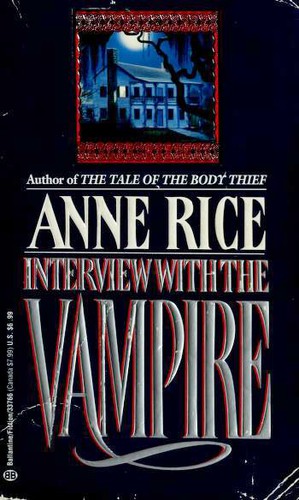
Interview with the Vampire
by Anne Rice · 1976
A vampire named Louis tells his 200-year life story to a young reporter, and Rice's decision to make the monster the narrator -- guilt-ridden, philosophical, more sad than scary -- rewired what vampire fiction was allowed to be.
Worth reading? Interview with the Vampire is less a horror novel than a character study that happens to have fangs. Rice's real innovation is making Louis the narrator of his own life instead of a monster observed from outside, and that choice is the reason the modern sympathetic-vampire genre -- from Anne Rice's own sequels through decades of imitators -- exists at all.
| Author | Anne Rice |
|---|---|
| Published | 1976 |
| Publisher | Ballantine Books |
| Category | Fiction |
| Favorite quote | “Evil is a point of view. God kills, indiscriminately, and so shall we.” |
The Verdict
Rice’s real move is giving Louis the microphone. Vampires before this were monsters you watched from outside; Louis narrates his own two centuries of guilt and doubt directly, and that shift in point of view is the whole reason the modern sympathetic-vampire genre exists.
Claudia is the book’s most unsettling idea, and Rice doesn’t flinch from it – an adult mind stuck permanently in a child’s body, aware of exactly what’s been taken from her. It’s the sharpest, saddest material in the book, and it’s not comfortable reading.
This isn’t a fast book. Rice is building mood and accumulated loneliness more than plot momentum, and if you’re expecting a horror thriller with regular scares, the pace will test you.
Read it if you want the book that invented the modern sympathetic-vampire genre, told as a genuinely melancholy character study. Skip it if you want fast-paced horror – this is slower and more interior than its genre reputation suggests.
you want the book that started the modern sympathetic-vampire genre, told as a genuinely melancholy character study rather than a monster-movie plot
you want a fast-paced horror novel -- this is a slow, interior, philosophical book about guilt and immortality, closer to literary fiction than a scary-vampire thriller
Book Summary
Louis, a 200-year-old vampire, recounts his entire life to a young interviewer in modern San Francisco, from his turn by the seductive, nihilistic Lestat through centuries of guilt, loneliness, and a search for meaning in an existence he never wanted.
The novel's most disturbing relationship is Louis and Lestat's creation of Claudia, a child vampire trapped forever in a five-year-old's body with an adult's rage and desire, whose arc becomes the book's sharpest exploration of what eternal, arrested existence actually costs.
Rice reframes the vampire as a figure of existential horror rather than gothic-monster horror -- Louis's real torment isn't fear of stakes or sunlight, it's the absence of God, meaning, or moral clarity in an unnaturally extended life, which pulls the book closer to philosophical fiction than genre horror.
Top 7 Lessons from Interview with the Vampire
- Making the vampire the first-person narrator, recounting his own guilt and doubt directly to an interviewer, was the book's genre-defining innovation -- vampires before Rice were almost always observed from the outside as monsters, not given interior access as narrators.
- Claudia's arc -- an adult mind trapped permanently in a child's body -- is the book's most unsettling idea, and Rice uses it to explore rage, arrested development, and the specific horror of a body that can never match an inner life.
- Louis's central torment is existential rather than physical -- he's less afraid of being destroyed than he is uncertain whether his endless life has any moral or spiritual meaning at all, which shifts the genre's core fear from death to meaninglessness.
- Lestat is written in this first book as genuinely cruel and manipulative, a portrayal Rice herself later softened and complicated across her many sequels, where he becomes closer to the series' protagonist.
- The interview framing device -- Louis narrating to a skeptical, then increasingly rattled, young reporter -- lets Rice control pacing and tone as a confession rather than a straightforward chronological plot.
- Rice wrote the book partly while grieving the death of her young daughter, and Claudia's storyline carries that grief directly, which reframes the character's horror as personal as well as literary.
- The book's slow, meditative pace and long philosophical passages are a deliberate choice, not a lack of plot discipline -- Rice is building a mood of accumulated loneliness rather than escalating action.
Top 4 Quotes from Interview with the Vampire
"That is the crowning evil, that we can even go so far as to love each other, you and I. And who else would show us a particle of love, a particle of compassion or mercy? Who else, knowing us as we know each other, could do anything but destroy us? Yet we can love each other."
Anne Rice, Interview with the Vampire
"Evil is a point of view. God kills, indiscriminately, and so shall we."
Anne Rice, Interview with the Vampire
"People who cease to believe in God or goodness altogether still believe in the devil... Evil is always possible. And goodness is eternally difficult."
Anne Rice, Interview with the Vampire
"You are in love with your mortal nature! You chase after the phantoms of your former self."
Anne Rice, Interview with the Vampire
Frequently Asked Questions
Is Interview with the Vampire scary?
Not in a jump-scare sense -- it's existential and melancholy horror, more concerned with guilt and meaninglessness than shocks, closer to literary fiction than a conventional horror thriller.
What is Interview with the Vampire about?
A 200-year-old vampire named Louis recounts his entire life -- his turning, his relationship with the vampire Lestat, and the creation of the child vampire Claudia -- to a young interviewer in modern San Francisco.
Do I need to read the rest of The Vampire Chronicles?
No -- this first book stands alone as a complete story, though it does launch a long series that follows Lestat more directly in later installments.
Book vs. the 1994 movie -- which should I do first?
Either works well -- the film is a fairly faithful adaptation, though the book gives Louis's interior guilt and philosophical doubt far more space than the film's runtime allows.
Is Interview with the Vampire the first modern vampire novel?
It's widely credited as the book that established the sympathetic, narrator-vampire template that most modern vampire fiction since has drawn on in some form.
Ready to read it?
Get Interview with the Vampire on Amazon