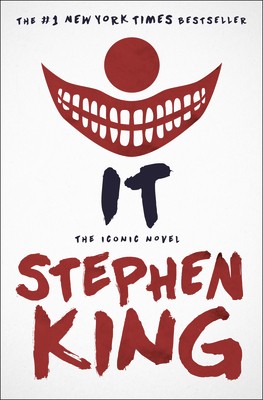
It
by Stephen King · 1986
Seven kids in a Maine town fight a shapeshifting evil that feeds on fear and children, then have to come back and finish the job 27 years later as adults who've mostly forgotten what happened -- in the book that made Pennywise the clown a permanent fixture of American nightmares.
Worth reading? It earns its reputation as one of King's most ambitious books precisely because it's really two novels braided together: a horror story about a monster that becomes whatever a child fears most, and a coming-of-age story about how childhood friendship gets forgotten by adulthood unless something forces you to remember it. The length is a genuine barrier, and one notorious scene has become a permanent asterisk on the book's reputation, but the structural idea, kids see and defeat a monster adults literally cannot perceive, is still the book's most effective piece of horror logic.
| Author | Stephen King |
|---|---|
| Published | 1986 |
| Publisher | Viking |
| Category | Fiction |
| Favorite quote | “We all float down here.” |
The Verdict
Strip away the clown and It is really a book about how completely adults forget what it felt like to be afraid as a child, and how much courage that forgetting costs you later. The 1985 timeline, where the Losers’ Club has to relearn who they used to be before they can fight anything, is more effective than most of the actual monster set pieces.
The book’s length is a real ask, over a thousand pages, and King uses a lot of it on Derry’s backstory and interludes that don’t always earn their page count. If you want a tight horror novel, this isn’t it (no pun intended).
The elephant in the room is the sewer scene near the end of the 1958 timeline. It’s been criticized consistently and specifically for decades, and it’s a legitimate reason some readers put the book down permanently. Don’t go in unaware of it.
Read it if you want an ambitious, sprawling horror novel that’s also genuinely about childhood and memory, and you’re prepared for the length. Skip it if you want tight pacing or you’d rather avoid the book’s most notorious and widely criticized scene.
you want a genuinely huge, ambitious horror novel that's also a coming-of-age story about childhood friendship and how memory works, and you don't mind a long commitment
you want efficient pacing or you're sensitive to King's most notorious and widely criticized scene -- the child sewer sequence -- which has drawn sustained criticism for decades and is a real reason some readers stop entirely
Book Summary
In 1958, seven childhood outcasts in Derry, Maine -- the self-named "Losers' Club" -- discover an ancient, shapeshifting entity that feeds primarily on children, usually appearing as Pennywise the Dancing Clown, and battle it in the town's sewer system after a summer of escalating horror.
Twenty-seven years later, in 1985, the survivors -- now adults who have mostly forgotten their childhood entirely, a magic King ties directly to the town of Derry's own selective forgetting of its violent history -- are called back to Derry by a promise they made as kids, to finish the fight if It ever returned.
King uses Derry itself as a character: the town's history of unexplained tragedies and mass violence is presented as a direct result of It feeding there for centuries, and the adult townspeople's willful blindness to it mirrors the way institutions and communities collectively look away from ongoing harm.
Top 8 Lessons from It
- It appears to each child as whatever they personally fear most (Pennywise the clown, a leper, a werewolf, a headless corpse), which is the book's core horror mechanic -- fear itself is the monster's fuel and its disguise.
- The adults of Derry are written as unable or unwilling to perceive the true danger in their town, a form of collective willful blindness King ties directly to how real communities and institutions ignore ongoing harm, especially to children.
- The Losers' Club forget almost everything about their childhood encounter with It once they leave Derry as adults, and King frames that forgetting as the town's own supernatural self-protection, not ordinary memory loss.
- The book alternates constantly between the 1958 and 1985 timelines rather than telling them in sequence, using the structure itself to argue that childhood trauma and adult life are never really separate, just differently visible.
- The children's initial victory over It in 1958 works because of their friendship and imagination, not physical strength -- the book's clearest thesis is that a shared belief system among the group is more powerful against It than any individual's courage.
- The book contains one deeply controversial scene, a group sexual encounter among the child characters used to symbolically cement their bond, that has drawn decades of sustained criticism from readers and critics and remains the single most cited reason people stop reading or recommend skipping the book.
- Derry's real-world violent history (documented in the book through in-world historical interludes) is presented as centuries of It quietly feeding, turning the town's mundane tragedies into evidence of a much larger, older evil hiding in plain civic sight.
- It, at over a thousand pages, is one of King's most structurally ambitious novels -- less a straightforward horror plot than an attempt to write a mythology for how childhood fear, memory, and friendship actually work.
Top 3 Quotes from It
"We all float down here."
Stephen King, It
"They float, and when you're down here with me, you'll float, too."
Stephen King, It
"Hiya, Georgie!"
Stephen King, It
Frequently Asked Questions
Is It worth reading?
Yes, if you want one of Stephen King's most ambitious horror novels and don't mind the length -- it's as much a coming-of-age story about childhood friendship as it is a horror novel about a monster.
How long is It by Stephen King?
Over 1,100 pages in most editions, making it one of King's longest single novels and a real time commitment.
Is the child scene in It as controversial as people say?
Yes -- the group sexual encounter among the child characters in the sewer is widely and consistently criticized, and it's the most commonly cited reason readers stop or recommend skipping the book.
Do I need to watch the It movies before reading the book?
No -- the 2017 and 2019 films (and the 1990 miniseries) simplify the plot and cut major elements, so the book stands entirely on its own and covers considerably more ground.
Is It connected to other Stephen King books?
Yes -- It is part of King's broader Derry, Maine mythology and connects to several of his other novels through shared characters, settings, and the recurring Dark Tower multiverse references.
Ready to read it?
Get It on Amazon