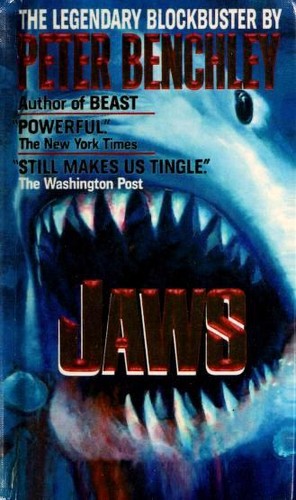
Jaws
by Peter Benchley · 1974
A great white shark starts killing swimmers off a small resort town, and the police chief has to fight both the shark and a mayor who won't close the beaches -- the novel that created the modern shark-panic genre a year before Spielberg's movie made it a phenomenon.
Worth reading? Jaws the novel is a rougher, more cynical book than the movie that made it famous. Benchley spends real time on small-town corruption, an affair subplot the film cut entirely, and a shark portrayed with almost mythic menace -- but Spielberg (and screenwriter Carl Gottlieb) trimmed the book down to something tighter and, frankly, better than the source.
| Author | Peter Benchley |
|---|---|
| Published | 1974 |
| Publisher | Ballantine Books |
| Category | Fiction |
| Favorite quote | “Other fish run from bigger things. That's their instinct. But this fish doesn't run from anything. He doesn't fear.” |
The Verdict
Benchley’s Amity is meaner than Spielberg’s – the mayor’s motives are tangled up with organized-crime-linked real estate money, and Chief Brody is a more bitter, less immediately likable protagonist than the film’s version. If you only know the movie, the book’s tone will surprise you.
The shark itself reads almost like a horror-novel monster, written with more apparent intent and malice than a real animal has. That choice made for a scarier book in 1974, but it’s also part of why the novel gets some blame for decades of exaggerated shark fear – something Benchley himself later pushed back against.
The Ellen-Hooper affair subplot is the biggest surprise for movie-only readers, and it’s not obviously an improvement – it slows the shark plot down more than it deepens the characters.
Read it if you’re curious how the movie diverged from its source and want the rougher original version of Amity Island. Skip it if you just want the shark thriller – the film trimmed the book’s weaker subplots for a reason.
you want the source material behind the movie that invented the summer blockbuster, and you're curious how much of the story is actually Benchley's versus Spielberg's
you're expecting the movie's tight, mostly-likable cast -- the book spends real time on an affair subplot and townspeople you won't recognize from the film, and Chief Brody is a less sympathetic character on the page
Book Summary
A great white shark begins killing swimmers off the fictional resort town of Amity Island just before the crucial summer tourist season, and police chief Martin Brody has to fight both the shark and Mayor Larry Vaughn's refusal to close the beaches and threaten the town's economy.
Benchley builds out a subplot largely cut from the film: an affair between Brody's wife Ellen and shark expert Matt Hooper, rooted in Ellen's class resentment and nostalgia for a wealthier social circle she married out of -- material that makes the book's Amity Island feel more bitter and stratified than the film's version.
The shark itself is written with a near-supernatural menace and a level of directed malice that reads more like a monster-movie antagonist than a realistic animal, which is part of why some later readers (and marine biologists) have pushed back on the book's role in shark-fear mythology.
Top 9 Lessons from Jaws
- The book's small-town corruption plot -- a mayor covering for organized-crime-linked real estate interests who need the beaches open -- gives Amity's refusal to act a harder, more cynical motive than the film's simpler economic-anxiety version.
- Ellen Brody and Matt Hooper's affair, entirely absent from the film, adds a layer of marital and class tension to the book that makes Chief Brody a more embittered, less straightforwardly heroic character than his film counterpart.
- Benchley gives the shark a level of apparent intent and menace that reads more like a horror-novel monster than a wild animal, a choice later criticized (including eventually by Benchley himself) for feeding public shark hysteria.
- The film's most famous line, 'You're gonna need a bigger boat,' does not appear in the novel -- it was improvised on set, one of several ways the movie's dialogue diverges from the book's.
- Quint's characterization and backstory differ meaningfully from the film's version, with the book giving him a more ruthless, less charismatic edge than Robert Shaw's performance.
- Benchley later expressed regret over the book and film's role in shark demonization, and became an advocate for shark conservation later in his life -- worth knowing as context for how the culture around the book has shifted since 1974.
- Unlike the film, the novel kills off Hooper -- he dies inside the shark cage during the final confrontation, one of several ways Benchley's ending is bleaker than Spielberg's more triumphant finale.
- The novel's climax has the shark dying from exhaustion and accumulated harpoon wounds as it closes in on Brody, rather than the film's explosive air-tank finish -- a quieter, less cinematic death that fits the book's harder-edged tone.
- Brody, Hooper, and Quint embody three different class relationships to the sea -- Brody's working-class caution, Hooper's moneyed scientific detachment, and Quint's blue-collar hunter's contempt for both of them -- a tension the film smooths into straightforward camaraderie.
Top 4 Quotes from Jaws
"Come up fish. Come to Quint."
Peter Benchley, Jaws
"Other fish run from bigger things. That's their instinct. But this fish doesn't run from anything. He doesn't fear."
Peter Benchley, Jaws
"The great fish moved silently through the night water."
Peter Benchley, Jaws
"What had once seemed shallow and tedious now loomed in memory like paradise."
Peter Benchley, Jaws
Frequently Asked Questions
Is Jaws the book worth reading if I've seen the movie?
Yes, mostly out of curiosity -- it's a rougher, more cynical book, with a cut affair subplot and a less sympathetic Chief Brody, and it's interesting to see how much Spielberg's film improved on the source.
What is Jaws about?
A great white shark terrorizes the resort town of Amity Island, and police chief Martin Brody fights to close the beaches over the mayor's objections as the death toll climbs.
Is the book scarier than the movie?
Not really -- the film's tension and pacing are generally considered tighter, and several of the book's subplots (the affair especially) dilute rather than add to the shark plot.
Is 'you're gonna need a bigger boat' in the book?
No -- that line was improvised for the film and doesn't appear in Benchley's novel, which is worth knowing before you go looking for it.
Did the author regret writing Jaws?
Benchley later expressed regret over the book's role in shark hysteria and became a shark conservation advocate, a notable shift worth knowing given the book's reputation.
Ready to read it?
Get Jaws on Amazon