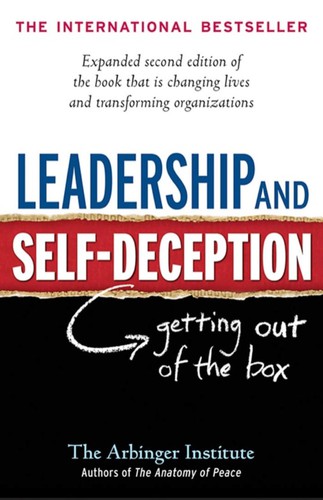
Leadership and Self-Deception
by The Arbinger Institute · 2000
The business-fable that explains why you can follow every leadership technique perfectly and still make things worse, because the problem was never the technique.
Worth reading? Leadership and Self-Deception delivers its idea through a business fable rather than a research summary, and the idea itself -- once you start treating people as obstacles instead of people ('being in the box'), every leadership technique you apply just becomes a more sophisticated way of manipulating them -- is sharp enough to justify the format. It's a quick read, closer in spirit to The 7 Habits' character-ethic argument than to a data-driven book like The Leadership Challenge, and it works precisely because the narrative makes an abstract idea concrete.
| Full Title | Leadership and Self-Deception: Getting Out of the Box |
|---|---|
| Author | The Arbinger Institute |
| Published | 2000 |
| Category | Self-Improvement & Psychology |
| Favorite quote | “The problem isn't that I don't see myself as helpful. The problem is that I do.” |
The Verdict
The fable format is a real choice here, not a gimmick – abstract ideas about self-justification land harder through a story you watch unfold than through a bulleted framework. It’s a quick read that rewards a second pass once the “box” concept clicks, since you’ll start noticing it in your own recent conflicts.
you want a fast, story-driven read on how self-justification quietly sabotages relationships and leadership
you want data, case studies, or a research-backed model, this is a parable, told through a fictional narrative, not an evidence-based framework
Book Summary
Self-deception, in the Arbinger Institute's framing, is "being in the box" -- a state where you've stopped seeing another person as a person with their own needs and legitimate perspective, and started seeing them only as an obstacle, a tool, or a threat relative to your own goals. Once you're in the box, no leadership technique works as intended, because the person on the receiving end senses they're being managed rather than genuinely regarded, and reacts accordingly.
The trap is self-reinforcing: once you're in the box toward someone, their reactions (defensive, uncooperative, resentful) seem to confirm your original negative view of them, which justifies staying in the box further. Getting out requires recognizing the moment you first betrayed your own sense of what you should do for another person -- because that original small self-betrayal, not the other person's behavior, is usually where the box began.
Top 7 Lessons from Leadership and Self-Deception
- Notice when you've stopped seeing someone as a person and started seeing them only as an obstacle to your goals ('being in the box').
- Technique applied from inside the box reads as manipulation to the other person, however well-intentioned.
- Self-justifying narratives about difficult people are often self-reinforcing, not accurate.
- The original 'self-betrayal' -- ignoring an impulse to help someone -- is often where the box begins, before any conflict with them.
- Getting out of the box starts with seeing the other person's legitimate needs and perspective again, not with a new technique.
- People sense when they're being managed rather than genuinely regarded, and react to that sense regardless of your stated intentions.
- Leadership problems framed as 'other people are the problem' are often self-deception about your own role.
Top 2 Quotes from Leadership and Self-Deception
"As long as I'm convincing myself that I'm not the problem, I'm helping to keep the problem alive."
The Arbinger Institute, Leadership and Self-Deception
"People invite from others the very treatment they resent."
The Arbinger Institute, Leadership and Self-Deception
Frequently Asked Questions
Is Leadership and Self-Deception worth reading?
Yes -- it's a short, story-driven read that delivers a genuinely useful reframe on why leadership techniques fail when the underlying attitude toward people is off, without requiring a long time investment.
What is 'being in the box' in Leadership and Self-Deception?
It's the book's term for treating another person as an obstacle or tool relative to your own goals rather than as a person with their own legitimate needs. Once you're in the box, techniques for influencing them read as manipulation.
Is Leadership and Self-Deception based on research?
No, it's delivered as a business fable (a fictional narrative illustrating the concept), not a research-based or data-driven book, unlike The Leadership Challenge.
Who published Leadership and Self-Deception?
The Arbinger Institute, a consulting and training organization, wrote and publishes the book without a single named individual author on the cover.
Ready to read it?
Get Leadership and Self-Deception on Amazon