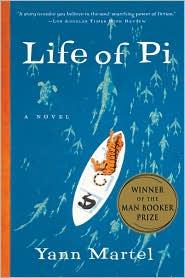
Life of Pi
by Yann Martel · 2001
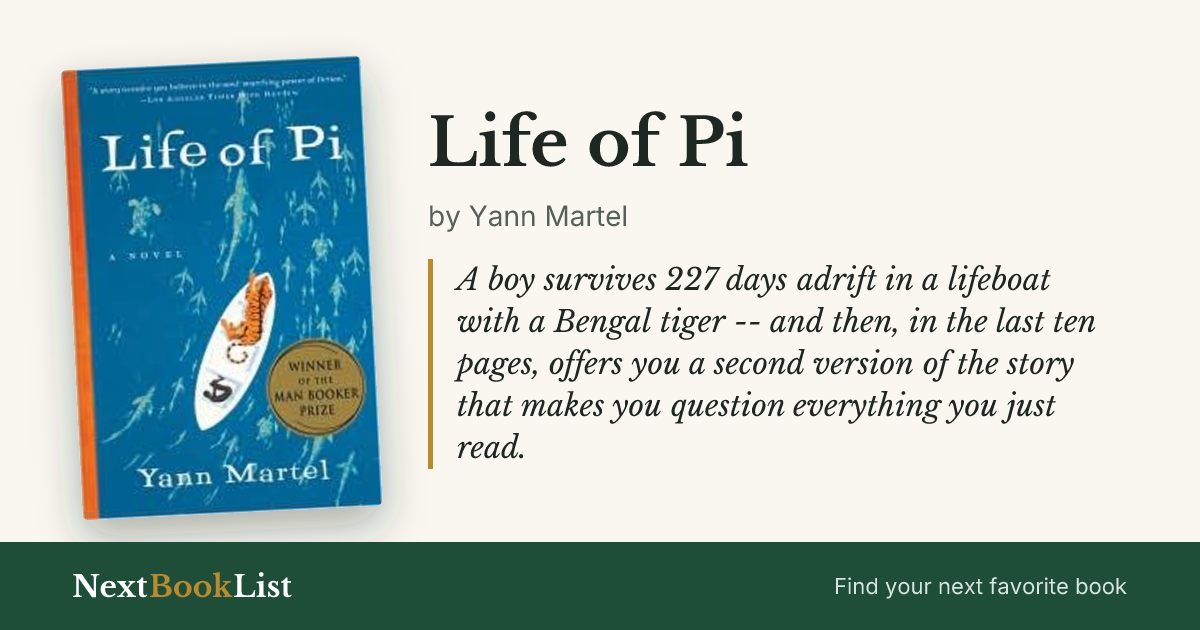
A boy survives 227 days adrift in a lifeboat with a Bengal tiger -- and then, in the last ten pages, offers you a second version of the story that makes you question everything you just read.
Worth reading? Life of Pi is a genuinely clever book let down slightly by its own cleverness -- the twist ending is the most-discussed thing about it for a reason, and it does retroactively deepen everything before it, but Martel telegraphs the theme (which story do you prefer?) so directly in the final chapters that it can feel like the book is grading your answer instead of trusting you to sit with the ambiguity.
| Author | Yann Martel |
|---|---|
| Published | 2001 |
| Publisher | Harcourt |
| Category | Fiction |
| Favorite quote | “I have a story that will make you believe in God.” |
The Verdict
The animal survival stuff is genuinely well-researched and tense enough to work as a straight adventure novel on its own – Martel isn’t coasting on the twist to carry the middle two-thirds. You could strip the ending entirely and still have a solid survival story.
But the ending is the point, and it’s a gutsy one: Martel makes you complicit in choosing the nicer story, then makes you sit with what that choice says about how you process hard truths generally, including religious ones. It’s smart. It’s also a little pleased with itself about being smart, which is the book’s one real flaw.
Read it if you want a survival novel that turns into a genuine philosophical gut-punch in its last ten pages. Skip it if you’d rather the book trust you with the ambiguity instead of explaining the trick to you directly.
you want a survival story that's really a philosophical trick about which version of a hard truth you'd rather believe, and you don't mind a novel that spends its first third on zoology and religion before the shipwreck even happens
you want a straight survival adventure without the metafictional twist -- the ending recontextualizes the entire book in a way some readers find brilliant and others find like a bait-and-switch
Book Summary
Piscine 'Pi' Patel, raised in a zookeeper's family in Pondicherry, India, survives a shipwreck that kills his family and ends up adrift in a lifeboat with a Royal Bengal tiger named Richard Parker, and the bulk of the novel details how he keeps himself alive for 227 days without becoming the tiger's next meal.
Martel spends the opening third establishing Pi's unusual, simultaneous devotion to Hinduism, Christianity, and Islam, and his fascination with animal behavior from growing up around his father's zoo -- both of which become directly practical survival knowledge once he's stranded with a predator.
In the novel's final pages, insurance investigators refuse to believe Pi's animal-filled account and Pi offers a second, brutal, entirely human version of the same 227 days, then asks the investigators (and the reader) which story they prefer -- reframing the entire book as a meditation on why people choose comforting narratives over hard truths.
The novel's real argument is that the "better story" (the animal-filled one) and the "true story" (the human one) may both be coping mechanisms, and that the choice to believe the more bearable version isn't naive so much as a basic human coping strategy that extends to religious belief itself.
Top 10 Lessons from Life of Pi
- Pi's simultaneous practice of three religions early in the book sets up the novel's ultimate question: is believing the more meaningful, harder-to-verify version of events a form of self-deception or a legitimate way to survive unbearable truth.
- Pi's zoo upbringing gives him real, specific knowledge, animal dominance behavior, territorial marking, training through consistency, that he applies to keeping Richard Parker from killing him, grounding the fantastical premise in something closer to plausible.
- The book uses survival mechanics (rainwater collection, fishing, managing a wild animal in a confined space) in granular detail, which is part of what makes the eventual doubt about the story's literal truth so effective.
- The alternate, human-only version of the story that Pi offers at the end recasts every animal in the lifeboat as a stand-in for a person, forcing the reader to reread the entire preceding narrative as possible allegory.
- The novel argues that the value of a story isn't necessarily its factual accuracy -- it's what the story lets a person survive, psychologically as well as physically.
- Richard Parker's abrupt, unceremonious departure at the end (he walks into the jungle without looking back) denies Pi, and the reader, the emotional closure a survival story usually delivers, which is a deliberate frustration of expectations.
- Richard Parker's name is itself a small joke about identity: a clerical mix-up on a shipping form swapped the tiger's and the hunter's names at capture, so the reader spends the whole book anchored to an administrative error.
- The surreal, carnivorous floating algae island Pi discovers mid-voyage is the novel's clearest piece of pure magical realism, and finding a human tooth inside one of its fruits hints that an earlier castaway didn't survive it.
- In the human-only version of the story, the ship's cook (standing in for the hyena) kills the sailor and Pi's mother before Pi kills the cook in turn -- the same beats as the animal story stripped of metaphor, which is what makes the parallel between both versions land so precisely.
- Pi's own name, shortened from Piscine Molitor Patel (after a Paris swimming pool) to escape schoolyard mockery, is a small early instance of the same theme the book plays out at scale later: choosing which version of yourself to present to the world.
Top 4 Quotes from Life of Pi
"I have a story that will make you believe in God."
Yann Martel, Life of Pi
"I suppose in the end, the whole of life becomes an act of letting go, but what always hurts the most is not taking a moment to say goodbye."
Yann Martel, Life of Pi
"To choose doubt as a philosophy of life is akin to choosing immobility as a means of transportation."
Yann Martel, Life of Pi
"If you stumble at mere believability, what are you living for? Love is hard to believe, ask any lover. Life is hard to believe, ask any scientist. God is hard to believe, ask any believer."
Yann Martel, Life of Pi
Frequently Asked Questions
Is Life of Pi worth reading?
Yes -- it's a genuinely inventive survival novel with an ending that changes how you read everything before it, even if the final chapters lean a bit hard on spelling out the theme.
What is Life of Pi actually about?
On the surface, a boy surviving a shipwreck with a tiger; underneath, a question about whether people prefer comforting stories to hard truths, applied to both personal trauma and religious belief.
Is the tiger real in Life of Pi?
The book deliberately leaves this ambiguous -- Pi offers two versions of events, one with animals and one without, and never confirms which is literally true.
Do I need religious knowledge to understand Life of Pi?
No, though familiarity with Hinduism, Christianity, and Islam adds texture to Pi's early religious exploration -- it's explained clearly enough for a general reader.
Is Life of Pi appropriate for younger readers?
It contains some disturbing survival and violence content in its final chapters, so it's better suited to teens and adults.
Ready to read it?
Get Life of Pi on Amazon