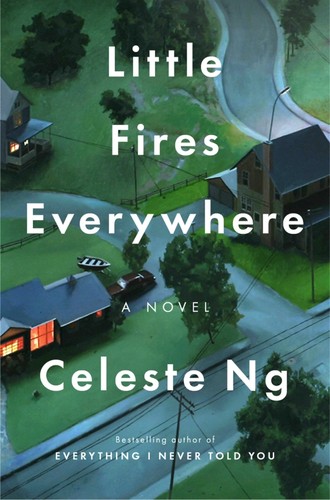
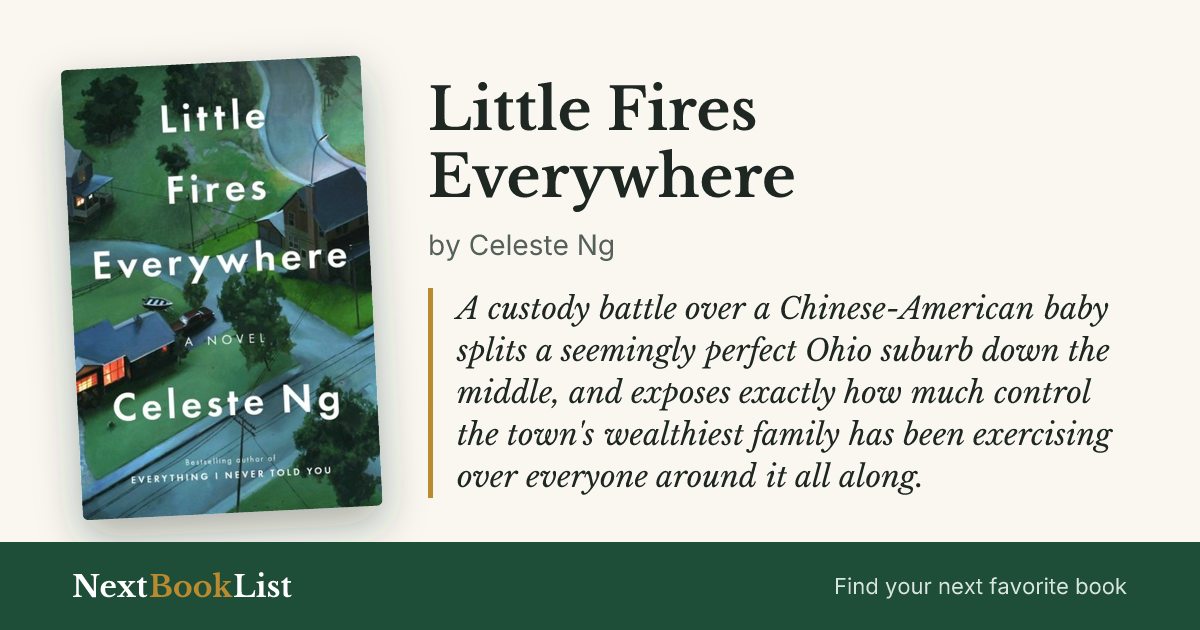
Little Fires Everywhere
by Celeste Ng · 2017
A custody battle over a Chinese-American baby splits a seemingly perfect Ohio suburb down the middle, and exposes exactly how much control the town's wealthiest family has been exercising over everyone around it all along.
Worth reading? Little Fires Everywhere is Celeste Ng at her sharpest on class and control, using the planned, rule-governed suburb of Shaker Heights as a physical metaphor for the Richardson family's need to manage everyone around them, including their own kids. The custody battle at the book's center is genuinely well-handled, giving real weight to both the adoptive parents and the birth mother instead of picking an obvious side, which is harder to pull off than the premise suggests.
| Author | Celeste Ng |
|---|---|
| Published | 2017 |
| Publisher | Penguin Press |
| Category | Fiction |
| Favorite quote | “Everyone in Shaker Heights was talking about it that summer: how Isabelle, the last of the Richardson children, had finally gone around the bend and burned the house down.” |
The Verdict
The Shaker Heights setting does more work than a lot of suburban fiction bothers with, Ng uses the town’s actual, real regulated aesthetic (paint colors, lawn height, house styles) as a running metaphor for Elena Richardson’s controlling instincts, and it pays off by the time the fires start.
The custody plot is the book’s real test, and Ng passes it by refusing to simplify either side. You understand exactly why the adoptive parents believe they’re right and exactly why the birth mother is fighting to get her daughter back, which makes the town’s split feel earned rather than manufactured for drama.
Read it if you want a sharp, slow-building novel about class, race, and motherhood with a genuinely balanced central conflict. Skip it if you need more plot momentum than a character-driven family drama typically delivers.
you want a novel that uses a hot-button custody dispute to dissect class, race, and motherhood in suburban America, told through an ensemble cast where almost nobody is fully right or fully wrong
you want a plot-forward thriller -- this is a slow-building character study, most of the tension comes from social and moral friction, not incident, and the pacing reflects that
Book Summary
In the meticulously planned Cleveland suburb of Shaker Heights, wealthy Elena Richardson rents her second property to Mia Warren, an itinerant artist and single mother, whose daughter Pearl becomes entangled with all four Richardson children -- setting off tensions that eventually erupt over a custody battle involving Mia's friend's adopted Chinese-American baby.
The custody fight, between Elena's friends (who are raising the baby) and the birth mother (who wants her back), splits the town and forces every character to reveal what they actually believe about class, race, and who deserves to be a parent, without the novel handing readers an easy answer.
Ng uses Elena and Mia as mirror-image mothers, one controlled, rule-bound, and defined by keeping up appearances, the other itinerant, secretive, and fiercely protective of her daughter's autonomy, to interrogate what "good mothering" even means across class lines.
The novel's title becomes literal at the very start (the Richardson house burns down, set by Elena's youngest daughter Izzy) and the narrative works backward to explain how a house, and a family, built entirely around control finally combusted.
Top 9 Lessons from Little Fires Everywhere
- Shaker Heights' planned, rule-governed design (down to regulated lawn heights and approved house paint colors) is used throughout the novel as a physical metaphor for Elena Richardson's need to control everything and everyone in her orbit.
- The custody battle deliberately withholds an easy moral answer, the adoptive parents love and can provide stability, the birth mother has real, sympathetic reasons for wanting her daughter back, forcing readers to sit with genuine ambiguity.
- Mia's secretive past and itinerant lifestyle are gradually revealed to be a direct response to trauma involving reproduction and control over her own body, tying her personal history directly to how she views the custody dispute.
- Izzy Richardson, the family's most rebellious child, is set up early as someone who absorbs and eventually acts on the tensions everyone else in the family suppresses, making her the one who literally sets the fires the title promises.
- The novel treats race explicitly, the custody dispute is heightened because the child is Chinese-American being raised by a white family, and it doesn't let any character, including the sympathetic ones, off the hook for their blind spots on the subject.
- Elena's journalistic instinct to dig into Mia's past, framed by Elena as protecting her town's order, is shown as its own form of control and violation, complicating any easy read of who the 'nosy' or 'wronged' party actually is.
- Mia's own backstory, revealed late, complicates the custody plot's parallels: she once agreed to be an egg donor and surrogate for a wealthy couple, then fled with the baby (Pearl) rather than hand her over, making her a birth mother who won her own custody fight outside the law.
- Lexie Richardson uses Pearl's name and insurance to get an abortion without her parents finding out, a teenage-scale version of the same instinct -- people with privilege borrowing less-privileged people's identities for their own convenience -- that runs through the custody plot.
- Mia becomes an artistic mentor and de facto second mother to Izzy, the Richardson child most alienated from Elena, setting up Izzy's choice at the end of the novel to leave her own family behind and follow Mia instead.
Top 1 Quotes from Little Fires Everywhere
"Everyone in Shaker Heights was talking about it that summer: how Isabelle, the last of the Richardson children, had finally gone around the bend and burned the house down."
Celeste Ng, Little Fires Everywhere
Frequently Asked Questions
Is Little Fires Everywhere worth reading?
Yes -- it's one of Celeste Ng's sharpest novels, using a custody battle to dig into class, race, and motherhood without offering easy answers.
What is Little Fires Everywhere about?
A custody battle over an adopted Chinese-American baby divides a planned Ohio suburb, exposing the class and control dynamics beneath its orderly surface.
Is Little Fires Everywhere a slow book?
It's more of a character-driven slow burn than a plot-driven thriller, though the opening scene (the Richardson house on fire) frames the whole narrative with a clear destination.
Is there a TV adaptation of Little Fires Everywhere?
Yes, a 2020 Hulu limited series starring Reese Witherspoon and Kerry Washington, which made some notable changes from the novel.
Does Little Fires Everywhere take a side in the custody battle?
No -- the novel deliberately gives real sympathy and legitimate reasoning to both the adoptive parents and the birth mother, refusing an easy resolution.
Ready to read it?
Get Little Fires Everywhere on Amazon