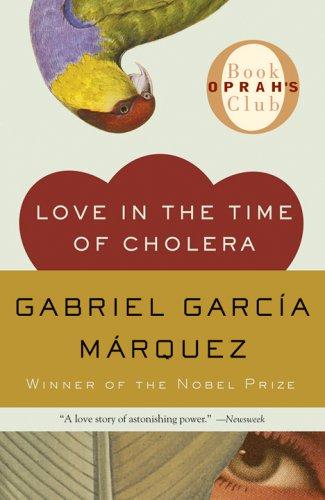
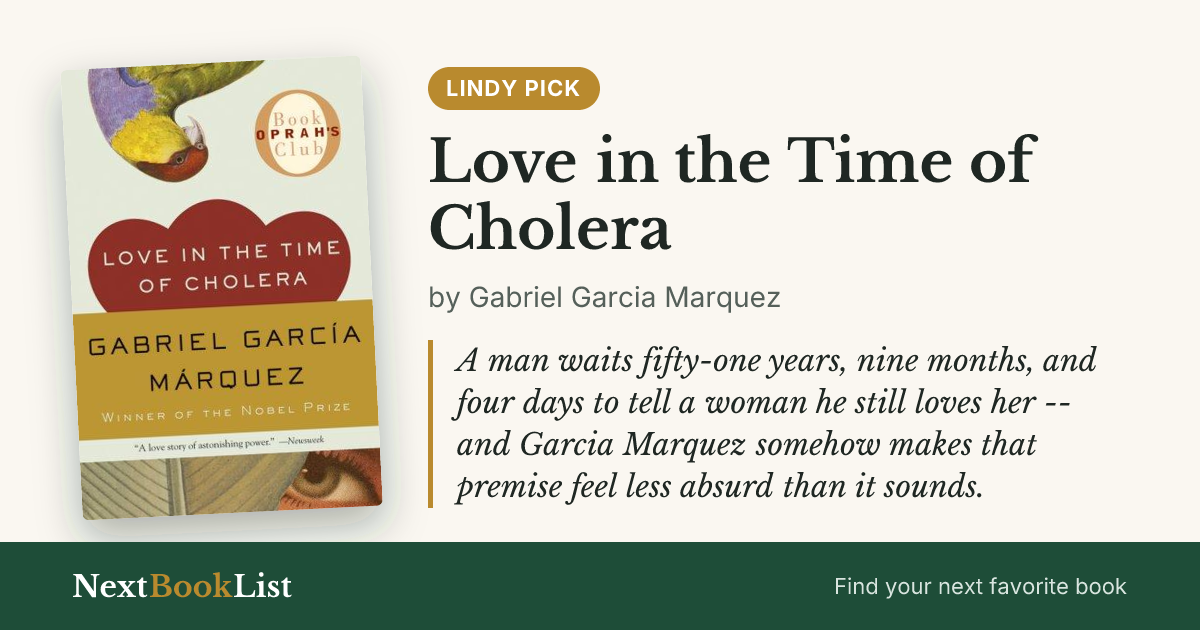
Love in the Time of Cholera
by Gabriel Garcia Marquez · 1985
A man waits fifty-one years, nine months, and four days to tell a woman he still loves her -- and Garcia Marquez somehow makes that premise feel less absurd than it sounds.
Worth reading? Love in the Time of Cholera is less magical-realist than One Hundred Years of Solitude and more emotionally direct, which makes it the better entry point for readers intimidated by Garcia Marquez's reputation. Florentino Ariza's decades-long devotion to Fermina Daza reads as romantic on the surface, but the novel is honest about how close obsession sits next to love, and it doesn't let him off easy for the affairs he has while waiting. Translation-wise, Edith Grossman's English version is the standard, and it's excellent.
| Author | Gabriel Garcia Marquez |
|---|---|
| Published | 1985 |
| Publisher | Vintage International |
| Category | Fiction |
| Favorite quote | “It was inevitable: the scent of bitter almonds always reminded him of the fate of unrequited love.” |
The Verdict
Florentino Ariza is a genuinely uncomfortable character to sit with once you notice how many affairs run parallel to his supposedly singular devotion, and the novel wants you to notice. That tension, between the grand romantic gesture and the messier reality underneath it, is what keeps the book from reading as simple sentimentality.
Fermina and Dr. Urbino’s marriage gets more page time and more nuance than you’d expect from a book ostensibly about the man waiting outside it, and that’s to the novel’s credit, it refuses to treat her husband as a mere obstacle.
Read it if you want Garcia Marquez without committing to the generational sprawl of One Hundred Years of Solitude. Skip it if you want your love stories uncomplicated, Florentino’s devotion comes with enough moral baggage that “romantic” isn’t the only word that fits.
you want the other great Garcia Marquez novel, a patient, deeply humane meditation on love across an entire lifetime instead of One Hundred Years of Solitude's magical-realist family saga
you want a conventional romance with a satisfying, uncomplicated resolution -- the novel treats obsession, aging, and desire with more moral ambiguity than that framing implies
Book Summary
Florentino Ariza falls in love with Fermina Daza as a young man, is rejected in favor of the wealthier Dr. Juvenal Urbino, and spends the next five decades waiting, having numerous affairs along the way, until Urbino's death finally gives him the chance to declare himself again.
Garcia Marquez treats love not as a single pure feeling but as something that coexists uncomfortably with obsession, vanity, and self-deception, Florentino's devotion is genuine and also, the novel makes clear, a kind of lifelong project he's built his identity around.
Set against recurring outbreaks of cholera in an unnamed Caribbean port city, the novel uses the disease as a loose metaphor for love itself, something that resembles illness in its symptoms and can be just as difficult to distinguish from the real thing.
Top 7 Lessons from Love in the Time of Cholera
- Florentino Ariza's fifty-one-year wait for Fermina Daza is romantic on its surface but the novel keeps complicating it: he has hundreds of affairs during that time while insisting his devotion to her never wavered.
- Fermina Daza's choice of the wealthier, more socially secure Dr. Urbino over Florentino is treated by the novel as a legitimate, unromantic, and ultimately reasonable decision, not simply a tragic mistake.
- The novel deliberately blurs the symptoms of cholera with the symptoms of lovesickness, using the disease as a running metaphor for how love can look and feel like illness.
- Garcia Marquez gives Dr. Urbino's marriage to Fermina real texture and difficulty, not a simple placeholder to be overcome, their decades together include real companionship as well as real friction.
- Florentino's eventual reunion with Fermina, both of them elderly by that point, treats late-life desire and romance without the condescension most fiction reserves for older characters.
- The novel's setting, an unnamed Caribbean port city plagued by cholera outbreaks and civil unrest, mirrors the instability and disease-like unpredictability of the romantic relationships within it.
- The book resists a tidy moral verdict on Florentino: readers disagree, deliberately, on whether his devotion is admirable or a form of obsessive self-mythologizing.
Top 3 Quotes from Love in the Time of Cholera
"It was inevitable: the scent of bitter almonds always reminded him of the fate of unrequited love."
Gabriel Garcia Marquez, Love in the Time of Cholera
"It is enough for me to be sure that you are on earth."
Gabriel Garcia Marquez, Love in the Time of Cholera
"He allowed himself to be swayed by his conviction that human beings are not born once and for all on the day their mothers give birth to them, but that life obliges them over and over again to give birth to themselves."
Gabriel Garcia Marquez, Love in the Time of Cholera
Frequently Asked Questions
Is Love in the Time of Cholera worth reading?
Yes -- it's a more emotionally direct entry point into Garcia Marquez than One Hundred Years of Solitude, and its treatment of love and obsession across a lifetime is genuinely moving without being simple.
What is Love in the Time of Cholera about?
Florentino Ariza's five-decade devotion to Fermina Daza, who married another man, and his eventual chance to reconnect with her after her husband's death, set in a cholera-stricken Caribbean port city.
Is Love in the Time of Cholera a happy love story?
It's complicated on purpose. Florentino's devotion is real, but so are the hundreds of affairs he has while waiting, and the novel doesn't ask you to simply admire him for it.
Do I need to read One Hundred Years of Solitude first?
No, the two novels aren't connected. This one is actually a gentler introduction to Garcia Marquez, with less magical realism and a more linear structure.
Which translation of Love in the Time of Cholera should I read?
Edith Grossman's English translation is the standard and widely considered excellent -- most English editions in print use it.
Ready to read it?
Get Love in the Time of Cholera on Amazon