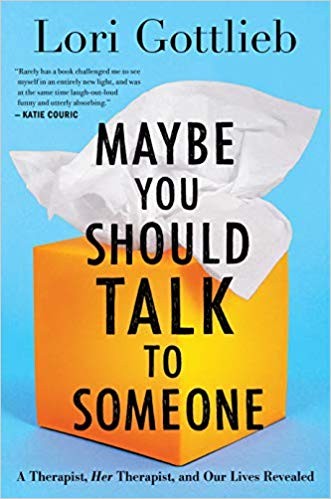
Maybe You Should Talk to Someone
by Lori Gottlieb · 2019
A therapist's own therapy sessions, woven with four of her patients' stories, that makes the case for therapy better than any explainer article could.
Worth reading? Maybe You Should Talk to Someone works because it's structured like four braided memoirs instead of one. Gottlieb, a therapist, becomes a patient herself mid-book after a breakup, and watching her sit in the client chair she usually sits across from is the hook that makes the psychology land. Compared to a more clinical book like Games People Play, this one earns its insight through story, not theory. Skip it if you want a workbook with exercises. Read it if you want to understand what therapy is actually for.
| Full Title | Maybe You Should Talk to Someone: A Therapist, Her Therapist, and Our Lives Revealed |
|---|---|
| Author | Lori Gottlieb |
| Published | 2019 |
| Publisher | Houghton Mifflin Harcourt |
| Category | Self-Improvement & Psychology |
| Favorite quote | “The truth is that pain can bring people together. It can also tear them apart, but pain and love often coexist.” |
The Verdict
Gottlieb’s trick is structural: she braids her patients’ stories with her own sudden crisis as a client, and that double view is what makes the psychology stick. If you’ve ever wondered what actually happens in a therapy session, this is the closest you’ll get without booking one.
you're curious what therapy actually looks like from the inside, or you're on the fence about starting
you want a how-to framework -- this is narrative nonfiction, not a workbook

Book Summary
Everyone, including therapists, needs someone to talk to. Gottlieb's own crisis, a sudden breakup, forces her into her own therapist's office and she narrates that experience with the same honesty she asks of her patients.
The stories she braids together, a dying man confronting regret, a young woman convinced she has terrible luck, an elderly woman planning suicide, a Hollywood producer who can't stop being cruel, show that most people's stated problem isn't their real problem.
Change happens slowly and non-linearly, and the goal of therapy isn't happiness, it's the capacity to hold complexity, grief and joy together, without needing to resolve it into a tidy story.
Top 8 Lessons from Maybe You Should Talk to Someone
- The problem someone brings to their first session is rarely the real problem underneath it.
- Avoidance isn't the absence of feeling, it's the postponement of it, and it comes due eventually.
- Therapists need therapy too -- expertise in a subject doesn't exempt you from needing help with it.
- People often mistake the story they tell about their life for the truth of their life.
- Grief doesn't resolve on a schedule, and pretending it should just adds shame to sadness.
- The 'unimportant' details a client mentions in passing are usually where the real work is.
- Change requires tolerating the discomfort of not knowing who you'll be without the old story.
- A good therapist withholds judgment and hands the client back their own insight instead of a verdict.
Top 4 Quotes from Maybe You Should Talk to Someone
"The truth is that pain can bring people together. It can also tear them apart, but pain and love often coexist."
Lori Gottlieb, Maybe You Should Talk to Someone
"We can't change what happened. We can change how we carry it."
Lori Gottlieb, Maybe You Should Talk to Someone
"The capacity for change is directly linked to our ability to trust ourselves."
Lori Gottlieb, Maybe You Should Talk to Someone
"People who don't want to look at the whole picture are usually trying to hide from something in it."
Lori Gottlieb, Maybe You Should Talk to Someone
Frequently Asked Questions
Is Maybe You Should Talk to Someone worth reading?
Yes -- it's one of the more honest looks at what therapy actually does, told through braided real stories, including the author's own.
Is this a self-help book?
It's narrative nonfiction more than a how-to. The insight comes from watching real patients (and the author) work through problems, not from prescribed exercises.
Do you need to be in therapy to get value from this book?
No. It's useful for anyone curious about how therapy works, or on the fence about starting, since it demystifies the process from both sides of the room.
Ready to read it?
Get Maybe You Should Talk to Someone on Amazon