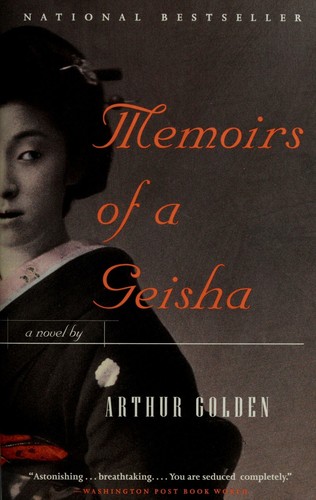
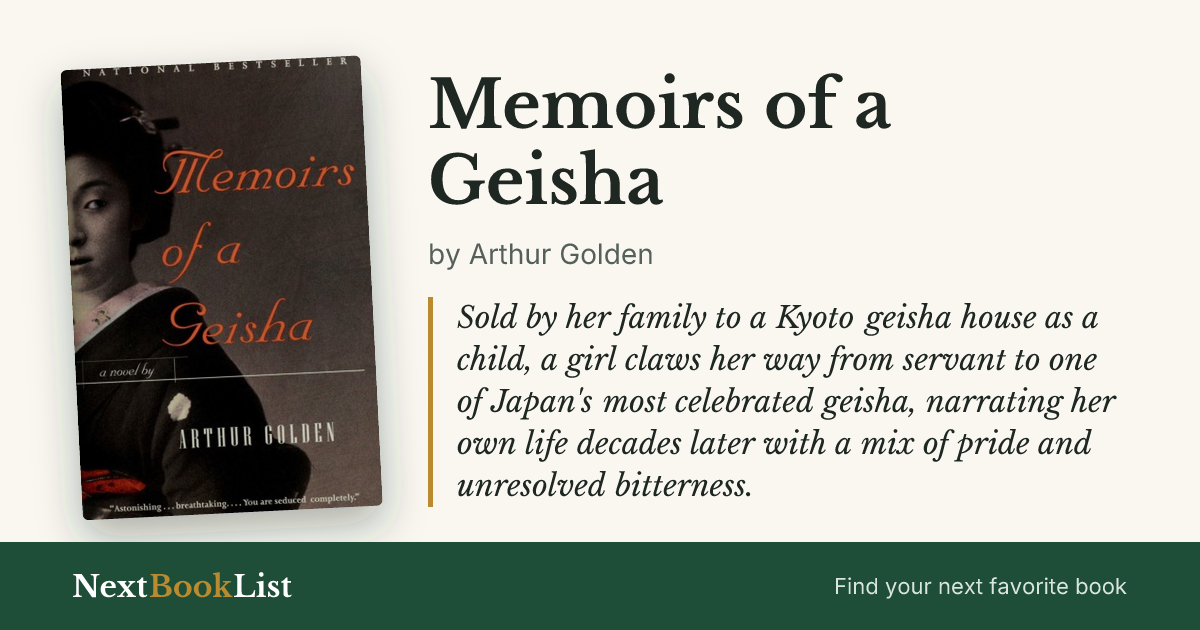
Memoirs of a Geisha
by Arthur Golden · 1997
Sold by her family to a Kyoto geisha house as a child, a girl claws her way from servant to one of Japan's most celebrated geisha, narrating her own life decades later with a mix of pride and unresolved bitterness.
Worth reading? Memoirs of a Geisha is a well-constructed, absorbing novel, and its account of geisha training and hierarchy reads with real authority. It's also a book you should read knowing the authorship complication: Golden interviewed a real former geisha, Mineko Iwasaki, for research and drew on her life more directly than she consented to, which she has publicly disputed.
| Author | Arthur Golden |
|---|---|
| Published | 1997 |
| Publisher | Knopf |
| Category | Fiction |
| Favorite quote | “Adversity is like a strong wind. It tears away from us all but the things that cannot be torn, so that we see ourselves as we really are.” |
The Verdict
The book’s real strength is texture: the geisha house’s internal economy, its debts and rivalries and status markers, is rendered with enough specificity that it reads like reporting even though it’s a novel. That’s also exactly where its complications live.
Golden researched this by interviewing Mineko Iwasaki, a real former geisha, and used her life more directly than she says she agreed to – she’s disputed the book’s portrayal publicly and published her own memoir partly in response. That context doesn’t erase the novel’s craft, but it should sit alongside your reading of it.
As a novel on its own terms, it moves well. Sayuri’s rise, her rivalry with Hatsumomo, and the frame device of an elderly woman narrating her own past all work.
Read it if you want an absorbing historical novel about a closed, hierarchical world. Skip it if you’d rather read Mineko Iwasaki’s own memoir first, or instead.
you want an immersive, richly detailed novel about a closed, hierarchical world you almost certainly don't know from the inside, told with real narrative momentum
you want a book written from genuine inside cultural authority -- Golden is an American man writing in a Japanese woman's first-person voice, and that mismatch has drawn real, fair criticism, including from the real geisha whose life partly inspired the novel
Book Summary
Chiyo, sold as a child by her impoverished family to a geisha house in Kyoto, endures years as a servant before being trained as a geisha herself, taking the name Sayuri. The novel follows her rise through a brutal internal hierarchy, competing against a rival geisha determined to see her fail, toward a status few women in the profession ever reach.
Golden frames the entire novel as Sayuri's own oral memoir, dictated decades later to a fictional translator, which lets him narrate the geisha world's customs, economics, and cruelty with the authority of a first-person insider even though the world itself is being reconstructed by an outside researcher.
The book is frank about what the geisha system actually was: an economy built on selling girls, arranging their virginity to the highest bidder (mizuage), and binding their careers to wealthy patrons -- Golden doesn't romanticize the geisha as pure artists so much as show a rigid, transactional world that happened to produce real artistry within it.
Top 10 Lessons from Memoirs of a Geisha
- The novel is most interesting when it treats geisha training as a genuine craft economy, with its own internal status ladder, debts, and rivalries.
- Sayuri's narration is unreliable in ways worth noticing -- she frames her own choices sympathetically even when the outcomes hurt other women around her.
- The book doesn't flinch from the geisha system's transactional core, including the sale of virginity to the highest bidder, rather than presenting geisha life as purely artistic.
- Hatsumomo, Sayuri's rival, functions less as a cartoon villain than as a product of the same brutal system that shaped Sayuri -- just without Sayuri's later success.
- The frame device (an elderly Sayuri dictating her memoir) lets the book claim retrospective wisdom that a real-time narrator wouldn't have access to.
- The novel's authorship controversy -- Golden's use of Mineko Iwasaki's life story without her full consent -- is worth knowing before treating the book as ethnographically authoritative.
- Mameha, a rival top geisha, takes over Sayuri's training largely to spite her own long-running feud with Hatsumomo -- meaning Sayuri's rise is fueled as much by two grown women's rivalry as by her own talent.
- The novel centers Sayuri's lifelong, secret devotion to 'the Chairman,' a businessman who showed her a single act of kindness as a child, and reframes her entire career as an oblique, decades-long pursuit of becoming his mistress.
- Sayuri's other patron, Nobu, is portrayed as genuinely loyal and caring in a system built on transaction, which makes her late, deliberate sabotage of his opinion of her -- so she can end up with the Chairman instead -- a morally uncomfortable choice the book doesn't fully let her off the hook for.
- Pumpkin, Sayuri's fellow initiate and one-time friend, is passed over for advancement and eventually turns on her out of resentment, showing how the geisha system's scarce opportunities corrode friendships as readily as they create rivals like Hatsumomo.
Top 2 Quotes from Memoirs of a Geisha
"Adversity is like a strong wind. It tears away from us all but the things that cannot be torn, so that we see ourselves as we really are."
Arthur Golden, Memoirs of a Geisha
"Because water can carve its way even through stone, and when trapped, water makes a new path."
Arthur Golden, Memoirs of a Geisha
Frequently Asked Questions
Is Memoirs of a Geisha worth reading?
Yes, as an absorbing, well-researched historical novel -- just go in aware of the real authorship controversy around how Golden used a real geisha's life story.
Is Memoirs of a Geisha a true story?
No, it's fiction, though Golden researched it by interviewing a real former geisha, Mineko Iwasaki, whose life he drew on more closely than she says she agreed to.
What is Memoirs of a Geisha about?
A girl sold to a Kyoto geisha house rises from servant to one of Japan's most celebrated geisha, narrating her own life story decades later.
Is Memoirs of a Geisha historically accurate about geisha culture?
It's well-researched but fictionalized, and its portrayal has been disputed by Mineko Iwasaki, the real geisha whose account partly inspired it -- she published her own memoir, Geisha, A Life, in response.
How does the book compare to the 2005 film?
The film compresses the novel's timeline significantly but follows the same core plot and ending.
Ready to read it?
Get Memoirs of a Geisha on Amazon