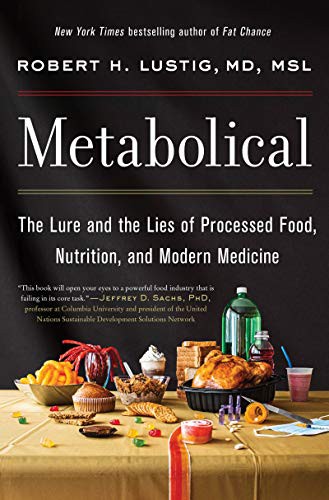
Metabolical
by Robert H. Lustig, M.D. · 2021
Lustig argues that most chronic disease traces back to one root cause -- processed food wrecking metabolic health -- and that medicine keeps treating the resulting symptoms instead of the food supply that causes them.
Worth reading? Lustig's real contribution is naming the shared mechanism -- metabolic dysfunction, driven substantially by processed food's effect on the liver and insulin -- behind a list of diseases usually treated as unrelated. That's a genuinely useful reframe, and the chapters walking through how 'health food' marketing and nutrition science got captured by industry money are some of the sharpest writing on the subject. Where it wears thin is the prosecutorial tone: everything from the food industry to the medical establishment is cast as complicit, and the case sometimes overwhelms the reader instead of persuading them.
| Full Title | Metabolical: The Lure and the Lies of Processed Food, Nutrition, and Modern Medicine |
|---|---|
| Author | Robert H. Lustig, M.D. |
| Published | 2021 |
| Publisher | Harper Wave |
| Category | Health & Fitness |
| Favorite quote | “We are being lied to. And it's making us sick.” |
The Verdict
Lustig’s mechanism-first approach is the book’s strength. Instead of another list of foods to avoid, he traces the actual biology – how fructose taxes the liver differently than glucose, how that drives insulin resistance, and how insulin resistance quietly underlies diagnoses that get treated as unrelated. That’s a more useful frame than most diet books offer, and it holds up under scrutiny better than a lot of pop-nutrition writing.
The prosecutorial tone is also the book’s main cost. Nearly every institution touched – food companies, regulators, nutrition science, the medical system – gets cast as complicit in the same story, and by the second half the sheer scope of the indictment starts to overwhelm the argument rather than reinforce it.
Read it if you want the clearest mechanism-level case for why processed food specifically, not any single nutrient, is driving modern chronic disease. Skip it if you want a measured, both-sides treatment of the food industry and medical establishment rather than a forcefully argued prosecution.
you want the case for why ultra-processed food, not any single nutrient, is the common thread behind obesity, diabetes, heart disease, and more, argued by a pediatric endocrinologist with decades in the field
you want a balanced, both-sides treatment of the food industry and medical system -- Lustig writes as a prosecutor building a case, not a neutral referee

Book Summary
Lustig's central claim is that a huge share of modern chronic disease -- obesity, type 2 diabetes, fatty liver, heart disease, some cancers -- shares one underlying driver: metabolic dysfunction caused substantially by ultra-processed food, particularly added sugar and refined carbohydrates, working through insulin resistance and liver stress rather than through any single "bad" nutrient.
A large portion of the book is a forensic look at how the food industry and, at points, nutrition science itself, shaped public understanding of what's healthy -- how "low-fat" and other health halos were used to sell products that were metabolically harmful in other ways, and how research funding shaped which studies got attention.
The back half turns to the medical system's incentives, arguing that a model built around treating individual diagnoses with drugs and procedures has little structural reward for addressing the shared metabolic root cause upstream of many of those diagnoses, which is why so many patients end up managing several "separate" chronic conditions that actually trace back to the same cause.
Top 9 Lessons from Metabolical
- A wide range of chronic diseases (obesity, type 2 diabetes, fatty liver, heart disease) is argued to share one common root: metabolic dysfunction driven substantially by ultra-processed food.
- Sugar's harm is framed as working mostly through the liver and insulin resistance, not simply through extra calories -- which is why 'a calorie is a calorie' is presented as a misleading simplification.
- Food industry marketing repeatedly used a 'health halo' (low-fat, low-cholesterol, natural) to sell products that were still metabolically harmful in other ways, like added sugar.
- Ultra-processed food is distinguished from 'processed' in general -- the concern is specifically industrial formulations designed for shelf life and palatability, not home cooking that involves some processing.
- The medical system's reimbursement structure is argued to reward treating individual diagnoses with drugs and procedures, with little built-in incentive to address the metabolic root cause shared across several of a patient's conditions.
- Fiber is highlighted as a protective factor stripped out of many processed foods, and its absence is tied to worse metabolic outcomes independent of sugar content alone.
- Nutrition research funding and industry influence are argued to have shaped which studies got prominence, contributing to decades of dietary advice that didn't match the underlying evidence.
- Fructose specifically (heavily used in processed food and drinks) is singled out as metabolized differently than glucose, placing more direct stress on the liver.
- The book argues that fixing food policy at a systemic level (labeling, subsidies, marketing rules) matters as much as individual dietary choices, since the current food environment is engineered to work against individual willpower.
Top 2 Quotes from Metabolical
"Sugar is not just empty calories; it's toxic, and it's why we're sick."
Robert H. Lustig, M.D., Metabolical
"We are being lied to. And it's making us sick."
Robert H. Lustig, M.D., Metabolical
Frequently Asked Questions
Is Metabolical worth reading?
Yes, if you want the case for processed food as the shared root cause behind a wide range of chronic diseases -- Lustig's mechanism-level argument (sugar, insulin, the liver) is sharper than most pop-nutrition books, though the prosecutorial tone toward industry and medicine doesn't leave much room for nuance.
What is Metabolical about?
Robert Lustig argues that ultra-processed food, acting through insulin resistance and liver stress, is the common driver behind obesity, diabetes, heart disease, and more, and that both the food industry and the medical system are structured to avoid addressing that root cause.
Does Metabolical recommend a specific diet?
Not a rigid meal plan -- the practical takeaway is to minimize ultra-processed food and added sugar and prioritize fiber and whole foods, but the book is mostly a diagnosis of the problem rather than a step-by-step program.
Is Metabolical the same argument as Fat Chance, Lustig's earlier book?
Related but broader -- Fat Chance focused specifically on sugar and obesity; Metabolical widens the lens to processed food generally and adds a sustained critique of the food industry and medical system's incentives.
How does Metabolical compare to How Not to Die?
Different emphasis on similar territory -- How Not to Die is a disease-by-disease case for what to eat; Metabolical is a mechanism-and-systems argument for why processed food specifically is the common thread and why the food and medical industries haven't fixed it.
Ready to read it?
Get Metabolical on Amazon