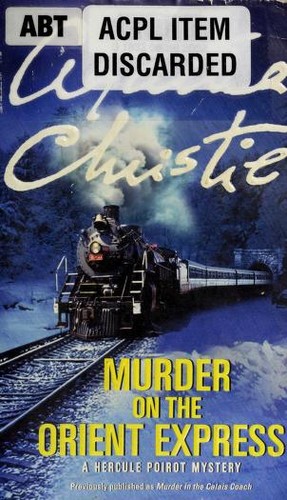
Murder on the Orient Express
by Agatha Christie · 1934
A passenger is stabbed twelve times in a locked train compartment somewhere in the Balkans, and Hercule Poirot has to find a killer among a dozen strangers who all seem to have alibis -- and one of the most famous twist solutions in mystery fiction.
Worth reading? Murder on the Orient Express is the Poirot novel people who don't read Poirot novels have still heard of, and the reason is the solution -- one of the most audacious in the genre's history. Christie builds a dozen believable suspects and then does something with them the format almost never allows.
| Author | Agatha Christie |
|---|---|
| Published | 1934 |
| Publisher | William Morrow |
| Category | Fiction |
| Favorite quote | “I do not approve of murder.” |
The Verdict
Christie’s real achievement here isn’t the murder itself, it’s the fairness – everything you need to solve the case is on the page, and the solution still manages to feel like a genuine swing rather than a cheat. That combination is rarer than the genre’s reputation suggests.
Poirot at his best is a psychologist first and a clue-hunter second, and this book is the clearest showcase of that approach – he’s reading contradictions in people’s stories more than he’s dusting for fingerprints.
The twist has been referenced, parodied, and half-spoiled in pop culture so many times that going in completely blind gets harder every year. If you already know it, the book still works as a well-built period mystery, just without the gut-punch of discovery.
Read it if you want peak classic Poirot in a plot bold enough to still get discussed nine decades later. Skip it if the twist’s already spoiled for you – read a different Christie first and come back to this one once you’ve forgotten the details.
you want a classic locked-room whodunit with Christie's most famous detective operating at the top of his game, in a plot that's still copied and parodied because the solution is that good
you already know the ending -- it's one of the most spoiled twists in the genre, referenced constantly in pop culture, so if you've absorbed it secondhand the reread value drops fast
Book Summary
Hercule Poirot boards the Orient Express and finds himself stuck on a snowbound train with a murdered American passenger, a dozen suspects from wildly different backgrounds and nationalities, and a crime scene that seems to implicate almost everyone and no one at once.
The victim, it turns out, was connected to a real tragedy in his past -- a kidnapping and murder loosely evoking the real-life Lindbergh baby case, which Christie uses to raise the question of whether private, collective justice can ever be morally justified when the legal system has failed.
Poirot's solution (avoiding spoilers here deliberately) reframes the entire investigation retroactively, and it's held up as one of the boldest structural swings in classic detective fiction -- a twist that changes not just who did it, but what "solving" the case even means.
Top 9 Lessons from Murder on the Orient Express
- Christie builds twelve distinct suspects with individually consistent alibis and backstories, which is a much harder plotting feat than the two-or-three-suspect mysteries most of the genre settles for.
- The victim's connection to a real-world-adjacent kidnapping tragedy gives the murder a moral weight beyond puzzle-solving -- the book asks a real question about vigilante justice, not just whodunit mechanics.
- Poirot's methodical, psychology-first interviewing style (reading people's inconsistencies rather than just physical clues) set the template a huge amount of later fictional detective work still follows.
- The train setting functions the same way the island does in And Then There Were None -- a closed environment that guarantees the killer is among a fixed, known cast, which sharpens the puzzle.
- The book plays scrupulously fair -- every clue needed to reach the solution is presented to the reader, which is why the twist rewards a reread instead of feeling like a cheat.
- Poirot's final choice about what to report to the authorities is the book's real ethical center, and Christie leaves his decision presented without editorializing about whether it's right.
- The snowbound train functioning as a self-contained crime scene forces Poirot to work purely from testimony and physical evidence rather than external investigation, which sharpens the puzzle into a pure test of deduction.
- Christie gives each suspect a distinct nationality, class, and manner of speech, using surface differences to misdirect the reader about who could plausibly be working together.
- The novel treats the original kidnapping tragedy as the moral engine for everyone aboard the train, showing how a single unpunished crime can radiate outward and reshape a dozen unrelated lives years later.
Top 1 Quotes from Murder on the Orient Express
"I do not approve of murder."
Agatha Christie, Murder on the Orient Express
Frequently Asked Questions
Is Murder on the Orient Express worth reading?
Yes, especially if you don't already know the twist -- it's one of the most celebrated solutions in mystery fiction and holds up as a tightly plotted classic Poirot case.
What is Murder on the Orient Express about?
Hercule Poirot investigates the murder of a passenger stabbed to death aboard a snowbound train, working through a dozen suspects to reach a solution that reframes the entire case.
Book vs. the 2017 or 1974 movie -- which should I do first?
Read the book first if the twist isn't already spoiled for you. Both major film adaptations follow the book's plot closely, so watching first will spoil the novel's central reveal.
Do I need to read other Poirot books first?
No -- this works as a standalone entry point, though Poirot's established methods and personality land a bit richer if you've met him in an earlier book first.
Is Murder on the Orient Express based on a true story?
Not directly, but the victim's backstory loosely evokes the real 1932 Lindbergh kidnapping case, which was recent news when Christie wrote the book.
Ready to read it?
Get Murder on the Orient Express on Amazon