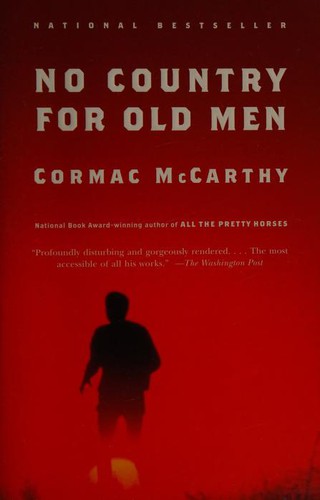
No Country for Old Men
by Cormac McCarthy · 2005
A welder stumbles on two million dollars from a drug deal gone wrong, pockets it, and spends the rest of the book being hunted by a killer who flips coins to decide who lives -- while an aging sheriff realizes he's too old for the world this money belongs to.
Worth reading? No Country for Old Men works as a lean, brutally efficient thriller on the surface, and as a meditation on whether an old moral order can survive a new, more senselessly violent one underneath it. Anton Chigurh is the engine, an assassin who treats his own coin flips as a more legitimate authority than any human judgment, but Sheriff Bell's exhausted narration is the book's actual center of gravity. McCarthy's refusal to give you the climax you're braced for is the most controversial choice in the book, and also the most honest one.
| Author | Cormac McCarthy |
|---|---|
| Published | 2005 |
| Publisher | Vintage International |
| Category | Fiction |
| Favorite quote | “You can't stop what's coming.” |
The Verdict
Anton Chigurh gets most of the attention, and he earns it, an assassin whose coin-flip logic makes him scarier than a normal villain because there’s no way to reason, bribe, or plead your way past a rule that isn’t really a rule. But Sheriff Bell’s tired, first-person interludes are what the book is actually about underneath the chase.
The ending is the thing to know going in. McCarthy skips the confrontation you’ve been braced for the entire book, and that omission is the point, not a cheat, violence in this book doesn’t resolve into narrative satisfaction, it just keeps happening to people.
Read it if you want a thriller that’s also genuinely thinking about what it means for an old moral order to be outpaced by something newer and colder. Skip it if you need your thrillers to deliver the climactic showdown the setup promises, this one won’t give it to you.
you want a lean, relentless thriller with genuine philosophical weight underneath it, and you don't need the plot to resolve as cleanly as genre fiction usually does
you want a satisfying cat-and-mouse resolution -- McCarthy deliberately denies the reader the climactic confrontation a normal thriller would build toward
Book Summary
Llewelyn Moss finds the aftermath of a drug deal gone wrong in the Texas desert, two million dollars in cash among the dead, and makes the fateful decision to take it, setting off a pursuit by the hitman Anton Chigurh that neither Moss nor the aging Sheriff Ed Tom Bell can outrun.
Anton Chigurh operates by a logic entirely his own, sometimes deciding a victim's fate with a coin flip, treating chance as a purer form of judgment than human morality, which makes him less a conventional villain than an embodiment of violence that doesn't answer to any recognizable code.
Sheriff Bell's narration, interspersed between the main action, carries the novel's real theme: his sense that the world has become more senselessly violent than the one he grew up policing, and that he, and the moral order he represents, may simply be too old for what's coming.
Top 7 Lessons from No Country for Old Men
- Llewelyn Moss's decision to take the drug money, rather than report it, is the single choice that sets the entire novel's violence in motion, and McCarthy frames it as understandable rather than foolish.
- Anton Chigurh's coin-flip ritual for deciding whether to kill someone treats chance as a form of impartial justice, a logic the novel presents without ever fully explaining or endorsing.
- Sheriff Ed Tom Bell's interspersed first-person narration is the novel's actual emotional core, an old lawman's growing sense that the violence he's seeing has outpaced anything his moral framework prepared him for.
- McCarthy deliberately withholds the climactic showdown between Chigurh and Moss that a conventional thriller would build toward, a choice that frustrated some readers and is central to the book's point.
- The title, drawn from a Yeats poem ('Sailing to Byzantium'), signals the novel's real subject: aging, obsolescence, and a world that no longer has room for an older generation's moral certainties.
- Carla Jean Moss, Llewelyn's wife, gets one of the novel's most morally significant scenes, refusing to let Chigurh's coin flip decide her fate on his terms.
- The novel is set in 1980, and its border-drug-trade violence functions as an early marker of a shift McCarthy suggests will only accelerate.
Top 2 Quotes from No Country for Old Men
"You can't stop what's coming."
Cormac McCarthy, No Country for Old Men
"I think if you were Satan and you were settin around tryin to think up somethin that would just bring the human race to its knees what you would probably come up with is narcotics."
Cormac McCarthy, No Country for Old Men
Frequently Asked Questions
Is No Country for Old Men worth reading?
Yes -- it's a lean, relentless thriller with real philosophical weight, built around one of fiction's more unsettling antagonists in Anton Chigurh.
What is No Country for Old Men about?
A welder who takes two million dollars from a drug deal gone wrong, the assassin hunting him for it, and an aging sheriff whose narration carries the novel's real theme about a changing, more senseless kind of violence.
Does No Country for Old Men have a satisfying ending?
Not in the conventional thriller sense. McCarthy deliberately skips the climactic confrontation genre fiction usually delivers, which is a deliberate choice, not an oversight, and it divides readers.
Is No Country for Old Men the same as the movie?
The Coen brothers' 2007 film adaptation follows the novel very closely, including its ending, more faithfully than most book-to-film adaptations.
Where does the title No Country for Old Men come from?
It's drawn from the opening line of W.B. Yeats's poem 'Sailing to Byzantium,' reflecting Sheriff Bell's sense that he's aged out of the world he's meant to police.
Ready to read it?
Get No Country for Old Men on Amazon