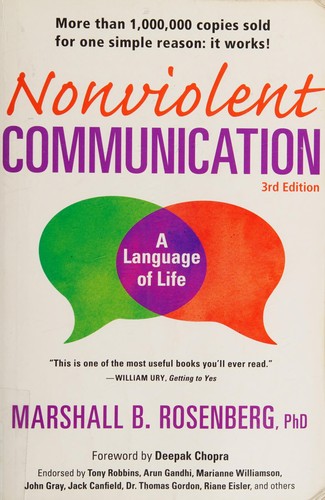
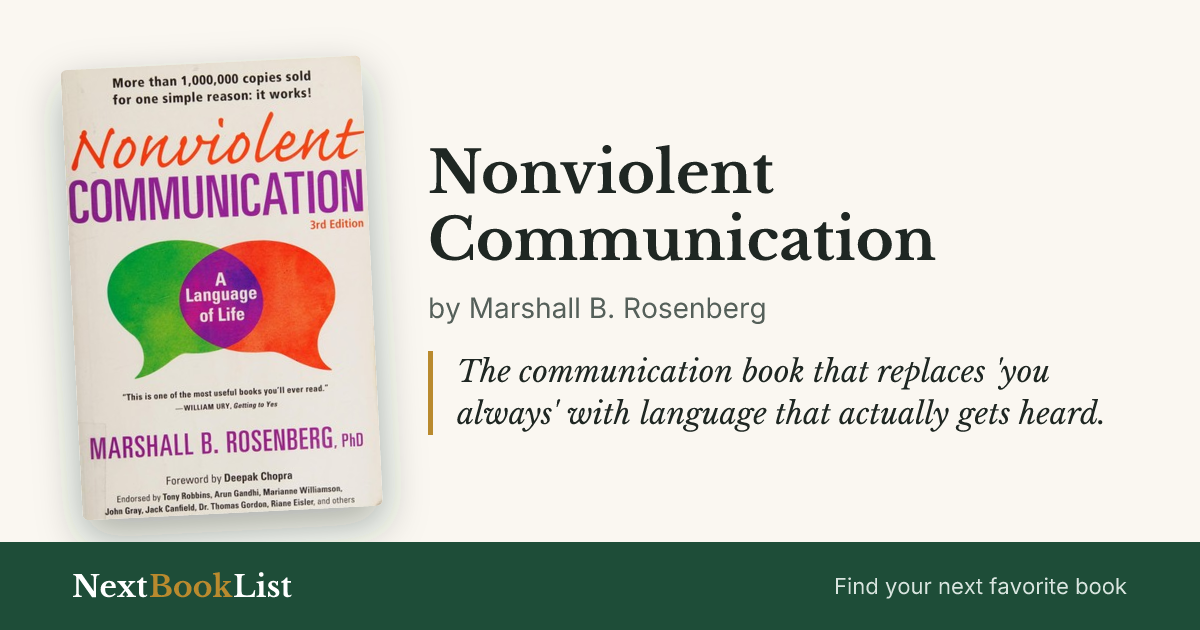
Nonviolent Communication
by Marshall B. Rosenberg · 1999
The communication book that replaces 'you always' with language that actually gets heard.
Worth reading? Crucial Conversations and Nonviolent Communication both teach you how to talk when the stakes and emotions are high, but they come from different angles. Crucial Conversations is tactical -- it gives you moves for the exact moment a conversation goes sideways. Rosenberg's book is foundational -- it rebuilds how you notice your own feelings and needs before you open your mouth at all, which makes the tactics from other books actually stick. Skip it if you want something you can apply verbatim tomorrow -- the observation/feeling/need/request structure feels stiff and robotic at first, and it takes real practice before it stops sounding like a script. If you need a fast fix for one specific conversation, a more tactical book will serve you better in the short term.
| Full Title | Nonviolent Communication: A Language of Life |
|---|---|
| Author | Marshall B. Rosenberg |
| Published | 1999 |
| Publisher | PuddleDancer Press |
| Category | Self-Improvement & Psychology |
| Favorite quote | “At the core of all anger is a need that is not being fulfilled.” |
The Verdict
Marshall Rosenberg built an entire communication method on one insight: judgment triggers defense, and defense kills every real conversation before it starts. Nonviolent Communication teaches you to say what actually happened, name what you feel, and ask for what you need – without the accusation baked into the sentence. It sounds stiff on page one and starts working by chapter three.
your conversations keep turning into arguments and you want words that land instead of provoke
you want quick scripts for one conversation -- this is a full framework, and it takes practice to sound natural
Book Summary
Most conflict starts with language that sounds like observation but is actually judgment ("you're always late" instead of "you arrived twenty minutes after we agreed"), and judgment triggers defensiveness before the real issue is even on the table. Rosenberg's core method -- observation, feeling, need, request -- is designed to strip judgment out of the sentence so the other person can actually hear you.
Every criticism and demand is really an unmet need wearing a disguise. When someone lashes out, Rosenberg argues they're expressing pain about a need not being met, however badly they're expressing it, and if you can hear the need underneath the accusation, you stop reacting to the accusation itself.
Comparing yourself to others, and secretly comparing your partner or coworker to some ideal, is one of the most common ways people quietly poison their own relationships. NVC asks you to replace comparison and judgment with clear observation and a specific, doable request -- which turns most arguments into solvable problems instead of character trials.
Top 9 Lessons from Nonviolent Communication
- Separate observation from judgment -- 'you were 20 minutes late' beats 'you're always late.'
- Name the feeling underneath your frustration before you speak.
- Every complaint is an unmet need in disguise -- find the need.
- End requests with a specific, doable action, not a vague complaint.
- Judgmental language triggers defensiveness before your real point lands.
- Comparing people to an ideal quietly poisons relationships over time.
- Anger is a secondary emotion -- there's almost always an unmet need underneath it.
- Demands provoke resistance. Requests invite cooperation.
- You can hear the need in someone's outburst without accepting how they expressed it.
Top 4 Quotes from Nonviolent Communication
"All violence is the result of people tricking themselves into believing that their pain derives from other people and that consequently those people deserve to be punished."
Marshall B. Rosenberg, Nonviolent Communication
"At the core of all anger is a need that is not being fulfilled."
Marshall B. Rosenberg, Nonviolent Communication
"When we combine observation with evaluation, others are apt to hear criticism."
Marshall B. Rosenberg, Nonviolent Communication
"Judgments of others are alienated expressions of our own unmet needs."
Marshall B. Rosenberg, Nonviolent Communication
Frequently Asked Questions
Is Nonviolent Communication worth reading?
Yes, especially if your arguments keep escalating over language rather than substance. It's slower to apply than a tactics book, but it changes the root cause instead of the symptom.
What is the main idea of Nonviolent Communication?
Most conflict comes from judgment disguised as observation. Rosenberg's method -- state the observation, name the feeling, identify the need, make a specific request -- strips out the judgment so people can actually hear each other.
Does Nonviolent Communication feel unnatural at first?
Yes, most readers say the structure sounds stiff and robotic in early practice. It takes real repetition before it stops sounding like a script and starts sounding like you.
Who should read Nonviolent Communication?
Anyone whose disagreements keep turning personal -- with a partner, a coworker, or a kid. Skip it if you need a fast script for tomorrow's conversation instead of a long-term communication rebuild.
Ready to read it?
Get Nonviolent Communication on Amazon