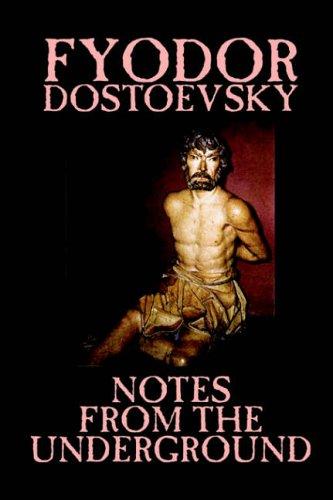
Notes from Underground
by Fyodor Dostoevsky · 1864
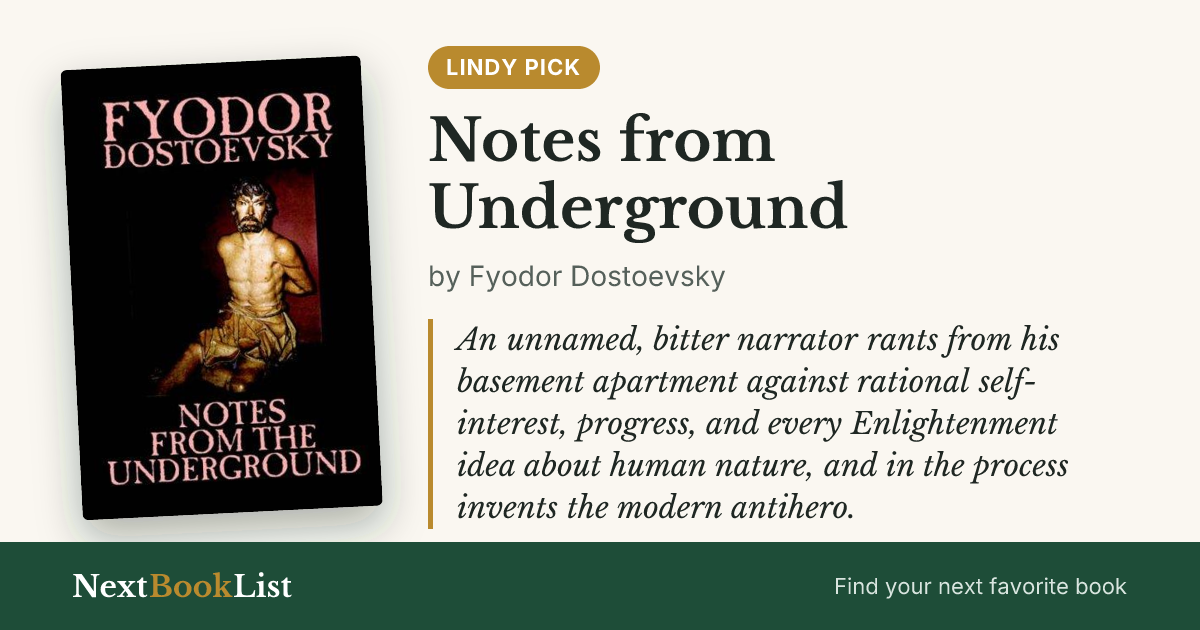
An unnamed, bitter narrator rants from his basement apartment against rational self-interest, progress, and every Enlightenment idea about human nature, and in the process invents the modern antihero.
Worth reading? Notes from Underground is short, mean, and more relevant to modern life than a book this old has any right to be. The Underground Man's rant against rational self-interest and human 'progress' reads like it's arguing with 21st-century optimization culture a century and a half early. It's uncomfortable to read because it's designed to be -- this narrator doesn't want your sympathy, he wants to prove you can't fully trust anyone's self-account, including his own.
| Full Title | Notes from Underground |
|---|---|
| Author | Fyodor Dostoevsky |
| Published | 1864 |
| Publisher | Vintage Classics |
| Category | Fiction |
| Favorite quote | “I am a sick man. I am a spiteful man. I am an unattractive man.” |
The Verdict
This is the fast way into Dostoevsky. Under 150 pages, and it hits harder than books four times its length because there’s no plot padding between you and the argument.
The Underground Man is genuinely unpleasant company, and that’s the point – he’s not a hero, he’s a warning about what happens when self-awareness curdles into permanent spite instead of change. Watching him wreck his one real shot at connection with Liza is uncomfortable in exactly the way Dostoevsky wanted.
Read it if you want to know fast whether Dostoevsky’s voice works for you. Skip it if you need to root for your narrator – this one’s built to be resisted, not liked.
you want the shortest, most concentrated dose of Dostoevsky's ideas, delivered by one of literature's first truly unreliable, self-sabotaging narrators
you need a sympathetic protagonist -- the Underground Man is petty, spiteful, and designed to be unpleasant company on purpose
Book Summary
Part one is a philosophical rant: the Underground Man attacks the Enlightenment idea that humans, if given enough rational self-interest, will naturally choose what's good for them. He argues people will deliberately choose self-destruction and irrationality just to prove they have free will, because being predictable, even predictably happy, feels like a cage.
Part two dramatizes the philosophy through a series of humiliating social episodes -- a dinner party he wasn't really invited to, an encounter with a prostitute named Liza he cruelly rejects after she offers him real connection -- showing the theory in action: given the chance at something good, the Underground Man sabotages it.
Dostoevsky is credited with essentially inventing the modern antihero here: a narrator who's self-aware about his own pettiness and spite but incapable of escaping it, closer to a case study than a role model.
The book is a direct rebuttal to utopian socialist novels of the era (particularly Chernyshevsky's What Is to Be Done?) that assumed rational planning could perfect society -- the Underground Man exists to argue that human contrariness will always wreck the blueprint.
Top 7 Lessons from Notes from Underground
- The core argument: people will act against their own rational self-interest just to prove they're free agents, not predictable machines -- an early rebuttal to any theory of human behavior built purely on rational self-interest.
- The Underground Man's self-awareness doesn't free him from his pettiness -- knowing you're being spiteful doesn't stop the spite, a genuinely dark observation about self-knowledge's limits.
- The Liza episode dramatizes how shame can curdle into cruelty -- offered real intimacy, the narrator destroys it rather than risk being vulnerable.
- The novel is a direct argument against 19th-century utopian rationalism, the idea that a perfectly planned society could eliminate human suffering through logic alone.
- Isolation ('the underground') is presented as both the narrator's prison and his only source of intellectual honesty -- he sees society's hypocrisies clearly precisely because he's outside it.
- This book essentially originates the modern literary antihero -- a narrator you're not meant to like or trust, but can't look away from.
- The unreliable narration itself is the argument: he keeps undercutting his own claims, forcing you to read past what he says to what he's actually doing.
Top 5 Quotes from Notes from Underground
"I am a sick man. I am a spiteful man. I am an unattractive man."
Fyodor Dostoevsky, Notes from Underground
"Man is sometimes extraordinarily, passionately, in love with suffering."
Fyodor Dostoevsky, Notes from Underground
"To be too conscious is an illness -- a real thoroughgoing illness."
Fyodor Dostoevsky, Notes from Underground
"Twice two makes four is no longer life, gentlemen, but is the beginning of death."
Fyodor Dostoevsky, Notes from Underground
"I say let the whole world go to pieces, so long as I always get my tea."
Fyodor Dostoevsky, Notes from Underground
Frequently Asked Questions
Is Notes from Underground worth reading?
Yes -- it's short, sharp, and arguably the best entry point into Dostoevsky's ideas if you don't want to commit to an 800-page novel first.
What is Notes from Underground about?
An unnamed, bitter narrator argues that people will deliberately act irrationally to prove they have free will, then proves it by sabotaging his own chances at connection.
Is Notes from Underground a good starting point for Dostoevsky?
Yes -- at around 130 pages it's a fast way to find out if his style and ideas work for you before committing to Crime and Punishment or The Brothers Karamazov.
Why is the narrator unlikeable?
On purpose -- Dostoevsky is using him as a case study in self-aware self-sabotage, not a character meant to earn your sympathy.
Is Notes from Underground considered an existentialist novel?
It's widely read as a precursor to existentialism, influencing later writers like Camus and Sartre even though it predates the formal movement.
Ready to read it?
Get Notes from Underground on Amazon