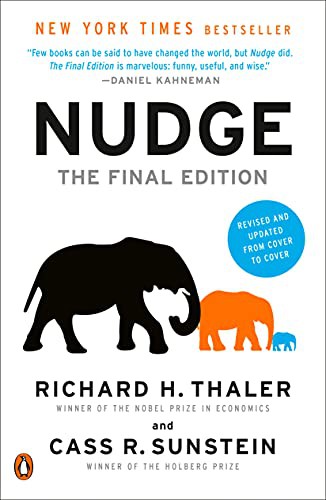
Nudge
by Richard H. Thaler & Cass R. Sunstein · 2008
The Nobel laureate who proved you're not a rational calculator, showing how the design of a choice quietly decides the outcome before you ever weigh in.
Worth reading? Nudge's core move is showing that there's no such thing as a neutral way to present a choice -- someone designs the default, the order, the framing, whether they mean to or not, and that design measurably changes what people pick. Thaler and Sunstein's 'libertarian paternalism' argument (nudge toward better outcomes while preserving the freedom to choose otherwise) shaped default-enrollment retirement plans and organ donation policy alike. It's less technical than Thinking, Fast and Slow, aimed at showing you how to design better choices, not just recognize your own biases.
| Full Title | Nudge: Improving Decisions About Health, Wealth, and Happiness |
|---|---|
| Author | Richard H. Thaler & Cass R. Sunstein |
| Published | 2008 |
| Category | Business & Money |
| Favorite quote | “A nudge is any aspect of the choice architecture that alters people's behavior in a predictable way without forbidding any options.” |
The Verdict
Thaler won a Nobel Prize largely for the research this book popularizes, and the “choice architecture” framing has since become standard vocabulary in policy, product design, and personal finance alike. Read it to recognize the defaults already steering your own decisions, then decide which ones actually deserve to keep steering you.
you want the popular, foundational case for how defaults and choice design shape financial and health decisions -- including your own
you've already read Misbehaving or other behavioral economics -- Nudge is the accessible entry point, not the deepest treatment of the underlying research
Book Summary
Every choice is presented within some "choice architecture" -- an order, a default, a framing -- and that architecture isn't neutral, it measurably steers outcomes even though all the original options remain technically available. The classic example is retirement savings: switching a 401(k) from opt-in to opt-out (automatic enrollment, with the option to leave) dramatically increases participation, without removing anyone's choice to not participate.
Thaler and Sunstein's answer to this unavoidable influence is "libertarian paternalism": designers of choices (employers, governments, product makers) should set defaults toward what most people would choose if they thought it through carefully, while keeping the exit easy for people who genuinely want something different -- influence without coercion.
Top 7 Lessons from Nudge
- Every choice has a design (order, framing, default) that isn't neutral, whether or not the designer intended it.
- Defaults matter hugely -- most people stick with whatever is preset, even when opting out costs nothing.
- A 'nudge' changes behavior while preserving every option -- it's influence, not restriction.
- Automatic enrollment (opt-out instead of opt-in) dramatically increases participation in savings and benefit programs.
- Libertarian paternalism: design defaults toward better outcomes while keeping the exit easy for anyone who wants something different.
- Inertia and loss aversion mean people rarely change from a bad default even when change is costless.
- Reframing a choice (opt-in vs. opt-out, gain vs. loss) can shift population-level behavior more than financial incentives.
Top 4 Quotes from Nudge
"A nudge is any aspect of the choice architecture that alters people's behavior in a predictable way without forbidding any options."
Richard H. Thaler & Cass R. Sunstein, Nudge
"If you think there is no such thing as 'pure' unbiased choice architecture, then libertarian paternalism is nothing more than an accurate description of reality."
Richard H. Thaler & Cass R. Sunstein, Nudge
"Everything matters."
Richard H. Thaler & Cass R. Sunstein, Nudge
"To design a good choice architecture, keep in mind that people are Humans, not Econs."
Richard H. Thaler & Cass R. Sunstein, Nudge
Frequently Asked Questions
Is Nudge worth reading?
Yes, especially as an entry point into behavioral economics for investors, policymakers, and anyone designing choices for others. It's more accessible than Thaler's later, denser work.
What is the main idea of Nudge?
No presentation of a choice is neutral -- defaults, framing, and order measurably steer decisions -- and 'libertarian paternalism' argues for designing those defaults toward better outcomes while preserving everyone's freedom to choose otherwise.
What is libertarian paternalism?
Thaler and Sunstein's term for designing defaults and choice architecture to nudge people toward what they'd likely choose if they thought it through carefully, while keeping the option to choose differently easy and freely available.
How does Nudge apply to investing specifically?
The retirement-savings example (automatic 401(k) enrollment dramatically increasing participation) is one of the book's most cited applications, and the broader lesson -- your own investing defaults and habits are shaped by design, not pure rational choice -- applies directly to managing your own behavior.
Ready to read it?
Get Nudge on Amazon