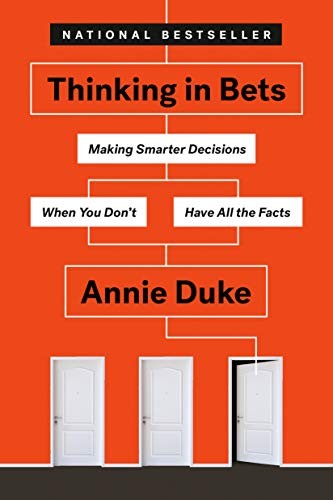
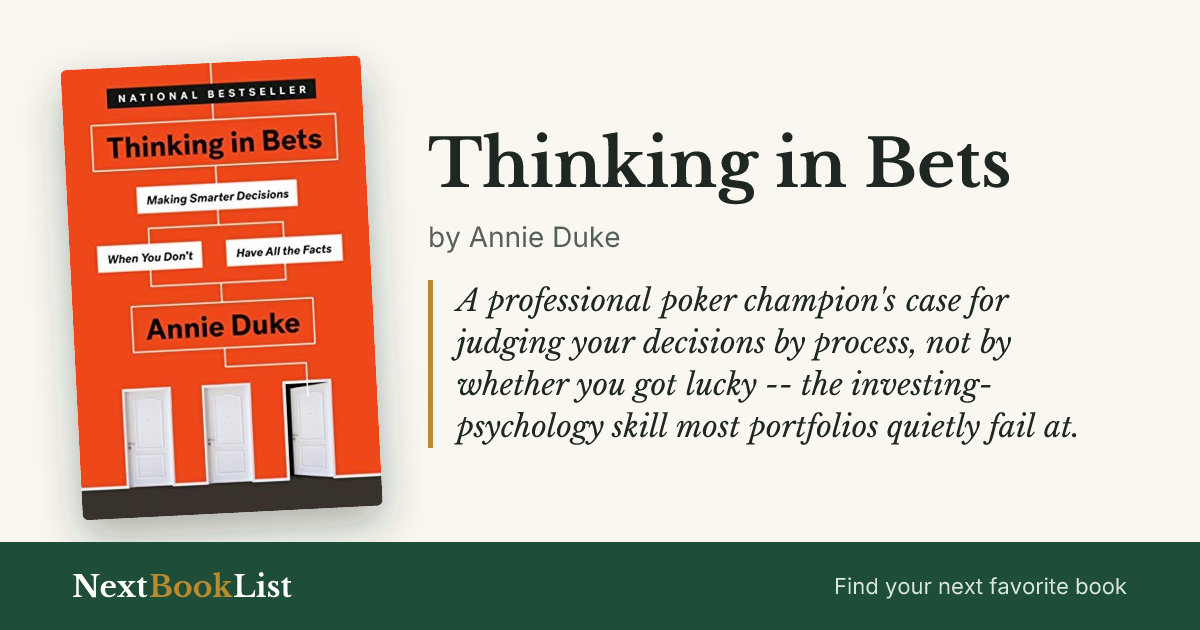
Thinking in Bets
by Annie Duke · 2018
A professional poker champion's case for judging your decisions by process, not by whether you got lucky -- the investing-psychology skill most portfolios quietly fail at.
Worth reading? Duke's core term is 'resulting' -- the habit of judging a decision entirely by its outcome, which trains you to repeat bad decisions that got lucky and abandon good decisions that got unlucky. As a former professional poker player, she's spent a career in a domain where skill and luck are both real and constantly tangled, which gives her reframe -- every decision is a bet made under uncertainty, and the bet can be well-made and still lose -- more teeth than most decision-making books manage. Pair it with Thinking, Fast and Slow for the underlying cognitive research, or Fooled by Randomness for Taleb's harder-edged version of the same warning.
| Full Title | Thinking in Bets: Making Smarter Decisions When You Don't Have All the Facts |
|---|---|
| Author | Annie Duke |
| Published | 2018 |
| Category | Business & Money |
| Favorite quote | “Living life is like playing a game of incomplete information... Poker teaches that decisions are bets on the future, and outcomes don't objectively define the quality of those bets.” |
The Verdict
Duke’s poker background is the book’s real asset – few professions force you to confront the gap between a good decision and a good outcome as constantly and expensively as tournament poker does. The “resulting” trap is easy to nod along to and hard to actually stop doing; this book gives you the specific vocabulary to catch yourself in the act.
you keep judging your investing or business calls by outcome alone -- praising a lucky win, beating yourself up over an unlucky loss with a sound process
you already separate decision quality from outcome quality instinctively -- that reframe is the entire book, and once it clicks you don't need the full treatment
Book Summary
"Resulting" is Duke's term for the common mistake of judging a decision's quality entirely by whether it worked out, when in reality most outcomes are a mix of decision quality and luck -- a good decision can still lose, and a bad decision can still win, especially over a single instance. Separating "was this a good decision" from "did this decision work" is the skill the book is built around.
She also pushes hard toward thinking in probabilities rather than certainties: instead of stating a belief as flatly true or false, assign it a rough confidence level, which forces you to notice how uncertain you actually are and makes you more receptive to evidence that should update that confidence. Treating your own beliefs as bets you'd be willing to stake something on is her practical test for whether you actually believe something or just habitually assert it.
Top 7 Lessons from Thinking in Bets
- Separate decision quality from outcome quality -- a good decision can still lose, a bad one can still win.
- 'Resulting': judging a decision purely by its outcome trains you to repeat lucky mistakes and abandon unlucky good calls.
- State beliefs as probabilities, not certainties, to notice how confident you actually are.
- Treat your beliefs as bets you'd genuinely stake something on -- it's a fast test of real conviction versus habit.
- Actively seek disconfirming evidence instead of only evidence that supports what you already believe.
- Practice saying 'I'm not sure' out loud -- it's a discipline, not a weakness, and it improves the quality of group decisions.
- Reframe losses from a sound process as the cost of playing the game, not proof the process was wrong.
Top 2 Quotes from Thinking in Bets
"Living life is like playing a game of incomplete information... Poker teaches that decisions are bets on the future, and outcomes don't objectively define the quality of those bets."
Annie Duke, Thinking in Bets
"Wanna bet? Those three words push us to engage in a deeper way with the belief, gauging our confidence."
Annie Duke, Thinking in Bets
Frequently Asked Questions
Is Thinking in Bets worth reading?
Yes, especially if you catch yourself judging investing or business decisions purely by outcome -- praising a lucky win or over-punishing an unlucky loss made with a sound process.
What is 'resulting' in Thinking in Bets?
Annie Duke's term for judging a decision's quality entirely by its outcome, ignoring the role luck played -- a habit that trains you to repeat lucky bad decisions and abandon unlucky good ones.
Who is Annie Duke?
A former professional poker player who won a World Series of Poker bracelet, now writing and consulting on decision-making under uncertainty, drawing directly on the skill of separating decision quality from outcome in poker.
How is this different from Thinking, Fast and Slow?
Thinking, Fast and Slow is the broader cognitive-bias research (Kahneman's Nobel-winning work). Thinking in Bets is narrower and more practical, focused specifically on separating decision quality from outcome quality using a poker-honed framework.
Ready to read it?
Get Thinking in Bets on Amazon