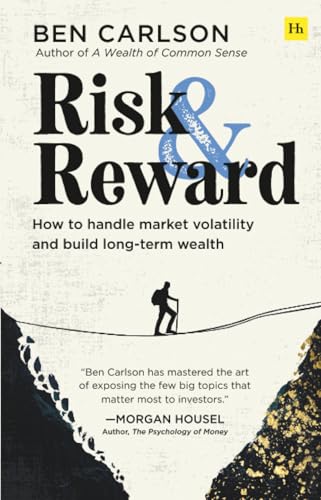
Risk and Reward
by Ben Carlson · 2024
Carlson's case for staying invested through volatility instead of trying to time the next crash.
Worth reading? Carlson's angle is behavioral, not technical: volatility is the price of admission for long-term returns, and most investors destroy their own results by reacting to it emotionally rather than accepting it as normal. It's a companion to his broader body of work on index investing and market history, aimed squarely at the investor whose actual enemy is their own reaction to a bad month. Skip it if drawdowns don't rattle you, you've already internalized the lesson.
| Full Title | Risk & Reward: How to Handle Market Volatility and Build Long-Term Wealth |
|---|---|
| Author | Ben Carlson |
| Published | 2024 |
| Category | Business & Money |
| Favorite quote | “Risk and reward are attached at the hip.” |
The Verdict
Carlson’s angle is behavioral, not technical: volatility is the price of admission for long-term returns, and most investors destroy their own results by reacting to it emotionally rather than accepting it as normal. It’s aimed squarely at the investor whose actual enemy is their own reaction to a bad month. Skip it if drawdowns don’t rattle you, you’ve already internalized the lesson.
investors who panic-sell during downturns and need a behavioral reset
you're already unbothered by drawdowns and just want asset-allocation specifics
Book Summary
Carlson's case for staying invested through volatility instead of trying to time the next crash. It earns its place by targeting the behavior gap that costs investors more than any single asset-allocation decision. Volatility is the toll you pay for long-term equity returns, not a signal to exit. Trying to time market drops usually costs more than riding them out. The practical move is to read it once, then act on the one idea that maps to your current bottleneck, rereading the whole thing rarely adds more than executing the part you skipped.
Top 7 Lessons from Risk and Reward
- Volatility is the toll you pay for long-term equity returns, not a signal to exit.
- Trying to time market drops usually costs more than riding them out.
- Your own behavior during downturns is a bigger risk to your returns than the downturn itself.
- Diversification reduces regret, even when it reduces peak returns.
- A written investment plan matters most in the moment you're most tempted to abandon it.
- Market history shows drawdowns are frequent and recoveries, while unpredictable in timing, are also frequent.
- Comparing your portfolio to others in real time usually leads to worse decisions, not better ones.
Top 4 Quotes from Risk and Reward
"Risk and reward are attached at the hip."
Ben Carlson, Risk and Reward
"Every investment decision you make involves trade-offs."
Ben Carlson, Risk and Reward
"I wrote this book to remind you that the long-term rewards makes the uncomfortable short-term risks worth it in the end."
Ben Carlson, Risk and Reward
"The book covers the two most important variables every investor must consider: 1. Your risk profile. 2. Your time horizon."
Ben Carlson, Risk and Reward
Frequently Asked Questions
Is Risk and Reward worth reading?
Yes, if the description fits you, investors who panic-sell during downturns and need a behavioral reset. Skip it if you're already unbothered by drawdowns and just want asset-allocation specifics.
What is the main idea of Risk and Reward?
Carlson argues that volatility is the unavoidable toll for long-term equity returns, and that investors who try to time it out usually cost themselves more than the volatility itself would have.
Who should read Risk and Reward?
Investors who panic-sell during downturns and need a behavioral reset. Skip it if drawdowns don't rattle you, you've already internalized the lesson.
What will you get out of Risk and Reward?
A clearer, opinionated take you can act on, plus the sharpest lessons pulled into a short list so you don't have to read the whole book to decide.
Ready to read it?
Get Risk and Reward on Amazon