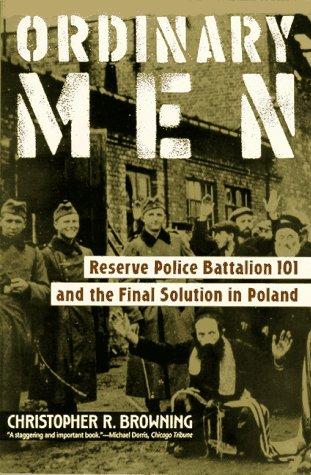
Ordinary Men
by Christopher R. Browning · 1992
A historian uses surviving trial testimony to show how a battalion of middle-aged German reservists, not fanatics, became mass murderers, and what that says about all of us.
Worth reading? Browning built this book from postwar interrogation transcripts of surviving members of Reserve Police Battalion 101, middle-aged German reservists, not committed Nazis, who were given the choice to opt out of killing Jewish civilians and mostly didn't. His finding, that only a small minority refused while most complied out of conformity, deference to authority, and peer pressure rather than ideological conviction, remains one of the most cited pieces of evidence in the psychology of atrocity. Read it as the rigorous historical companion to Milgram and Zimbardo's lab experiments. Skip it only if the subject matter itself is more than you can sit with right now.
| Full Title | Ordinary Men: Reserve Police Battalion 101 and the Final Solution in Poland |
|---|---|
| Author | Christopher R. Browning |
| Published | 1992 |
| Category | History |
| Favorite quote | “If the men of Reserve Police Battalion 101 could become killers under such circumstances, what group of men cannot?” |
The Verdict
This isn’t an easy book, and it shouldn’t be. Browning built his argument from actual postwar testimony, not theory, and the uncomfortable finding, that permission to refuse didn’t stop most men from participating, is exactly why the book still gets assigned in psychology and history courses decades later.
readers who want the most rigorous historical answer to how ordinary people commit atrocity
the subject matter, sustained detail on mass killing, is genuinely difficult reading

Book Summary
Browning's central finding, drawn from actual trial testimony rather than theory, is that the men of Battalion 101 were explicitly told they could refuse to participate in mass shootings without punishment, and the overwhelming majority still complied. Only about 10 to 20 percent consistently refused or found ways to avoid direct killing.
His explanation isn't ideological fanaticism, it's conformity to the group, deference to perceived authority, and the psychological difficulty of being the one who stands apart from your unit, echoing (and predating academic knowledge of) Milgram's obedience experiments and Zimbardo's Stanford Prison Experiment, but grounded in real historical atrocity rather than a lab.
Top 7 Lessons from Ordinary Men
- When given explicit permission to opt out of atrocity, most people in Browning's study still didn't.
- Conformity to the group predicted compliance better than ideological conviction did.
- Being the one who stands apart from your unit carries real psychological cost, which shaped who refused.
- Perceived authority doesn't need to be absolute or coercive to produce compliance, deference alone is often enough.
- The men who refused weren't uniformly braver, some found situational ways to avoid direct participation without formally objecting.
- Historical, documented atrocity confirms lab findings (Milgram, Zimbardo) about obedience under real, not simulated, stakes.
- Calling perpetrators 'monsters' can be a way of avoiding the harder, more uncomfortable question of what ordinary circumstances produce.
Top 1 Quotes from Ordinary Men
"If the men of Reserve Police Battalion 101 could become killers under such circumstances, what group of men cannot?"
Christopher R. Browning, Ordinary Men
Frequently Asked Questions
Is Ordinary Men worth reading?
Yes, it's one of the most rigorously documented historical answers to how ordinary people, not fanatics, participate in mass atrocity, built directly from trial testimony.
What is Ordinary Men about?
Historian Christopher Browning's account of Reserve Police Battalion 101, middle-aged German reservists who were given the option to refuse participation in mass shootings of Jewish civilians during the Holocaust, and mostly didn't.
How does Ordinary Men relate to the Milgram experiment?
Browning's findings echo Stanley Milgram's obedience research, conformity and deference to authority predicted compliance better than ideology, but Ordinary Men is grounded in real historical atrocity and trial testimony rather than a laboratory simulation.
Ready to read it?
Get Ordinary Men on Amazon