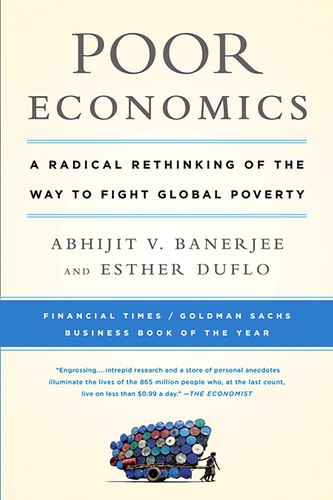
Poor Economics
by Abhijit V. Banerjee & Esther Duflo · 2011
Forget the big theories -- Banerjee and Duflo tested what actually helps poor people, one randomized experiment at a time.
Worth reading? Poor Economics is the anti-Jeffrey-Sachs book, even though it never quite says so directly. Sachs-style development economics argues for big, coordinated aid pushes to break poverty traps at a macro level. Banerjee and Duflo argue the opposite instinct: stop guessing at the top and test specific interventions -- deworming pills, bed nets, micro-loans, teacher incentives -- the way a doctor tests a drug, with randomized trials. Their answer is almost always "it's more complicated and more specific than either side of the aid debate wants to admit." Worth reading if you want to understand why so many well-intentioned anti-poverty programs fail for reasons that have nothing to do with corruption or laziness. Skip it if you want ideology confirmed rather than complicated -- this book is allergic to grand theories, including the free-market one and the big-aid one.
| Full Title | Poor Economics: A Radical Rethinking of the Way to Fight Global Poverty |
|---|---|
| Author | Abhijit V. Banerjee & Esther Duflo |
| Published | 2011 |
| Category | Business & Money |
| Favorite quote | “The poor are no less rational than anyone else -- quite the opposite.” |
The Verdict
Banerjee and Duflo later won the Nobel Prize in part for the research method this book popularizes: treat anti-poverty programs like clinical trials, not political statements. The book is patient and detailed rather than punchy, but that’s the point – it earns its conclusions instead of asserting them.
you want evidence for what actually reduces poverty instead of another ideological argument about aid
you want a grand unified theory of why poverty exists -- this book deliberately refuses to give you one
Book Summary
The biggest fights in development economics -- does aid help or hurt, do markets or governments solve poverty -- are mostly unanswerable at the scale they're usually argued. Banerjee and Duflo's response is to stop arguing at 30,000 feet and instead run randomized controlled trials on specific interventions: does a free bed net get used more than a subsidized one, does paying teachers for attendance improve learning, does a nudge to save more actually change behavior. The answers are often surprising and rarely fit either side's preferred narrative.
A recurring finding is that poor people aren't making irrational choices -- they're making locally rational choices under constraints (bad information, no insurance, unreliable institutions) that people with more resources don't face. A farmer who doesn't buy fertilizer that would pay for itself isn't ignorant; he's often responding correctly to genuine uncertainty about rain, credit, and whether the fertilizer sold to him is even real.
Small design details in a program -- whether a vaccine comes with a bag of lentils as a nudge, whether a loan is due weekly or monthly, whether a subsidy requires a form -- change outcomes more than the big ideological framing of the program does. The book's real argument is that fighting poverty is a problem of a thousand specific, testable design choices, not one grand policy lever.
Top 10 Lessons from Poor Economics
- Test specific anti-poverty interventions with randomized trials instead of guessing from theory.
- Poor people usually make locally rational choices under real constraints, not irrational ones.
- Bad information and no insurance explain more 'bad' decisions than laziness does.
- Small design details in a program often matter more than its big ideological framing.
- Free isn't always better than subsidized -- test which price point actually gets used.
- A nudge (like a bag of lentils with a vaccine) can outperform a lecture about health.
- Aid and free markets both fail when applied as one-size-fits-all answers.
- Micro-loans help some households and trap others -- the effect depends on design, not ideology.
- Teachers and health workers respond to incentives just like everyone else does.
- Grand theories about why poverty exists are less useful than testable local fixes.
Top 5 Quotes from Poor Economics
"The poor are no less rational than anyone else -- quite the opposite."
Abhijit V. Banerjee & Esther Duflo, Poor Economics
"There is always some cheap pleasant thing to tempt you."
Abhijit V. Banerjee & Esther Duflo, Poor Economics
"Poverty is not just a lack of money; it is not having the capability to realize one's full potential as a human being."
Abhijit V. Banerjee & Esther Duflo, Poor Economics
"The curriculum and organization of schools often date back to a colonial past, when schools were meant to train a local elite to be the effective allies of the colonial state."
Abhijit V. Banerjee & Esther Duflo, Poor Economics
"If we resist the kind of lazy, formulaic thinking that reduces every problem to the same set of general principles; if we listen to poor people themselves and force ourselves to understand the logic of their choices; if we accept the possibility of error and subject every idea to rigorous empirical testing, then we will be able to construct a toolbox of effective policies."
Abhijit V. Banerjee & Esther Duflo, Poor Economics
Frequently Asked Questions
Is Poor Economics worth reading?
Yes if you want evidence-based answers about what actually fights poverty instead of another ideological aid debate. It's dense in places but the payoff is real.
What is the main idea of Poor Economics?
Fighting global poverty is a problem of testing specific, well-designed interventions -- not choosing between big aid and free markets as competing grand theories.
Is Poor Economics the same book as Good Economics for Hard Times?
No. Poor Economics focuses specifically on global poverty. Good Economics for Hard Times, by the same authors, broadens the lens to trade, immigration, inequality, and growth in rich and poor countries alike.
Who should read Poor Economics?
Anyone who wants a rigorous, humble, evidence-based look at global poverty instead of a polarized aid-versus-markets argument.
Ready to read it?
Get Poor Economics on Amazon