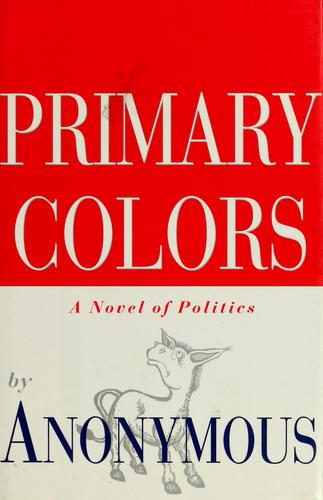
Primary Colors
by Anonymous (Joe Klein) · 1996
A thinly veiled Bill Clinton campaign novel, published anonymously, that got Washington obsessed with guessing who wrote it -- and turned out to be a journalist who'd covered the real campaign up close.
Worth reading? Primary Colors works as both a novel and a stunt. The anonymous authorship, revealed to be journalist Joe Klein after months of public speculation, was itself part of the book's appeal, but the novel holds up independent of that mystery because it captures campaign life, the compromises, the charisma, the exhaustion, with more specificity than a typical political thriller manages.
| Full Title | Primary Colors: A Novel of Politics |
|---|---|
| Author | Anonymous (Joe Klein) |
| Published | 1996 |
| Publisher | Random House |
| Category | Fiction |
| Favorite quote | “Cynicism is what passes for insight among the mediocre.” |
The Verdict
Klein’s insider knowledge is the book’s real asset. The campaign-trail details, the exhaustion, the spin sessions, the way staffers rationalize a candidate’s worst behavior in service of his best qualities, read like they came from someone who’d actually lived it, because they did.
The anonymous publication stunt mostly worked as marketing, but it also served the material: writing from behind a pseudonym let Klein land harder punches at a sitting president’s campaign than a byline might have allowed.
Read it if you want a sharply observed, morally uncomfortable novel about what it takes to work for a talented, deeply flawed political candidate. Skip it if you want the satire explained for readers without much memory of the 1992 Clinton campaign it’s modeled on.
you want a sharp, cynical inside-baseball novel about a charismatic presidential candidate's campaign, written by someone who clearly covered a real one
you want the roman a clef angle explained -- the novel assumes some familiarity with 1992 Clinton-campaign details that have faded from public memory since
Book Summary
The novel follows Henry Burton, a young Black campaign staffer, joining the presidential campaign of Governor Jack Stanton, a charismatic, undisciplined Southern politician whose personal recklessness (infidelity, a possible past scandal) constantly threatens to derail a campaign built on genuine political talent and empathy.
Klein, writing from real experience covering the 1992 Clinton campaign as a journalist, uses Henry's outsider-becoming-insider perspective to show how a campaign operation manages, spins, and sometimes buries a candidate's personal scandals while trying to preserve the genuine political appeal underneath them.
The book's central tension is moral: Henry, and by extension the reader, has to decide whether Stanton's real gifts, his empathy, his political skill, his connection with voters, justify working for and protecting a deeply flawed, sometimes dishonest man, a question the novel doesn't resolve neatly.
Top 9 Lessons from Primary Colors
- Campaign staffers often face a choice between their personal ethics and loyalty to a candidate whose talent and worse behavior are inseparable, a tension the book refuses to resolve cleanly.
- Political charisma and genuine policy talent can coexist with serious personal recklessness in the same candidate, complicating simple hero-or-villain narratives about political figures.
- Campaign operations dedicate enormous energy to managing and containing scandal, sometimes more than they spend on policy, a dynamic Klein depicts from an insider's close observation.
- Henry's arc from idealistic outsider to compromised insider mirrors a common trajectory for people who go to work for a cause or candidate they initially admire without reservation.
- The novel's roman a clef structure, closely mirroring real 1992 campaign events while fictionalizing names and specifics, let Klein say things about the Clinton campaign that a straight journalistic account might not have allowed.
- Loyalty within a campaign is often less about ideology than about personal relationships and shared exhaustion built during the grind of the trail, which the book depicts as its own kind of bond.
- Stanton's genuine empathy and connection with ordinary voters is portrayed as real, not manufactured, even alongside his recklessness -- the novel refuses to reduce his talent to mere charisma.
- The press corps' hunt for the next scandal is depicted as its own kind of theater, staffers spend as much energy managing journalists' narratives as they do managing the candidate.
- The novel deliberately withholds a clean verdict on whether Stanton's talent justifies protecting him, leaving that judgment to the reader rather than resolving it through plot.
Top 4 Quotes from Primary Colors
"Cynicism is what passes for insight among the mediocre."
Anonymous (Joe Klein), Primary Colors
"Every saint has a past, every sinner has a future."
Anonymous (Joe Klein), Primary Colors
"Never underestimate the educational power of sheer fucking pain."
Anonymous (Joe Klein), Primary Colors
"Her inability to see my color -- a quality that at first seemed so fetching in her, so exhilarating and optimistic -- ultimately became a statement I could not accept: that my color wasn't important."
Anonymous (Joe Klein), Primary Colors
Frequently Asked Questions
Is Primary Colors worth reading?
Yes, especially for readers interested in campaign politics -- it's a sharply observed insider novel, though some of its 1992-specific references have faded for readers unfamiliar with that campaign.
Who wrote Primary Colors?
It was published anonymously in 1996 and later revealed to be journalist Joe Klein, who had covered the 1992 Clinton presidential campaign.
Is Primary Colors based on a true story?
It's fiction, but it closely mirrors real events and figures from Bill Clinton's 1992 campaign, making it a roman a clef rather than pure invention.
Was Primary Colors made into a movie?
Yes -- a 1998 film adaptation starred John Travolta as Governor Jack Stanton and Emma Thompson as his wife.
Ready to read it?
Get Primary Colors on Amazon