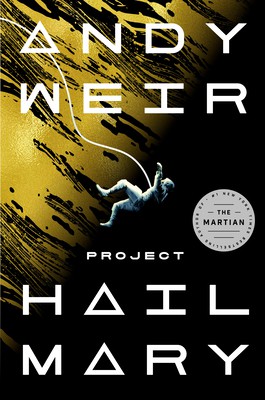
Project Hail Mary
by Andy Weir · 2021
A lone astronaut wakes up alone on a spaceship with amnesia, tasked with saving humanity from an extinction-level threat -- and slowly remembers he's not as alone out there as he thought.
Worth reading? The best hard sci-fi puzzle box in years, and the alien friendship at its center is what elevates it past The Martian.
| Author | Andy Weir |
|---|---|
| Published | 2021 |
| Publisher | Ballantine Books |
| Category | Fiction |
| Favorite quote | “Evolution can be insanely effective when you leave it alone for a few billion years.” |
The Verdict
The amnesia setup is doing real structural work here, not just mystery-box padding – it lets Weir dole out the stakes of the mission at the same pace the reader needs them, while the present-tense chapters keep moving on pure problem-solving momentum. That’s the same trick that made The Martian work, just applied to a bigger canvas.
What pushes this past The Martian is Rocky. A human stuck alone with math problems is compelling for a while; a human and an alien slowly building a working friendship out of trial, error, and genuine curiosity about each other is a different level of book, and it’s the reason people who don’t even like hard sci-fi end up loving this one.
Skip it if you want literary prose – Weir’s sentences are functional, heavy on internet-generation banter, and not built for quotability. Read it if you want a science puzzle box with an emotional core that actually earns its ending, which is rarer in this genre than it should be.
you want hard science fiction that explains its own physics and chemistry in a way that's genuinely fun to follow, with a central friendship that carries the emotional weight of the whole book
you want literary prose or emotional subtlety -- Weir writes for problem-solving momentum and a very online sense of humor, not lyrical sentences
Book Summary
Ryland Grace wakes up on a spacecraft with no memory of who he is or why he's there, alone except for two dead crewmates, and has to reconstruct his own mission through deduction alone -- Earth is facing an extinction-level threat from a microbe consuming the sun's energy, and he's humanity's last, one-way shot at a solution. The book alternates between his present-tense problem-solving in space and flashbacks that slowly restore his memory of how he ended up drafted into the mission at all.
Weir's real strength, as in The Martian, is making competence itself the entertainment -- every chapter is essentially a puzzle Grace has to solve with real chemistry, physics, and engineering, and the book trusts you to follow the reasoning rather than hand-waving past it. What elevates it past being just a smarter Martian is Rocky, an alien engineer Grace eventually encounters, whose halting communication and genuine partnership becomes the emotional core of the book.
The friendship between a scared human and an alien who processes the world through solid-state chemistry becomes the novel's real argument: that cooperation between two entirely different forms of life is possible, and might be the thing that saves both their species.
Top 8 Lessons from Project Hail Mary
- Grace's amnesia isn't a gimmick, it forces the reader to reconstruct the mission's stakes at the same pace he does, so the scope of the crisis lands as a series of discoveries rather than an opening info-dump.
- Competence under pressure, built moment to moment through trial and error, is treated as more interesting and more human than confident expertise -- Grace fails constantly before he succeeds.
- The friendship with Rocky works because neither character needs to fully understand the other's biology or culture to trust them -- competence and consistency earn the trust that shared background can't.
- Communication across a genuine gap (species, language, sensory experience) is shown as slow, effortful, and worth it, rather than a problem solved by a single clever translation trick.
- Grace's backstory reveals he avoided real stakes for most of his adult life, and the mission forces him into exactly the kind of consequential choice he'd spent years dodging.
- Isolation doesn't have to be the same as loneliness -- once Rocky is on board, the vastness of space stops being the story's core threat and becomes just the setting for it.
- Sacrifice in the book is never framed as noble suffering, it's framed as the logical extension of caring about someone else's survival as much as your own.
- The novel's optimism is deliberate -- unlike much first-contact fiction, cooperation, not conflict, is the default assumption once two intelligent species actually start talking.
Top 4 Quotes from Project Hail Mary
"Evolution can be insanely effective when you leave it alone for a few billion years."
Andy Weir, Project Hail Mary
"There's no Eureka moment. Just a slow, steady progression toward a goal."
Andy Weir, Project Hail Mary
"'You and me are good people,' Rocky says. 'Yeah.' I smile. 'I suppose we are.'"
Andy Weir, Project Hail Mary
"Once again I'm struck by melancholy. I want to spend the rest of my life studying Eridian biology! But I have to save humanity first. Stupid humanity. Getting in the way of my hobbies."
Andy Weir, Project Hail Mary
Frequently Asked Questions
Is Project Hail Mary worth reading?
Yes -- it's Andy Weir's best book, built on the same competence-under-pressure engine as The Martian but with a genuinely moving alien friendship at its center.
Do I need to have read The Martian first?
No, it's a standalone story with no connection to The Martian beyond the author and the hard-science approach.
Is Project Hail Mary hard science fiction?
Yes, heavily -- expect real chemistry, physics, and orbital mechanics explained in detail. If that's not your thing, the book leans into it constantly.
Is there a movie based on Project Hail Mary?
Yes, a film adaptation starring Ryan Gosling has been in production following the book's success.
Ready to read it?
Get Project Hail Mary on Amazon