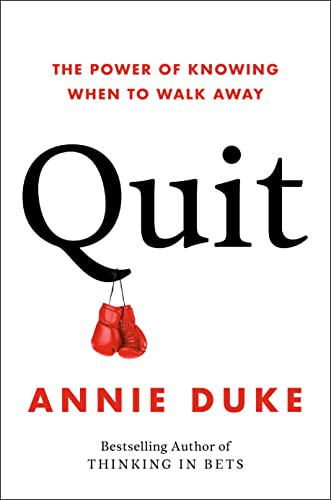
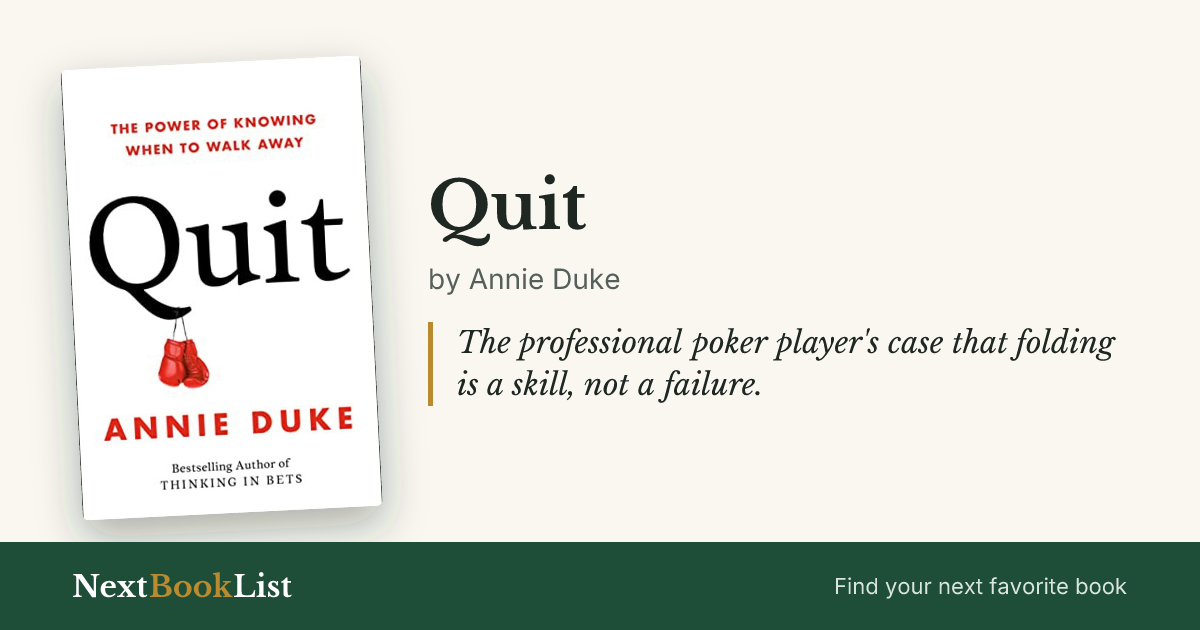
Quit
by Annie Duke · 2022
The professional poker player's case that folding is a skill, not a failure.
Worth reading? Quit is the deliberate counterweight to Grit, and the site needed both. Duckworth made perseverance the default virtue; Duke, a former professional poker player turned decision scientist, argues that quitting on time is the harder and more valuable skill, because sunk cost and identity keep people in bad hands long after the math says fold. It's not an argument against grit -- it's an argument for knowing when grit stops paying off. Read it after Grit, not instead of it.
| Full Title | Quit: The Power of Knowing When to Walk Away |
|---|---|
| Author | Annie Duke |
| Published | 2022 |
| Category | Self-Improvement & Psychology |
| Favorite quote | “Contrary to popular belief, winners quit a lot. That's how they win.” |
The Verdict
Duke’s pitch is simple and mostly right: quitting gets treated as failure when it’s often the correct call, and the reason people miss it is sunk cost plus identity, not bad math. The “kill criterion” idea – deciding your exit conditions before you’re emotionally invested – is the most useful tool in the book and worth stealing on its own.
Read it as the deliberate other half of Grit. Duckworth tells you when to push through. Duke tells you when pushing through is just expensive stubbornness. You need both books to make either one actionable.
anyone deciding whether to walk away from a project, job, or relationship that isn't working
you're looking for another book that tells you to grit your way through everything
Book Summary
Sunk costs are gone whether you quit or not. The money, time, and effort you already spent should never factor into the decision to continue -- only the expected value of what happens next matters.
Grit culture has a survivorship bias problem. We celebrate the people who stuck it out and won, but we don't see the much larger group who stuck it out and lost, because quitters don't get to tell their story on a stage.
Identity makes quitting feel like admitting failure, even when the smart move is obvious to everyone outside your head. Treating "quitter" as a slur is exactly what keeps people trapped in jobs, startups, and relationships past the point of no return.
Set your quitting criteria before you're emotionally invested in the outcome. A "kill criterion" decided in advance, when you're clear-headed, beats a decision made in the middle of the sunk-cost fog.
Top 9 Lessons from Quit
- Sunk costs are gone either way -- don't let them drive the next decision.
- Decide your quitting criteria before you start, while you're still rational.
- Grit culture survivorship-biases you toward stories of people who stuck it out and won.
- A 'quitter' isn't failing -- they're reallocating time and money to something with better expected value.
- Identity ('I'm not a quitter') is one of the strongest forces keeping people in bad situations.
- Ask 'would I start this today, knowing what I know now?' -- if no, quit.
- Waiting for a rock-bottom signal to quit means quitting later than you should have.
- A pre-set kill criterion removes emotion from the decision when it matters most.
- The best poker players aren't the ones who never fold -- they're the ones who fold correctly.
Top 5 Quotes from Quit
"Contrary to popular belief, winners quit a lot. That's how they win."
Annie Duke, Quit
"When it comes to quitting, the most painful thing to quit is who you are."
Annie Duke, Quit
"Quitting is the tool that allows us to react to new information that is revealed after we make a decision."
Annie Duke, Quit
"Quitting on time usually feels like quitting too early, and the usually part is specifically when you're in the losses."
Annie Duke, Quit
"Optimism gets you to stick to things that are worthwhile. But optimism also gets you to stick to things that are no longer worthwhile. And life's too short to do that."
Annie Duke, Quit
Frequently Asked Questions
Is Quit by Annie Duke worth reading?
Yes, especially if you've read Grit and only heard half the argument. Duke makes a sharp, well-argued case that knowing when to walk away is an undervalued skill, backed by her background in poker and decision science.
What is the main idea of Quit?
Persistence is only a virtue when the odds justify it. Sunk costs, identity, and grit culture push people to keep going long after the smart move is to stop -- and quitting on time is a skill worth building deliberately.
Is Quit the opposite of Grit?
It's a counterweight, not a rebuttal. Duke isn't arguing against perseverance -- she's arguing that knowing when to stop persevering is the harder, less-discussed half of the same decision.
Who should read Quit?
Anyone weighing whether to leave a job, kill a project, or end a relationship that's stopped working. Skip it if you're looking for more reasons to push through -- this book is the opposite pitch.
Ready to read it?
Get Quit on Amazon