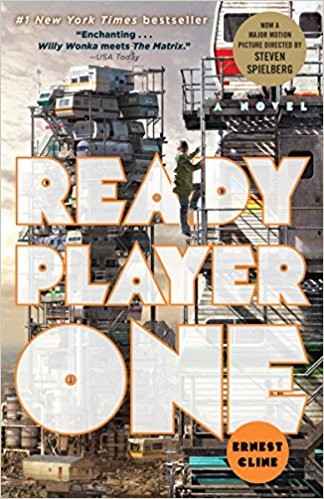
Ready Player One
by Ernest Cline · 2011
In a dystopian 2044 where most people escape into a massive virtual reality called the OASIS, a teenager hunts for a hidden treasure buried in the system by its dead creator, using nothing but an encyclopedic knowledge of 1980s pop culture.
Worth reading? Ready Player One is built almost entirely on nostalgia as plot mechanism, and it works exactly as well as your own familiarity with 80s pop culture lets it. The world-building around economic collapse and escapism into VR is more interesting than the treasure hunt itself, but the treasure hunt is what most readers came for.
| Author | Ernest Cline |
|---|---|
| Published | 2011 |
| Publisher | Crown Publishers |
| Category | Fiction |
| Favorite quote | “Being human totally sucked most of the time. Videogames were the only thing that made life bearable.” |
The Verdict
The nostalgia-as-plot-mechanism approach is either the book’s biggest strength or its biggest limitation, depending on your own relationship to 80s arcade games and movies. If you know the references, the puzzle-solving lands as genuinely clever. If you don’t, a lot of it reads as a list.
The dystopian backdrop – climate collapse, poverty, mass retreat into virtual reality – is more thoughtfully built than the treasure hunt gives it credit for, and it’s a shame the book doesn’t spend more time there instead of cycling through pop-culture trivia challenges.
Wade’s arc from isolated escapist to someone who values real-world connection is a little tidy, but it keeps the book from being purely a nostalgia delivery mechanism.
Read it if you grew up steeped in 80s pop culture and want a treasure hunt built on that specific knowledge. Skip it if those references mean little to you – a lot of the book’s appeal depends on recognition, not just plot.
you grew up on 80s movies, arcade games, and early internet culture and want a treasure-hunt plot built almost entirely out of nostalgia references and puzzle-solving
the 80s pop-culture references mean nothing to you -- the book's puzzles and world are dense with specific trivia, and without that context a lot of the appeal falls flat
Book Summary
In 2044, climate change and economic collapse have made the real world bleak enough that most people spend their lives inside the OASIS, a massive shared virtual reality platform used for school, work, and entertainment. When the OASIS's reclusive creator, James Halliday, dies, he leaves behind a public will: whoever finds three hidden keys and solves puzzles based entirely on his obsessive knowledge of 1980s pop culture inherits his fortune and control of the OASIS itself.
Wade Watts, a poor teenager living in a stacked trailer slum, becomes obsessed with Halliday's "Easter egg" hunt and immerses himself in decades of 80s movies, video games, and music to prepare, competing against thousands of other "gunters" (egg hunters) and a corporate conglomerate that wants to win the contest to monetize and control the OASIS.
Cline's real interest is in escapism itself -- the book is explicit that people retreat into the OASIS because the real world has become too broken to inhabit, and the plot's resolution deliberately pushes Wade back toward valuing real, offline relationships and stakes over the virtual world he's spent the whole book mastering.
Top 8 Lessons from Ready Player One
- Halliday's puzzle hunt is built entirely around his personal obsession with 1980s pop culture, meaning success in the contest requires the kind of encyclopedic nostalgia knowledge that functions as the book's central skill system.
- The OASIS functions as mass escapism from a real world made unlivable by climate change, poverty, and economic collapse -- the book is explicit that virtual immersion is a coping response to a broken physical world, not just entertainment.
- Wade's real-world poverty (living in a stacked trailer slum called 'the stacks') contrasts sharply with his effectively unlimited freedom and status inside the OASIS, highlighting how virtual equality can mask real inequality.
- IOI, the corporate antagonist, wants to win the contest specifically to monetize and restrict the OASIS, framing the plot as a fight over whether a shared digital commons stays open or gets enclosed by a corporation.
- The puzzles require literal recreation of classic video games and movies, meaning contestants have to master decades-old media perfectly rather than solve abstract riddles.
- Wade's isolation -- most of his real friendships exist only as OASIS avatars until late in the book -- eventually gets challenged as the plot forces him into real-world contact and danger.
- The ending's message pushes back against the book's own nostalgia obsession: Halliday's final lesson to Wade is that reality, however imperfect, matters more than the escape the OASIS offers.
- The book treats virtual-world skill (button-perfect recreation of arcade games, deep trivia recall) as a genuinely valuable and portrayed skill, which is part of why it resonated so strongly with gaming and 80s-nostalgia readers specifically.
Top 2 Quotes from Ready Player One
"Being human totally sucked most of the time. Videogames were the only thing that made life bearable."
Ernest Cline, Ready Player One
"Going outside is highly overrated."
Ernest Cline, Ready Player One
Frequently Asked Questions
Is Ready Player One worth reading?
If you have real familiarity with 1980s pop culture, arcade games, and early internet nostalgia, yes -- the book's puzzles and appeal depend heavily on that context.
What is Ready Player One about?
Wade Watts, a teenager in a dystopian 2044, competes against corporate rivals in a global treasure hunt built on 1980s pop-culture trivia, hidden by the creator of the massive virtual reality platform most of humanity escapes into.
Do you need to know 80s pop culture to enjoy Ready Player One?
It helps a lot -- the puzzles and much of the book's appeal are built directly on specific 80s movies, games, and music references.
Is Ready Player One appropriate for teens?
Yes, it's written accessibly and is popular with teen and adult readers alike, though the dystopian setting includes some violence and dark real-world backdrop.
Is the movie faithful to the book?
Steven Spielberg's 2018 film changes several major plot points and puzzles from the book, so the two versions diverge meaningfully in their second half.
Ready to read it?
Get Ready Player One on Amazon