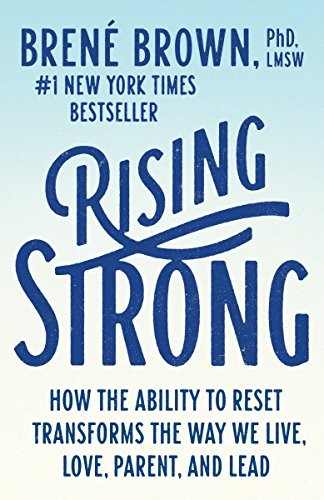
Rising Strong
by Brené Brown · 2015
What to do after you fall on your face -- Brown's process for getting back up.
Worth reading? Rising Strong is the sequel Daring Greatly earns: that book argues you should get in the arena, this one is what happens after you get knocked down in it. Brown's three-part process -- the reckoning, the rumble, the revolution -- is more actionable than Daring Greatly's broader case, because it's built around one specific moment: the fall, not the decision to try. Read it after Daring Greatly, not instead of it. Skip Rising Strong if you're not already sold on vulnerability as worth the risk -- this book assumes that fight is settled and gets straight to "okay, I fell, now what."
| Full Title | Rising Strong: How the Ability to Reset Transforms the Way We Live, Love, Parent, and Lead |
|---|---|
| Author | Brené Brown |
| Published | 2015 |
| Publisher | Spiegel & Grau |
| Category | Self-Improvement & Psychology |
| Favorite quote | “If we are brave enough, often enough, we will fall. This is the physics of vulnerability.” |
The Verdict
If Daring Greatly is the pep talk to get in the arena, Rising Strong is the manual for the moment you get thrown out of it. The reckoning-rumble-revolution framework is genuinely more useful day-to-day than anything in her first two books, because it gives you something to actually do the next time you fail.
you're stuck replaying a failure and need a process to move through it, not just around it
you haven't read Daring Greatly yet -- this assumes you already accept the vulnerability argument
Book Summary
Failure isn't optional if you're doing anything that matters -- it's the tax on daring greatly. What separates people who recover well from people who stay stuck isn't that they fail less, it's that they have a process for getting back up: Brown calls it the reckoning (noticing the emotion instead of numbing it), the rumble (getting curious about the story you're telling yourself about what happened), and the revolution (using what you learn to change how you show up next).
Most people's first reaction to failure is to write a fast, self-protective story -- "I'm not good enough," "they're out to get me" -- because an unfinished story feels worse than a false one. The rumble means catching that first draft and questioning it before you act on it as fact.
Story is how humans process experience, which means the stories you tell about your own failures aren't neutral -- they shape whether you rise stronger or just paper over the crack and wait for it to reopen.
Top 8 Lessons from Rising Strong
- Failure is the tax on daring greatly -- if you're never failing, you're not really in the arena.
- The first story you tell yourself about a failure is a rough draft, not the truth.
- The reckoning: notice the emotion instead of immediately numbing or denying it.
- The rumble: get curious about the story before you accept it as fact.
- The revolution: use what the rumble taught you to actually change your behavior.
- An unfinished story feels worse than a false one -- which is why we rush to blame.
- Creativity requires failure. There's no version of making something that skips it.
- Vulnerability is the path back to connection after a fall, not around it.
Top 4 Quotes from Rising Strong
"The most dangerous stories we make up are the narratives that diminish our inherent worthiness."
Brené Brown, Rising Strong
"We are wired for story. Story is literally in our DNA."
Brené Brown, Rising Strong
"There is no innovation and creativity without failure. Period."
Brené Brown, Rising Strong
"If we are brave enough, often enough, we will fall. This is the physics of vulnerability."
Brené Brown, Rising Strong
Frequently Asked Questions
Is Rising Strong worth reading?
Yes, if you've already read Daring Greatly. It gives you an actual process -- the reckoning, the rumble, the revolution -- for what to do after a failure, rather than just the case for taking the risk.
What is the main idea of Rising Strong?
Falling is the guaranteed cost of daring greatly. Rising strong isn't about avoiding failure, it's about catching the false story you tell yourself right after it happens and rewriting it before it hardens into identity.
How long does it take to read Rising Strong?
About 6 hours. It's 336 pages and denser with process and framework than Daring Greatly.
Do I need to read Daring Greatly before Rising Strong?
You don't strictly need to, but it helps a lot. Rising Strong assumes you already accept that vulnerability is worth the risk and picks up right at the moment you fail after taking it.
Ready to read it?
Get Rising Strong on Amazon