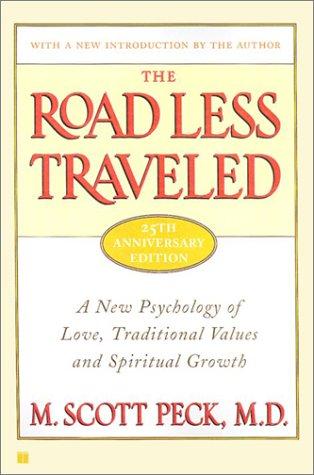
The Road Less Traveled
by M. Scott Peck · 1978
The psychiatrist who opened a bestseller with 'life is difficult' and made millions feel better about it.
Worth reading? Peck's opening line does more work than most books' whole first chapter: life is difficult, and accepting that is the beginning of solving it. Read it for the discipline and love sections, which hold up. Skip the later spiritual-growth chapters if you want something more clinical -- Feeling Good gives you the CBT version without the theology, and Man's Search for Meaning covers suffering-as-meaning in a third of the pages.
| Full Title | The Road Less Traveled: A New Psychology of Love, Traditional Values, and Spiritual Growth |
|---|---|
| Author | M. Scott Peck |
| Published | 1978 |
| Category | Self-Improvement & Psychology |
| Favorite quote | “Life is difficult. This is a great truth, one of the greatest truths.” |
The Verdict
Peck was a practicing psychiatrist, and it shows in how precisely he defines discipline and love instead of just gesturing at them. The first third of the book is genuinely useful and still gets quoted for a reason. The back half, where he moves into grace, evil, and religious experience, is more a product of its late-70s moment. Read it for the framework, keep what’s useful, and don’t feel obligated to buy the whole worldview.
you want a serious, spiritually-grounded book on discipline, love, and suffering, not a quick-fix framework
you want secular, evidence-based psychology. Peck leans religious, and some of his views on grace and evil haven't aged cleanly
Book Summary
Most psychological suffering comes from avoiding necessary pain. Peck's four tools of discipline -- delaying gratification, accepting responsibility, dedication to truth, and balancing -- are the mechanism for facing problems instead of dodging them, and dodging is what turns ordinary difficulty into a disorder.
Peck also draws a hard line between love and the feelings that get mistaken for it. Real love is "the will to extend one's self for the purpose of nurturing one's own or another's spiritual growth" -- it's an act of will and effort, not the infatuation most people call love and expect to just happen to them.
Top 8 Lessons from The Road Less Traveled
- Life is difficult -- accepting that fact removes the extra suffering of resenting it.
- Delay gratification: face the pain first, get the pleasure after.
- Take responsibility for your own problems instead of blaming circumstance.
- Dedicate yourself to truth, even when a comfortable lie is easier to live with.
- Balance discipline with flexibility -- rigidity is its own trap.
- Love is an action and a choice, not a feeling that happens to you.
- Real love extends the self to nurture someone else's growth, not just your own comfort.
- Spiritual growth requires giving up outgrown, simpler views of the world, which is its own kind of grief.
Top 4 Quotes from The Road Less Traveled
"Life is difficult. This is a great truth, one of the greatest truths."
M. Scott Peck, The Road Less Traveled
"Discipline is the basic set of tools we require to solve life's problems."
M. Scott Peck, The Road Less Traveled
"Love is not a feeling by which we are overwhelmed. It is a committed, thoughtful decision."
M. Scott Peck, The Road Less Traveled
"Until you value yourself, you won't value your time. Until you value your time, you won't do anything with it."
M. Scott Peck, The Road Less Traveled
Frequently Asked Questions
Is The Road Less Traveled worth reading?
Yes, especially the first two sections on discipline and love. It's dated in places and religious in tone, but the core framework for facing pain instead of avoiding it still holds up.
What is the main idea of The Road Less Traveled?
Life is inherently difficult, and most psychological suffering comes from refusing to accept that and avoiding necessary pain instead of working through it.
Is The Road Less Traveled religious?
The later chapters get explicitly spiritual and lean on Christian concepts of grace and evil. The discipline and love sections are more secular and practical.
What's a good alternative to The Road Less Traveled?
Feeling Good covers similar ground on facing hard truths with a clinical, CBT-based approach instead of Peck's spiritual framing.
Ready to read it?
Get The Road Less Traveled on Amazon