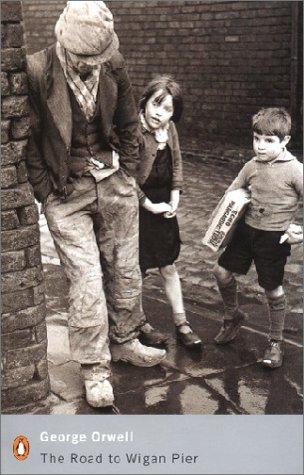
The Road to Wigan Pier
by George Orwell · 1937
Orwell goes underground into England's Depression-era coal towns, then turns the second half into a brutally honest essay on why socialism keeps failing to win over the working class it claims to speak for.
Worth reading? The first half is straight reportage, Orwell living among unemployed miners in Lancashire and Yorkshire, describing squalid housing and grinding poverty with a journalist's precision. The second half is the reason people still argue about this book: a long, self-lacerating essay on why British socialism repelled the very working class it claimed to champion, full of criticism Orwell's own political allies hated. Read it if you want reportage from inside real poverty plus an author who refuses to let his own side off the hook. Skip it if you want a clean ideological argument, this book picks fights with everyone, including itself.
| Author | George Orwell |
|---|---|
| Published | 1937 |
| Category | History |
| Favorite quote | “One sometimes gets the impression that the mere words 'Socialism' and 'Communism' draw towards them with magnetic force every fruit-juice drinker, nudist, sandal-wearer, sex-maniac, Quaker, 'Nature Cure' quack, pacifist, and feminist in England.” |
The Verdict
Orwell doesn’t let anyone off easy in this book, not the mine owners, not the government, and not his own socialist allies. The reportage half earns its reputation on documentary detail alone; the essay half is what makes people still argue about it nearly a century later.
readers who want firsthand economic reportage paired with an author willing to criticize his own side
you want a tidy political argument, Orwell spends half the book attacking his own movement's failures
Book Summary
The book's structure is its argument: Part One is documentary, Orwell descending literal coal mines and living in squalid boarding houses to record working-class life exactly as he found it, without romanticizing it. Part Two turns that reporting into a hard question, if socialism is supposed to represent these people, why does it keep failing to win them over.
Orwell's answer, controversial then and now, is that middle-class socialists of his era were often more interested in abstract theory and moral posturing than in the actual material conditions of the poor, and that this disconnect, not capitalist propaganda, was socialism's biggest obstacle in 1930s Britain.
Top 7 Lessons from The Road to Wigan Pier
- Firsthand reporting beats theory when trying to understand poverty, Orwell went and lived it before writing about it.
- A movement that claims to represent a group but doesn't understand its daily life will struggle to win it over.
- Class markers (accent, manners, taste) can matter more to political persuasion than economic self-interest.
- Criticizing your own side honestly is more useful, and more dangerous, than attacking only your opponents.
- Documentary detail (exact wages, exact rents, exact living conditions) makes an argument land harder than abstraction.
- Ideological purity can alienate the very people a movement claims to serve.
- Physical discomfort and direct exposure change how a writer argues, Orwell's time underground shows in every page.
Top 1 Quotes from The Road to Wigan Pier
"One sometimes gets the impression that the mere words 'Socialism' and 'Communism' draw towards them with magnetic force every fruit-juice drinker, nudist, sandal-wearer, sex-maniac, Quaker, 'Nature Cure' quack, pacifist, and feminist in England."
George Orwell, The Road to Wigan Pier
Frequently Asked Questions
Is The Road to Wigan Pier worth reading?
Yes, both for the firsthand Depression-era reportage and for Orwell's willingness to turn his criticism on his own political movement, which still makes the book uncomfortable and useful.
What is The Road to Wigan Pier about?
George Orwell's two-part account of Depression-era poverty in England's coal towns, followed by a long essay on why British socialism kept failing to connect with the working class.
Why is The Road to Wigan Pier controversial among socialists?
Orwell's second half attacks what he saw as middle-class socialists' theoretical, moralizing approach, arguing it alienated the working-class people the movement claimed to represent, a critique his own allies pushed back on hard.
Ready to read it?
Get The Road to Wigan Pier on Amazon