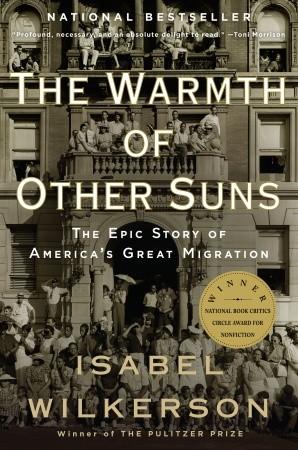
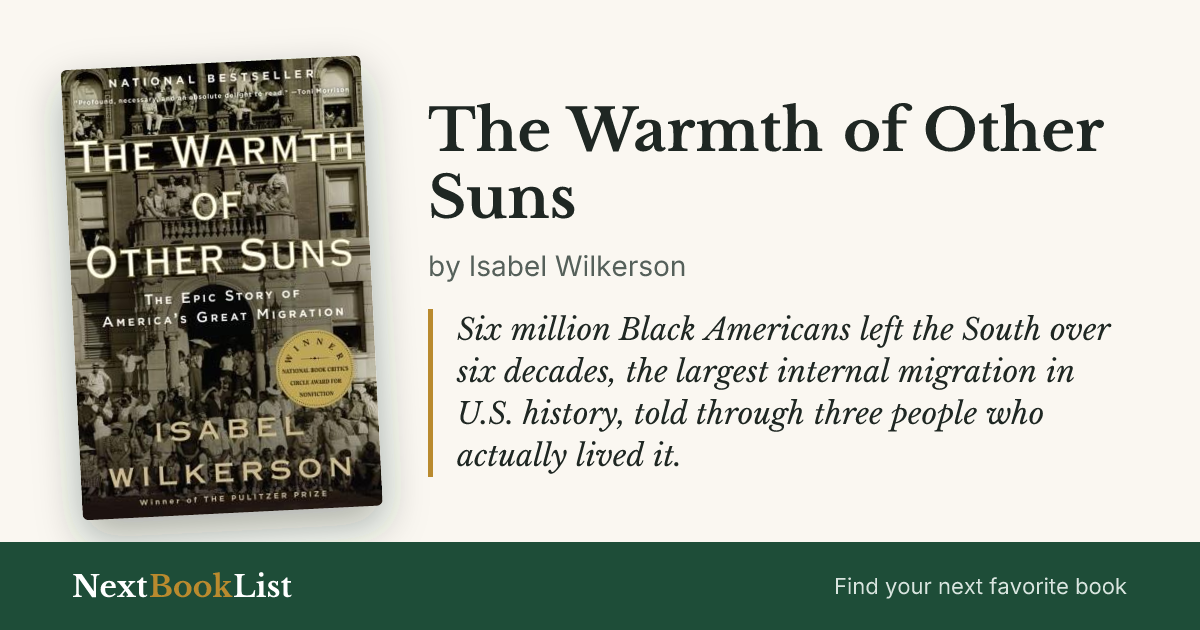
The Warmth of Other Suns
by Isabel Wilkerson · 2010
Six million Black Americans left the South over six decades, the largest internal migration in U.S. history, told through three people who actually lived it.
Worth reading? Wilkerson spent over fifteen years and interviewed more than a thousand people to write this, following three specific individuals -- Ida Mae Gladney, who fled Mississippi sharecropping for Chicago in 1937; George Starling, who fled Florida citrus groves for Harlem in 1945; and Robert Foster, a surgeon who left Louisiana for California in 1953 -- across their entire lives, using their specific stories to carry the larger historical narrative of six million Black Americans leaving the Jim Crow South between 1915 and 1970. The scale of research shows: this reads as intimate biography that happens to also be sweeping national history, rather than the reverse.
| Full Title | The Warmth of Other Suns: The Epic Story of America's Great Migration |
|---|---|
| Author | Isabel Wilkerson |
| Published | 2010 |
| Category | History |
| Favorite quote | “In the end, the Great Migration was a leaderless revolution.” |
The Verdict
Wilkerson’s fifteen years of research produced something rare: a work of genuine historical scale that never loses the texture of individual lives inside it. The three people she follows aren’t illustrations of a larger point – their full lives, with all their specific complications, are the actual subject, and the history emerges from that specificity rather than the other way around.
you want the Great Migration told through specific, deeply-researched individual lives rather than statistics and policy summary
you want a compact overview -- this is a long, deeply researched book (over 600 pages) built from over a thousand interviews, not a brief survey
Book Summary
The Great Migration, per Wilkerson's framing, deserves to be understood with the same historical weight as other major migrations in world history -- six million people relocating within one country over six decades in response to systemic terror and economic exclusion, yet it's rarely taught with the depth given to migrations of comparable scale, a gap Wilkerson's fifteen years of research were specifically built to correct.
By following three individuals across their entire adult lives rather than treating migration as a single event, Wilkerson shows how the decision to leave, the journey itself, and the decades of adjustment afterward (facing new, different forms of racism in the North and West, building community, raising families) were each their own distinct, difficult chapters -- migration wasn't a single choice but a sustained, lifelong process with real costs and real gains at every stage.
Top 7 Lessons from The Warmth of Other Suns
- The Great Migration deserves recognition as a major historical migration on the scale of internationally-studied population movements.
- Migration is a sustained, lifelong process -- the decision to leave, the journey, and decades of adjustment are each distinct, difficult chapters.
- Systemic terror and economic exclusion (Jim Crow) can drive population-scale relocation decisions, not just individual economic opportunity.
- Racism took different, evolving forms in the North and West after migration -- leaving the South didn't mean escaping racism entirely, just its specific Southern form.
- Deeply researched individual life stories can carry the weight of sweeping historical narrative more effectively than statistics and policy summary alone.
- A historical phenomenon studied at massive scale (six million people) is still made of millions of specific, individually consequential decisions.
- Extended, patient research (fifteen years, a thousand-plus interviews) can surface a level of historical intimacy that faster scholarship misses.
Top 2 Quotes from The Warmth of Other Suns
"In the end, the Great Migration was a leaderless revolution."
Isabel Wilkerson, The Warmth of Other Suns
"They did what human beings looking for freedom, throughout history, have often done. They left."
Isabel Wilkerson, The Warmth of Other Suns
Frequently Asked Questions
Is The Warmth of Other Suns worth reading?
Yes -- it's one of the most thoroughly researched accounts of the Great Migration, built from over fifteen years of work and a thousand-plus interviews, told through three individual lives that carry the larger historical narrative.
What is The Warmth of Other Suns about?
Isabel Wilkerson's history of the Great Migration -- the movement of six million Black Americans out of the Jim Crow South between 1915 and 1970 -- told through the specific lives of three people: Ida Mae Gladney, George Starling, and Robert Foster.
How long did Isabel Wilkerson research The Warmth of Other Suns?
Over fifteen years, including more than a thousand interviews, though the book ultimately follows three individuals in depth to carry the broader historical narrative.
How is this different from Caste, also by Isabel Wilkerson?
The Warmth of Other Suns is a specific historical account of the Great Migration told through individual lives. Caste is a broader analytical framework arguing that a hierarchical caste system, not just racism, structures American social order. They're complementary but distinct books.
Ready to read it?
Get The Warmth of Other Suns on Amazon