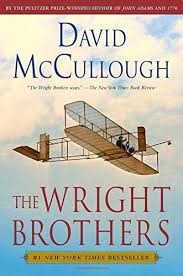
The Wright Brothers
by David McCullough · 2015
Two bicycle mechanics from Dayton, Ohio, with no college education and no government funding, solved powered flight before teams with far more resources, told by the biographer who also gave us 1776 and John Adams.
Worth reading? McCullough draws on an unusually rich source -- the extensive Wright family papers, including their sister Katharine's own letters -- to tell a story that's less about a single eureka moment and more about years of patient, methodical trial and error by two men with no formal engineering training and minimal funding, working out of a bicycle shop while better-funded, more credentialed competitors (including a Smithsonian-backed effort) failed. It's a smaller, more intimate book than McCullough's presidential biographies, and Katharine Wright's role, largely left out of the popular Wright Brothers myth, gets real attention here.
| Author | David McCullough |
|---|---|
| Published | 2015 |
| Category | History |
| Favorite quote | “No bird soars in a calm.” |
The Verdict
McCullough’s access to the Wright family’s own letters is what makes this more than a familiar invention story – Katharine Wright’s role alone is worth the book, since she’s almost entirely absent from the popular version most readers already know. It’s a smaller, quieter book than McCullough’s presidential biographies, and that scale suits the material.
you want the human, unglamorous story behind one of history's most consequential inventions, built from the Wright family's own extensive papers
you want deep engineering or aerodynamics detail -- McCullough writes character-driven narrative history, not a technical account of flight mechanics
Book Summary
Wilbur and Orville Wright succeeded where far better-funded, more credentialed competitors failed largely through methodical, patient engineering discipline -- systematically testing and iterating on wing design, control mechanisms, and engine power over years, rather than betting on a single breakthrough insight, working out of their bicycle shop's profits with no outside investment or government funding.
McCullough gives significant attention to their sister Katharine Wright, a Oberlin-educated teacher who managed correspondence, provided crucial emotional and practical support, and later became genuinely central to the brothers' public recognition in Europe -- a role largely absent from the popular version of the Wright Brothers story that McCullough's access to the family papers lets him restore.
Top 7 Lessons from The Wright Brothers
- Methodical, patient engineering iteration can outperform better-funded, more credentialed competitors chasing the same breakthrough.
- Formal credentials (the Wright brothers had no college education) aren't a prerequisite for solving genuinely hard technical problems.
- Working with minimal external funding can force a discipline and focus that well-funded competitors sometimes lack.
- Family support (Katharine Wright's role) is often central to a celebrated achievement while remaining invisible in the popular telling.
- Public skepticism can persist even after a genuine breakthrough -- the Wrights faced years of public disbelief even after successful flights.
- Solving a hard technical problem (flight) required solving multiple sub-problems (control, power, lift) simultaneously, not one single insight.
- Access to primary historical sources (family papers) can meaningfully correct a popular historical narrative that's flattened over time.
Top 1 Quotes from The Wright Brothers
"No bird soars in a calm."
David McCullough, The Wright Brothers
Frequently Asked Questions
Is The Wright Brothers worth reading?
Yes, especially for a character-driven, human account of powered flight's invention rather than a technical engineering history. McCullough's access to the Wright family papers gives it unusual intimacy.
What is The Wright Brothers about?
David McCullough's account of Wilbur and Orville Wright's methodical, years-long development of powered flight, working with minimal funding out of their bicycle shop, and their sister Katharine's underrecognized role in their success.
Does The Wright Brothers cover the technical details of flight?
Not deeply. McCullough writes character-driven narrative history focused on the brothers' process, personalities, and public reception, not a technical account of aerodynamics.
Who was Katharine Wright?
Wilbur and Orville Wright's sister, an Oberlin-educated teacher who managed correspondence, provided crucial support, and became central to the brothers' public recognition, particularly in Europe -- a role McCullough restores using the family's papers.
Ready to read it?
Get The Wright Brothers on Amazon