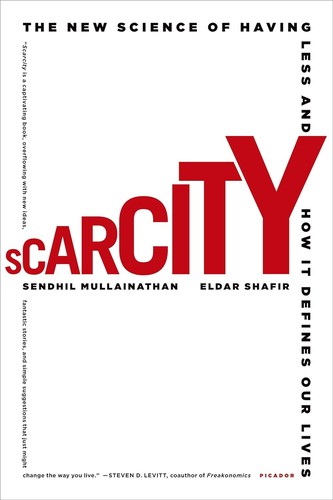
Scarcity
by Sendhil Mullainathan & Eldar Shafir · 2013
Poverty isn't a character flaw -- it's a bandwidth tax that makes everyone worse at thinking.
Worth reading? Scarcity and Poor Economics both look at poverty, but they answer different questions. Banerjee and Duflo test which anti-poverty programs actually work. Mullainathan and Shafir explain why poor people -- and busy people, and dieters, and anyone else starved of a resource -- make the decisions they do in the first place. Read Scarcity first if you want the psychological mechanism; read Poor Economics next for what to do about it. Skip Scarcity if you already know the "bandwidth tax" concept from a psych class or a summary -- the book's core claim fits in a paragraph, and the rest is repetition across different scarcity types (money, time, food, friendship) to prove it generalizes. Worth it if you want the evidence, not just the headline.
| Full Title | Scarcity: Why Having Too Little Means So Much |
|---|---|
| Author | Sendhil Mullainathan & Eldar Shafir |
| Published | 2013 |
| Category | Business & Money |
| Favorite quote | “Scarcity captures the mind.” |
The Verdict
Mullainathan and Shafir take a question that sounds obvious – why do poor people make decisions that seem to keep them poor – and show it’s the wrong question. It’s not about the poor. It’s about anyone under scarcity, of anything. The book earns that claim with experiments, not just theory, which is why it holds up better than the usual “poverty mindset” takes you’ve heard before.
you want to understand why busy, broke, or lonely people make worse decisions -- and it's not about willpower
you're looking for a productivity book with action steps rather than a behavioral-economics argument
Book Summary
Scarcity captures the mind. When you don't have enough of something -- money, time, food, even social contact -- your attention gets pulled toward the shortage automatically, whether you want it to or not. Mullainathan and Shafir call this "tunneling": you get sharper at solving the immediate problem in front of you and measurably worse at everything outside the tunnel, including things that would help you escape the shortage in the long run.
This isn't a poor-people problem. The authors run the same experiments on busy executives short on time and dieters short on food, and get the same tunneling, the same neglect of everything outside the pressing need. Scarcity works the same way regardless of what's scarce.
The mechanism has a name and a cost: the "bandwidth tax." Being preoccupied with scarcity eats into fluid intelligence and impulse control by an amount comparable to losing a full night's sleep, or roughly 13 IQ points in the lab. That's not a motivation problem you can lecture someone out of -- it's a cognitive capacity problem, and it explains why people under scarcity make choices that look irrational from the outside but are actually a predictable response to having less bandwidth to spend.
Top 11 Lessons from Scarcity
- Scarcity captures the mind whether you want it to or not.
- Tunneling makes you sharper on the urgent problem and blind to everything else.
- Being short on money taxes your bandwidth like a lost night of sleep.
- The bandwidth tax hits fluid intelligence and self-control, not motivation.
- Scarcity of time works the same way as scarcity of money -- busy people tunnel too.
- Juggling scarcity means borrowing slack from tomorrow to patch today.
- The poor aren't worse decision-makers -- anyone under scarcity makes the same mistakes.
- Fixing scarcity means building in slack, not lecturing people about willpower.
- Small buffers and defaults beat willpower because willpower is what scarcity depletes first.
- Anti-poverty programs fail when they assume unlimited attention and rational planning.
- Loneliness is a scarcity of social contact and produces the same tunneling effect.
Top 1 Quotes from Scarcity
"Scarcity captures the mind."
Sendhil Mullainathan & Eldar Shafir, Scarcity
Frequently Asked Questions
Is Scarcity worth reading?
Yes if you want the psychological case for why poverty and busyness cause bad decisions -- it's evidence-backed, not just a metaphor. Skip it if you only need the one-paragraph summary of the bandwidth tax.
What is the main idea of Scarcity?
Having too little of any resource -- money, time, food, company -- captures your attention and taxes your mental bandwidth, making you worse at everything outside the immediate shortage.
Is Scarcity the same argument as Poor Economics?
No. Scarcity explains the psychology behind poor decisions under any kind of shortage. Poor Economics tests which specific programs help people escape poverty. They pair well together.
Who should read Scarcity?
Anyone who wants to understand why smart, capable people under money or time pressure make choices that look irrational from the outside.
Ready to read it?
Get Scarcity on Amazon