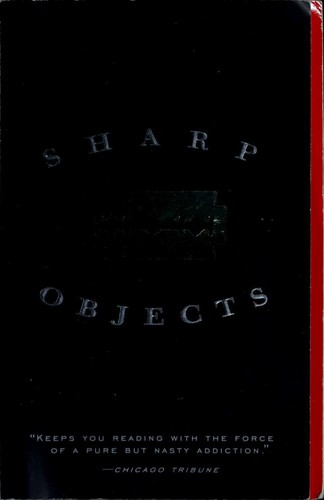
Sharp Objects
by Gillian Flynn · 2006
A reporter returns to her hometown to cover the murders of two young girls and gets pulled back into the toxic orbit of her mother and the self-harm habits she thought she'd left behind.
Worth reading? Sharp Objects is Flynn's debut and the rawest thing she's written, which is saying something given Gone Girl came after it. The murder mystery is almost secondary to the real subject: a mother-daughter relationship so corrosive it reads as horror even before the plot's darkest reveal lands. It's a hard read, deliberately, and it earns that difficulty.
| Author | Gillian Flynn |
|---|---|
| Published | 2006 |
| Publisher | Shaye Areheart Books |
| Category | Fiction |
The Verdict
Flynn doesn’t write Adora as a cartoonish villain, which is what makes her genuinely frightening. Every controlling, invasive thing she does is dressed up as maternal concern, and the book lets you feel Camille’s inability to push back even as an adult who should know better.
The murder plot exists, and it resolves, but it’s not really why you keep reading. You keep reading because you need to know how deep the family rot goes, and Flynn doesn’t flinch from the answer.
Read it if you want psychologically dark fiction that treats damage honestly instead of using it for cheap shock. Skip it if self-harm content is a hard line for you, or you want the mystery itself to be the main draw.
you want dark, character-driven Southern Gothic noir with a genuinely damaged narrator, and you can handle graphic material around self-harm and family cruelty without it being gratuitous
self-harm content is a hard limit for you, or you want a plot-forward whodunit -- this is much more interested in psychological damage than procedural mystery mechanics
Book Summary
Camille Preaker, a Chicago reporter with a history of self-harm, gets sent back to her small Missouri hometown to cover the murders of two preteen girls. The assignment forces her back into her family's house, where her mother Adora's controlling, smothering presence and Camille's younger half-sister Amma's unsettling behavior recreate the environment that damaged Camille in the first place.
Flynn structures the book so the town's murder investigation and Camille's unraveling mental state run in parallel, and the two threads converge on a family secret that recontextualizes both the crimes and Camille's own childhood scars, literal ones, carved into her skin, that give the book its title.
What makes the novel land is Flynn's refusal to soften Adora or make Camille's damage tidy or redemptive by the end -- the book is more interested in showing how cruelty gets passed down through a family than in providing catharsis.
Top 9 Lessons from Sharp Objects
- The novel treats self-harm not as a plot device for shock but as a documented, ongoing part of Camille's psychology, rendered with specificity rather than sensationalism.
- Adora's controlling, medically suspicious behavior toward her daughters is the book's real horror engine, more unsettling on a reread than the murder mystery itself.
- The murder investigation and Camille's psychological unraveling are structured to converge, so the town's crimes and the family's private cruelty turn out to be linked rather than parallel but separate.
- Amma's dual nature (performed innocence at home, something darker outside it) is set up carefully so her role in the ending recontextualizes earlier scenes rather than arriving as a random twist.
- The book resists a tidy redemptive arc for Camille -- her damage isn't cured by solving the mystery, which is a deliberate departure from more comforting thriller conventions.
- Small-town claustrophobia (everyone knows everyone, secrets are structural rather than incidental) is used to make Camille's homecoming feel inescapable rather than just a setting choice.
- Camille's training as a journalist, taught to observe without inserting herself, collides with her inability to stay detached once the story becomes her own family, undercutting her professional distance.
- The self-inflicted words carved into Camille's skin function as a literal text other characters and the reader have to learn to read, tying her self-harm directly to the book's larger theme of buried communication.
- Flynn withholds the full pattern of Adora's behavior gradually, so what first reads as overbearing mothering is recontextualized as active harm only once enough evidence accumulates.
Top 1 Quotes from Sharp Objects
"My sweater was new, stinging red and ugly."
Gillian Flynn, Sharp Objects
Frequently Asked Questions
Is Sharp Objects worth reading?
Yes, if you can handle dark material -- it's a raw, well-crafted debut, though heavier than Gone Girl in its handling of self-harm and family cruelty.
What is Sharp Objects about?
A reporter with a history of self-harm returns to her hometown to cover two murders and is drawn back into her controlling mother's toxic household.
Does Sharp Objects have graphic content?
Yes -- it includes detailed depictions of self-harm and family cruelty that some readers will find difficult.
Is Sharp Objects by the same author as Gone Girl?
Yes -- Gillian Flynn wrote Sharp Objects first, as her debut novel, before Gone Girl.
Was Sharp Objects adapted for TV?
Yes, as an HBO limited series starring Amy Adams and directed by Jean-Marc Vallee.
Ready to read it?
Get Sharp Objects on Amazon