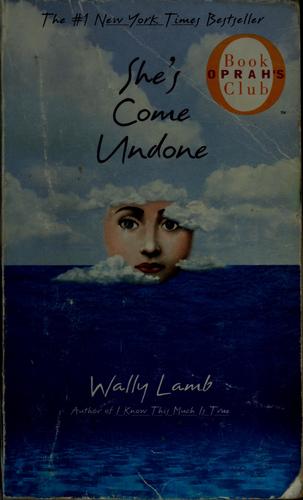
She's Come Undone
by Wally Lamb · 1992
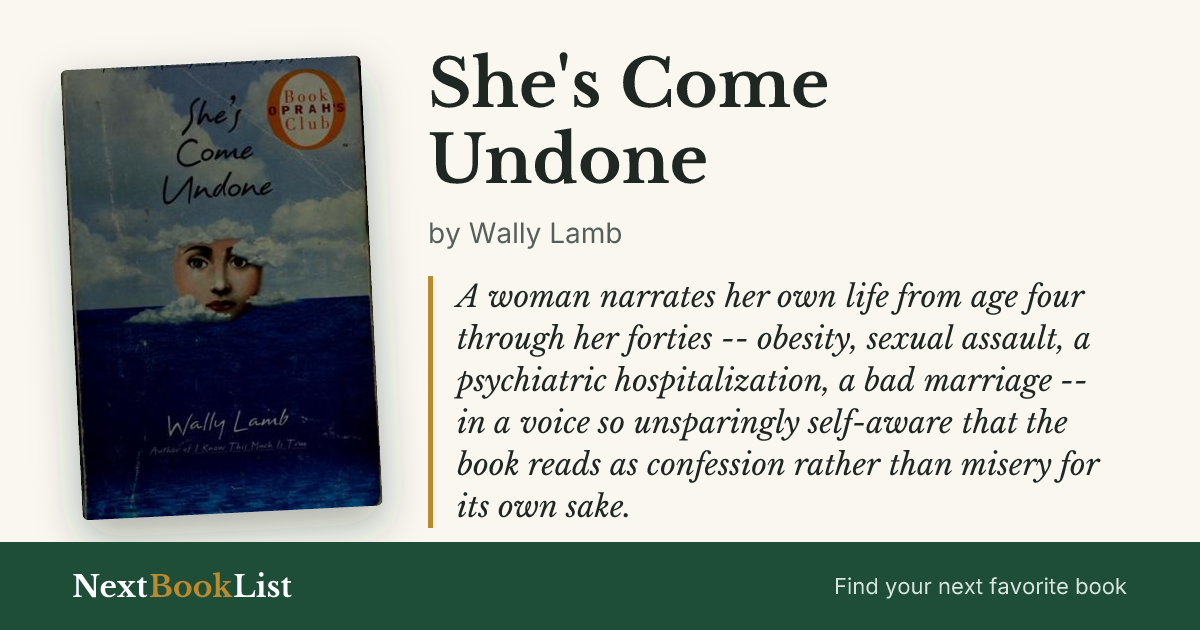
A woman narrates her own life from age four through her forties -- obesity, sexual assault, a psychiatric hospitalization, a bad marriage -- in a voice so unsparingly self-aware that the book reads as confession rather than misery for its own sake.
Worth reading? She's Come Undone works because Wally Lamb, a man, wrote a woman's entire interior life from childhood to middle age with enough specificity and self-loathing honesty that the choice of narrator's gender mostly disappears into the writing.
| Author | Wally Lamb |
|---|---|
| Published | 1992 |
| Publisher | Pocket Books |
| Category | Fiction |
The Verdict
What holds up best here is the voice – Dolores narrates her own worst behavior with the same unflinching clarity she brings to what was done to her, and that refusal to soften either side is what keeps the book from tipping into either misery-lit or cheap redemption.
It’s a long, demanding read, and Lamb doesn’t rush the unglamorous middle stretch of Dolores’s life to get to a resolution faster. That patience is the point: recovery here isn’t a scene, it’s a slow accumulation of honesty.
Read it if you want a long, emotionally unsparing novel that earns its difficult material. Skip it if you need something lighter right now – the trauma content here is direct and sustained, not a subplot.
you want a long, emotionally heavy first-person novel that treats trauma and recovery with real specificity instead of a tidy redemption arc
you want a plot-driven read or need trigger-light material -- sexual assault, suicide attempts, and eating disorder content are depicted directly, not glossed over
Book Summary
Dolores Price narrates her own life starting at age four, through a childhood marked by her parents' divorce, a sexual assault by a neighbor as a young girl, escalating obesity used as both comfort and armor, a devastating loss in college, and a psychiatric hospitalization that becomes a genuine turning point rather than a plot device.
Lamb structures the novel as a long, unbroken first-person account, letting Dolores's voice -- self-lacerating, funny in a bitter way, brutally honest about her own worst behavior -- carry the reader through material that would be unbearable in a more distant narration. The book doesn't flinch from her being, at times, genuinely unlikable.
The back half of the novel tracks Dolores's slow, non-linear recovery: a difficult marriage, therapy, and a hard-won capacity to be honest with herself, without ever suggesting that recovery erases what happened to her or excuses what she did in response to it.
Top 9 Lessons from She's Come Undone
- Dolores's obesity is treated as a specific psychological response to trauma (self-protection, numbing, control) rather than a vague character trait or moral failing.
- The novel doesn't sanitize Dolores into a sympathetic victim -- she's cruel, self-destructive, and often unlikable, and the book trusts readers to stay with her anyway.
- Her psychiatric hospitalization is depicted as genuinely useful rather than either a punishment or a magic fix, a rarer choice than most novels make with mental health treatment.
- The sexual assault early in the book is treated as a root cause the narrative keeps circling back to, rather than a single scene the plot moves past.
- Lamb writes across five decades of one woman's interior life without skipping the unglamorous middle years, which is part of what makes the recovery arc feel earned rather than tidy.
- The novel's structure -- long, digressive, unbroken first person -- mirrors how someone actually narrates their own life to themselves: nonlinear, self-justifying in places, brutally clear in others.
- Dolores's relationship with food shifts meaning across the decades, from comfort to punishment to something closer to neutral, tracking her psychological state more than any single external event.
- Her eventual marriage is portrayed as flawed and imperfect rather than a reward for having recovered, resisting the idea that healing has to end in a storybook partnership.
- The novel gives real weight to a devastating loss Dolores experiences in college, treating it as a second trauma layered onto the earlier assault rather than one wound that explains everything.
Frequently Asked Questions
Is She's Come Undone worth reading?
Yes, if you want a heavy, character-driven novel that treats trauma with real specificity -- it's emotionally demanding but not gratuitous.
Does the book contain difficult content?
Yes -- sexual assault, suicide attempts, disordered eating, and psychiatric hospitalization are all depicted directly. Go in aware.
Was this an Oprah's Book Club pick?
Yes -- its selection for Oprah's Book Club in 1997 drove much of its commercial success years after initial publication.
Is it strange that a male author wrote this from a woman's first-person perspective?
It's a common point of discussion, but most readers and critics found Lamb's voice for Dolores convincing and specific rather than a stunt.
Does the book have a happy ending?
It has a hard-won, realistic one -- recovery and self-honesty, not a tidy resolution that erases what happened to her.
Ready to read it?
Get She's Come Undone on Amazon