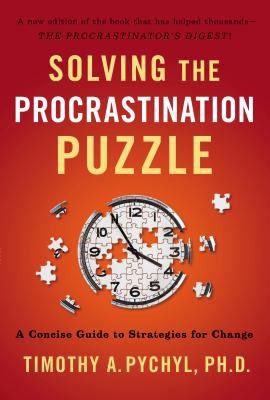
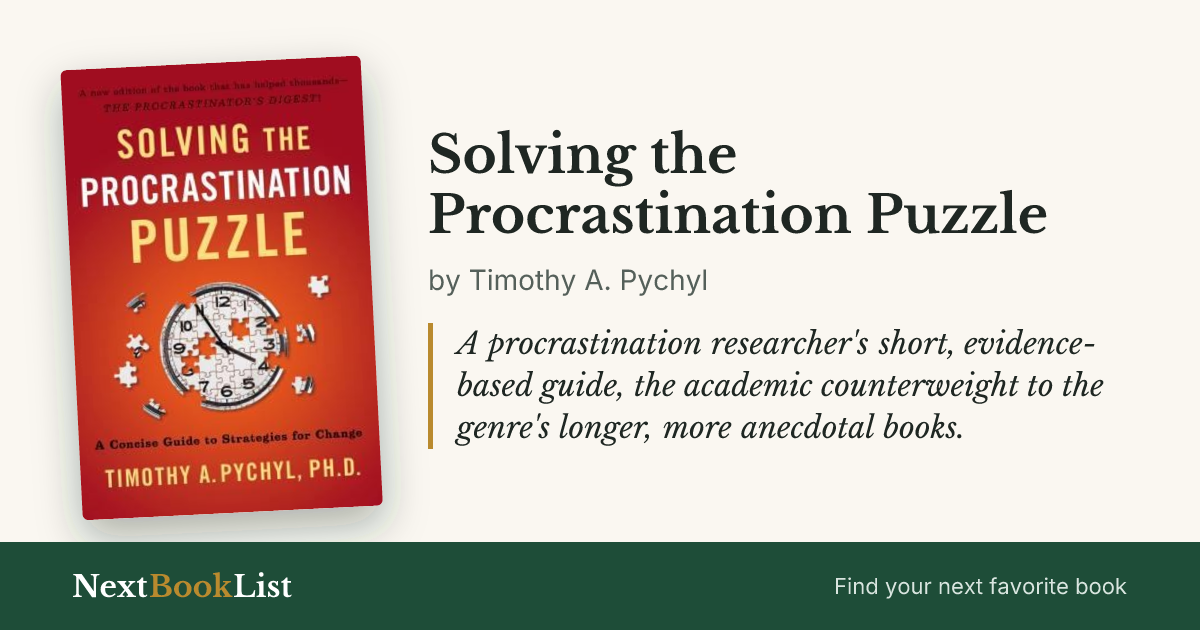
Solving the Procrastination Puzzle
by Timothy A. Pychyl · 2013
A procrastination researcher's short, evidence-based guide, the academic counterweight to the genre's longer, more anecdotal books.
Worth reading? Pychyl is a research psychologist who's studied procrastination specifically since 1995, and this book is his attempt to compress that research into the shortest useful form rather than pad it into a longer narrative. The core reframe -- procrastination is fundamentally about mood repair (avoiding the negative feeling a task provokes right now) rather than time management -- is backed by real research and delivered without much filler. It's the fastest read on procrastination on this list, and the most research-dense per page.
| Full Title | Solving the Procrastination Puzzle: A Concise Guide to Strategies for Change |
|---|---|
| Author | Timothy A. Pychyl |
| Published | 2013 |
| Category | Self-Improvement & Psychology |
| Favorite quote | “Procrastination is the voluntary delay of an intended action despite expecting to be worse off for the delay.” |
The Verdict
Pychyl doesn’t pad this out – it’s built to be read in one sitting and then acted on, which is fitting for a book about closing the gap between intention and action. If you want the research-backed core of procrastination psychology without committing to a longer program, this is the fastest path there.
you want the current research on procrastination in the shortest possible form, from someone who's studied it since 1995
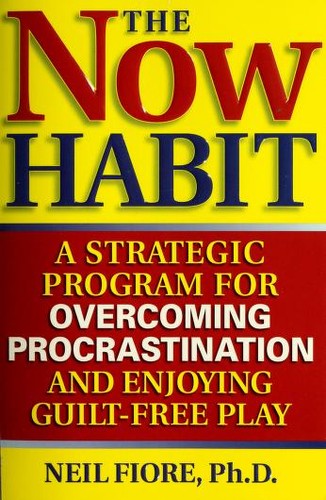
you want depth and case studies, this is deliberately concise (under 100 pages), a guide rather than a deep-dive; The Now Habit covers similar ground with more clinical narrative
Book Summary
Procrastination, in Pychyl's research, is best understood as a short-term mood-repair strategy: faced with a task that provokes a negative feeling (boredom, anxiety, frustration, self-doubt), people procrastinate to escape that feeling in the moment, at the cost of larger, delayed consequences. It's an emotional regulation problem wearing a time-management disguise.
His research also emphasizes the "action gap" between intention and behavior -- most procrastinators genuinely intend to start a task, but the gap between deciding and acting is where procrastination lives, and his practical tools (like simply starting with the smallest possible next physical action, "just get started") are aimed specifically at closing that gap rather than addressing motivation or willpower more broadly.
Top 7 Lessons from Solving the Procrastination Puzzle
- Procrastination is primarily a short-term mood-repair strategy, avoiding a negative feeling a task provokes right now.
- Focus on the 'action gap' between intending to start and actually starting -- that's where procrastination actually lives.
- Identify the smallest possible next physical action and start there, rather than trying to overcome the whole task at once.
- Treat your future self as a real person you're making commitments to, not an abstract idea -- this reduces the tendency to offload discomfort onto 'future you.'
- Self-forgiveness for past procrastination reduces the likelihood of procrastinating again, contrary to the intuition that guilt should motivate better behavior.
- Emotional regulation skills, not just scheduling tools, address the actual root of chronic procrastination.
- Notice the specific negative emotion (boredom, anxiety, self-doubt) driving avoidance of a particular task, rather than treating procrastination as one uniform problem.
Top 2 Quotes from Solving the Procrastination Puzzle
"Procrastination is the voluntary delay of an intended action despite expecting to be worse off for the delay."
Timothy A. Pychyl, Solving the Procrastination Puzzle
"Just get started."
Timothy A. Pychyl, Solving the Procrastination Puzzle
Frequently Asked Questions
Is Solving the Procrastination Puzzle worth reading?
Yes, especially if you want the current psychological research on procrastination in the shortest possible form. It's concise and evidence-dense rather than narrative or anecdotal.
What is the main idea of Solving the Procrastination Puzzle?
Procrastination is primarily a short-term mood-repair strategy -- avoiding the negative feeling a task provokes right now -- rather than a time-management or laziness problem, and closing the gap between intention and action is the practical fix.
Who is Timothy Pychyl?
A psychology professor at Carleton University who has researched procrastination specifically since 1995, and hosts the iProcrastinate podcast and Psychology Today's Don't Delay blog.
How is this different from The Now Habit?
Both frame procrastination as an emotional issue rather than a discipline failure, but Pychyl's book is much shorter and more directly research-cited, while The Now Habit offers a fuller clinical program with more exercises and narrative.
Ready to read it?
Get Solving the Procrastination Puzzle on Amazon