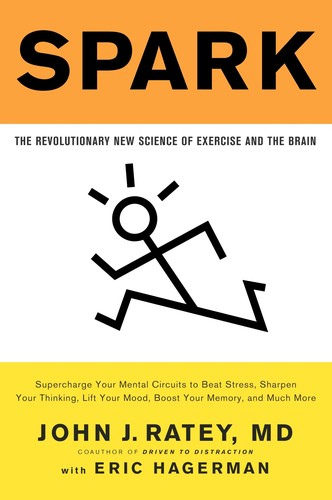
Spark
by John J. Ratey · 2008
A Harvard psychiatrist makes the case that exercise isn't just good for your body -- it's the single most underused drug for your brain, anchored by a school district that put PE before class and watched test scores jump.
Worth reading? Spark is the book that made 'exercise is basically an antidepressant' a mainstream idea, and the core argument has held up well against newer research. If you want a tighter, more recent synthesis of similar evidence, there are newer exercise-science books out there, but Ratey's Naperville school case study alone -- PE before class, test scores up -- is worth the read on its own.
| Full Title | Spark: The Revolutionary New Science of Exercise and the Brain |
|---|---|
| Author | John J. Ratey |
| Published | 2008 |
| Publisher | Little, Brown and Company |
| Category | Science & Nature |
| Favorite quote | “What it means is that you have the power to change your brain. All you have to do is lace up your running shoes.” |
The Verdict
Ratey isn’t the first to say exercise helps your mood, but he’s one of the first to make the mechanism-level case with actual brain chemistry, and the Naperville example does more persuasive work than most self-help anecdotes manage. If you’ve been treating exercise as purely cosmetic, this book is the reframe.
you want the neuroscience case for exercise as mental-health treatment, not just fitness advice -- the book leans hard into brain chemistry (BDNF, neurogenesis, stress hormones) with real studies behind it
you want workout programming or a training plan -- Ratey makes the scientific argument for why to exercise, not a prescribed routine; pair it with an actual training book if you need the how
Book Summary
Ratey opens with the Naperville, Illinois school district's "zero hour" PE program, which put rigorous exercise before the school day and saw both fitness and academic gains, using it as the entry point for the book's core claim: exercise is a direct biological intervention on the brain, not just the body.
The book centers on BDNF (brain-derived neurotrophic factor), which Ratey nicknames "Miracle-Gro for the brain," and traces how aerobic exercise supports neuron growth, regulates stress hormones, and can rival medication in treating mild-to-moderate depression, anxiety, and even ADHD symptoms. Different chapters extend the same argument to learning, aging, and cognitive decline, building the case that exercise deserves to be treated as a primary lever for mental health, not an optional add-on.
Top 9 Lessons from Spark
- Ratey opens with the Naperville, Illinois school district's 'zero hour' PE program, which put rigorous exercise before class and saw academic and fitness gains.
- Exercise triggers the release of BDNF (brain-derived neurotrophic factor), which Ratey nicknames 'Miracle-Gro for the brain,' supporting neuron growth and connections.
- The book argues aerobic exercise can be as effective as medication for mild-to-moderate depression and anxiety, without the side effects.
- Ratey connects regular exercise to improved learning and memory through increased blood flow and neurogenesis in the hippocampus.
- Chronic stress is framed as neurologically damaging, with exercise presented as a direct countermeasure that regulates cortisol and stress-response chemistry.
- The book covers exercise's role in managing ADHD, arguing it can improve focus and executive function similarly to stimulant medication for some people.
- Ratey discusses exercise's protective effects against age-related cognitive decline and dementia risk.
- Different types of exercise -- aerobic, strength, skill-based -- are shown to affect brain chemistry somewhat differently, though aerobic work gets the most attention.
- The book pushes back on treating exercise as merely a body-shaping tool, reframing it as a primary lever for mental health and cognitive performance.
Top 4 Quotes from Spark
"Exercise is as effective as certain medications for treating anxiety and depression."
John J. Ratey, Spark
"What it means is that you have the power to change your brain. All you have to do is lace up your running shoes."
John J. Ratey, Spark
"If everyone knew that exercise worked as well as Zoloft, I think we could put a real dent in the disease."
John J. Ratey, Spark
"One of the prominent features of exercise, which is sometimes not appreciated in studies, is an improvement in the rate of learning."
John J. Ratey, Spark
Frequently Asked Questions
Is Spark worth reading?
Yes, if you want the science behind why exercise helps mental health, not just the intuition that it does. The Naperville school case study alone makes a strong opening argument.
Is Spark a workout guide?
No. It's the scientific case for why to exercise, built on brain chemistry and research, not a training program. Pair it with a dedicated fitness book if you need actual programming.
Does Spark cover ADHD and anxiety, or just depression?
All three, plus learning, aging, and stress. Ratey extends the same brain-chemistry argument across several mental health and cognitive topics, not just depression.
Who should read Spark?
Anyone who wants a research-backed reason to prioritize aerobic exercise for mental health, not just physical fitness. Skip it if you already exercise consistently and just want a training plan.
Ready to read it?
Get Spark on Amazon