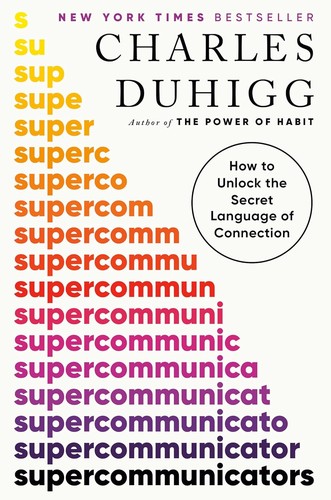
Supercommunicators
by Charles Duhigg · 2024
Most bad conversations aren't about disagreement -- they're two people having entirely different kinds of conversation at once.
Worth reading? Supercommunicators is the best communication book since Crucial Conversations, and it's more research-grounded than most of its category. Duhigg's three-conversation-types framework (practical, emotional, social) is simple enough to actually use mid-conversation, which is more than you can say for most active-listening advice. Skip it only if you've already internalized 'match the conversation type' from somewhere else.
| Full Title | Supercommunicators: How to Unlock the Secret Language of Connection |
|---|---|
| Author | Charles Duhigg |
| Published | 2024 |
| Publisher | Random House |
| Category | Self-Improvement & Psychology |
| Favorite quote | “The most effective communicators pause before they speak and ask themselves: Why am I opening my mouth?” |
The Verdict
Duhigg’s three-conversation-types idea sounds obvious once you hear it, which is exactly why it works – you’ll start noticing it mid-argument within a week of reading this. Most communication books give you vibes; this one gives you a diagnostic you can run in real time.
It’s not flawless. The negotiation chapters run a little long, and some of the case studies (a CIA interrogation, a jury deliberation) are more entertaining than directly applicable to your Tuesday-night argument with your partner. Still, this is the one to read first.
you want a practical framework for why conversations go sideways and how to fix them in real time
you've already read Nonviolent Communication or Crucial Conversations and want a genuinely new framework, not a research-backed restatement
Book Summary
Duhigg's central claim is that every conversation is really one of three kinds: practical (what's this actually about), emotional (how do we feel), or social (who are we to each other). Most miscommunication happens when two people are having different kinds of conversation simultaneously -- one person wants problem-solving while the other wants to be heard. Supercommunicators aren't naturally gifted; they consciously identify which kind of conversation is happening and match it, often by asking "deep questions" about values and experience instead of surface small talk, and by "looping for understanding" -- repeating back what they heard in their own words and checking if they got it right. The book extends this into negotiation and difficult conversations, arguing the best negotiators treat the exchange as a creative, collaborative act rather than a battle. Duhigg also flags that digital communication strips out the cues that let us detect which type of conversation we're in, which is why texts and emails misfire so often.
Top 10 Lessons from Supercommunicators
- Every conversation is practical, emotional, or social -- identify which one you're in before responding.
- Miscommunication usually happens when two people are having different types of conversation at the same time.
- 'Looping for understanding': repeat back what you heard in your own words, then ask if you got it right.
- Ask 'deep questions' about values, beliefs, and experiences instead of defaulting to surface small talk.
- Pause before speaking and ask yourself why you're about to say what you're about to say.
- Matching someone's energy and tone builds unconscious rapport faster than matching their words.
- Top negotiators treat negotiation as a creative, collaborative act, not an adversarial battle.
- Vulnerability loops -- one person shares something real, inviting the other to reciprocate -- build trust quickly.
- Digital communication strips out the tonal and physical cues that signal which type of conversation is happening, which is why texts misfire.
- Supercommunicating is a learnable skill built from specific techniques, not an innate personality trait.
Top 4 Quotes from Supercommunicators
"Miscommunication occurs when people are having different kinds of conversations. If you are speaking emotionally, while I'm talking practically, we are, in essence, using different cognitive languages."
Charles Duhigg, Supercommunicators
"The most effective communicators pause before they speak and ask themselves: Why am I opening my mouth?"
Charles Duhigg, Supercommunicators
"Negotiation, among its top practitioners, isn't a battle. It's an act of creativity."
Charles Duhigg, Supercommunicators
"It's a fairly simple technique—prove you are listening by asking the speaker questions, reflecting back what you just heard, and then seeking confirmation you understand—but studies show it is the single most effective technique for proving to someone that we want to hear them."
Charles Duhigg, Supercommunicators
Frequently Asked Questions
Is Supercommunicators worth reading?
Yes -- it's the most usable communication framework in years, backed by real research rather than generic advice about eye contact and active listening.
What is the main idea of Supercommunicators?
That every conversation is practical, emotional, or social, and most miscommunication happens when two people are having different types of conversation without realizing it.
How is Supercommunicators different from other communication books?
It gives you a diagnostic (which type of conversation is this) instead of just a list of listening tips, which makes it easier to apply mid-conversation.
Who should read Supercommunicators?
Anyone who wants a practical framework for why conversations go wrong and how to redirect them in the moment -- managers, partners, and anyone who negotiates for a living.
Ready to read it?
Get Supercommunicators on Amazon