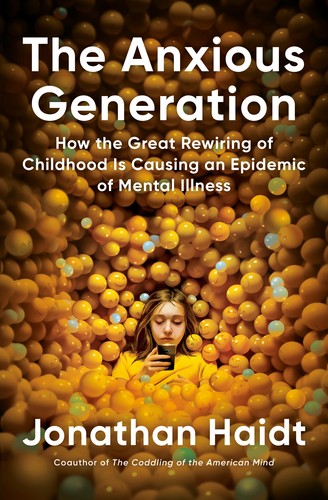
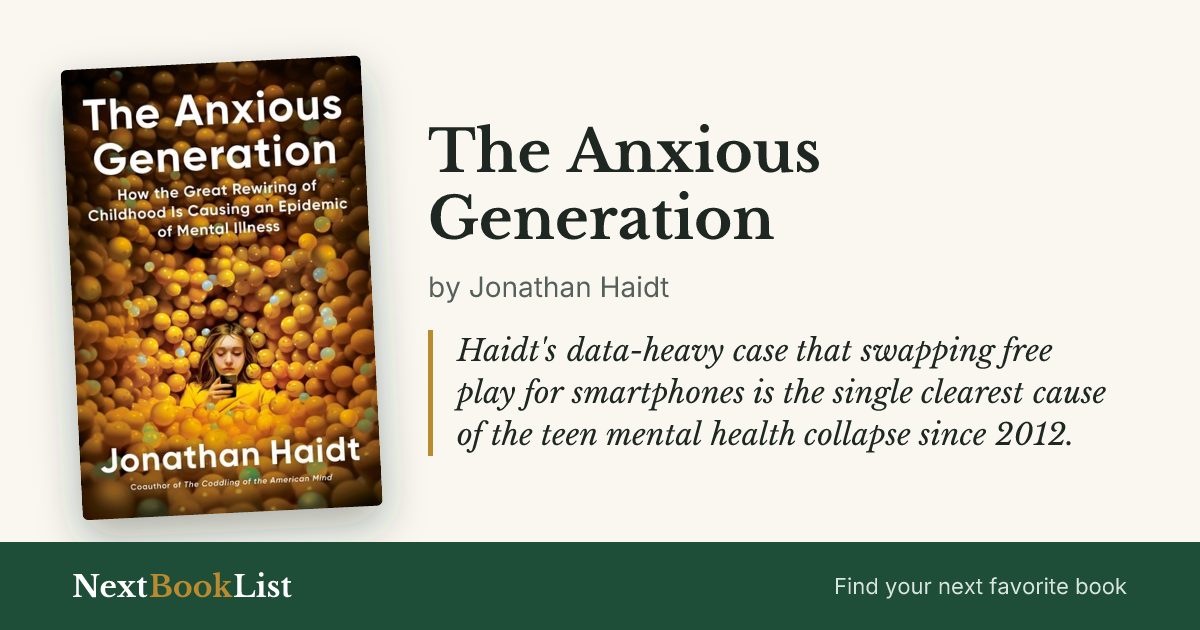
The Anxious Generation
by Jonathan Haidt · 2024
Haidt's data-heavy case that swapping free play for smartphones is the single clearest cause of the teen mental health collapse since 2012.
Worth reading? The Anxious Generation makes a blunt causal claim most books hedge on: the shift from a "play-based childhood" to a "phone-based childhood" starting around 2010-2015 is the primary driver of the spike in teen anxiety, depression, and self-harm. Compared to Haidt's earlier The Coddling of the American Mind, this one is narrower and more actionable, four concrete rules instead of a broad cultural diagnosis. The data section is the book's strength and its most argued-over part; go in expecting a strong thesis, not a balanced literature review. Skip it if you want nuance over conviction. Read it if you're making a phone or social-media decision for a kid right now.
| Full Title | The Anxious Generation: How the Great Rewiring of Childhood Is Causing an Epidemic of Mental Illness |
|---|---|
| Author | Jonathan Haidt |
| Published | 2024 |
| Publisher | Penguin Press |
| Category | Self-Improvement & Psychology |
| Favorite quote | “We have overprotected our children in the real world and underprotected them online.” |
The Verdict
Haidt doesn’t hedge: the swap from play-based to phone-based childhood is, in his read, the primary driver of the teen mental health collapse since 2010. Whether or not you buy every causal claim, the four rules (no phones before high school, no social media before 16, phone-free schools, more real-world independence) are worth deciding on deliberately rather than by default.
you're a parent, teacher, or anyone deciding when a kid gets a smartphone or social media account
you want parenting tactics for toddlers -- this is squarely about adolescence, phones, and social media
Book Summary
Something changed for teen mental health specifically between 2010 and 2015, coinciding with the rise of smartphones with front-facing cameras and the arrival of social media in its current, algorithm-driven form. Haidt argues this isn't correlation, it's the primary cause.
Childhood shifted from "play-based" (unsupervised, risk-taking, physically social) to "phone-based" (supervised in person but unsupervised online, sedentary, socially mediated by algorithms). That swap removed the exact experiences kids need to build resilience.
Haidt proposes four concrete rules: no smartphones before high school, no social media before 16, phone-free schools, and far more unsupervised play and independence in the real world. The fixes are collective-action problems, not individual willpower problems.
Top 8 Lessons from The Anxious Generation
- Teen mental health didn't decline gradually, it broke sharply around 2010-2015, tracking the rise of smartphones and social media.
- Play-based childhood built resilience through risk, boredom, and unsupervised social friction; phone-based childhood removed all three.
- No smartphones before high school; delay the always-on internet in a kid's pocket as long as socially possible.
- No social media before age 16; the algorithmic feed format is the specific harm, not screens in general.
- Phone-free schools improve both attention and in-person social bonding, and it has to be a whole-school policy to work.
- Kids need far more unsupervised, real-world independence and risk-taking than modern parenting typically allows.
- This is a collective action problem: no single family can fix it by opting out alone, because peer networks are the actual product.
- Algorithmic social media specifically harms teen girls' mental health more than boys', largely through social comparison.
Top 3 Quotes from The Anxious Generation
"We have overprotected our children in the real world and underprotected them online."
Jonathan Haidt, The Anxious Generation
"The play-based childhood was replaced by the phone-based childhood."
Jonathan Haidt, The Anxious Generation
"Human childhood, everywhere, is a preparation for adult life, via play."
Jonathan Haidt, The Anxious Generation
Frequently Asked Questions
Is The Anxious Generation worth reading?
Yes, especially for parents deciding on a first smartphone or social media account. It's a strong-conviction, data-driven case, not a hedged literature review.
What are the four rules from The Anxious Generation?
No smartphones before high school, no social media before 16, phone-free schools, and far more unsupervised real-world play and independence for kids.
Is the book controversial?
Some researchers dispute how strongly the data proves causation versus correlation. Read it as a strong argument backed by real data, not an uncontested consensus.
Ready to read it?
Get The Anxious Generation on Amazon