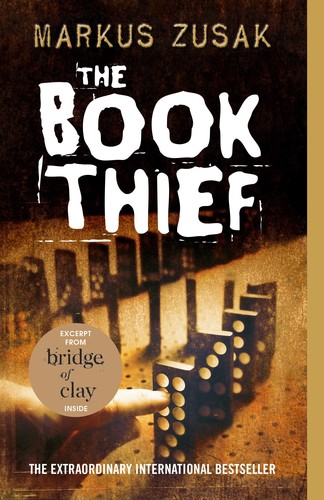
The Book Thief
by Markus Zusak · 2005
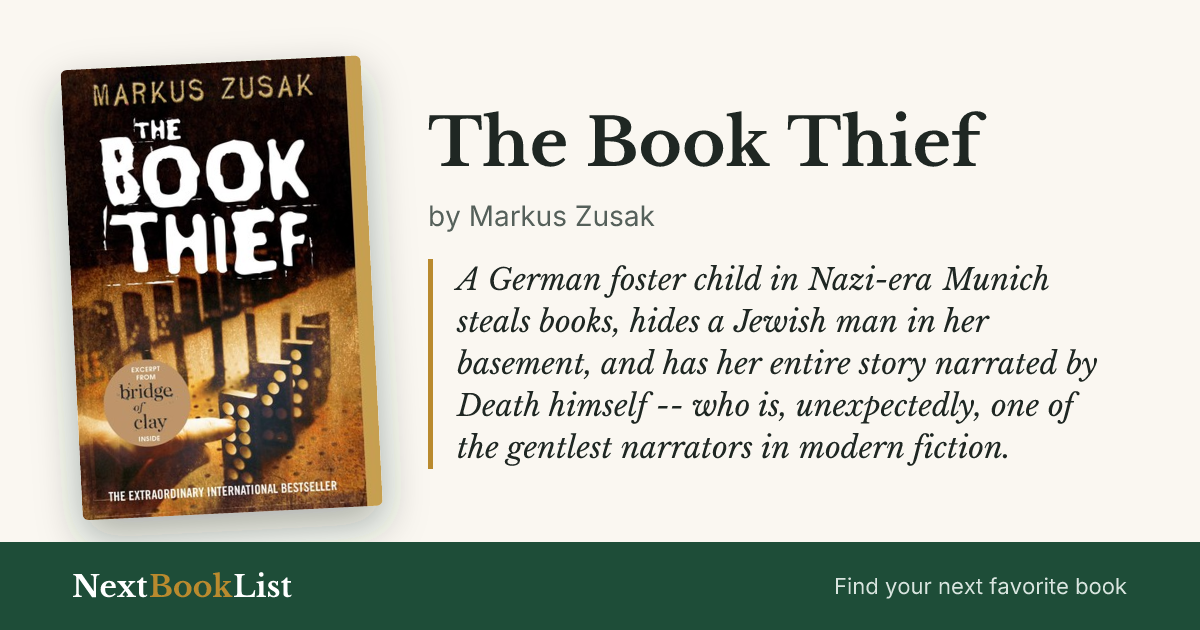
A German foster child in Nazi-era Munich steals books, hides a Jewish man in her basement, and has her entire story narrated by Death himself -- who is, unexpectedly, one of the gentlest narrators in modern fiction.
Worth reading? The Book Thief succeeds almost entirely on the strength of its narrator. Having Death tell Liesel's story, matter-of-fact about mortality, oddly tender about the living, turns what could've been a fairly standard WWII coming-of-age story into something genuinely distinct. Zusak also does something less common in WWII fiction: he centers an ordinary German family sheltering a Jewish man, showing quiet resistance and complicity coexisting in the same household without resolving that tension neatly.
| Author | Markus Zusak |
|---|---|
| Published | 2005 |
| Publisher | Alfred A. Knopf |
| Category | Fiction |
| Favorite quote | “I have hated the words and I have loved them, and I hope I have made them right.” |
The Verdict
Death as narrator is the choice that makes this book. Zusak commits fully to it, letting Death spoil major plot points well in advance and comment freely on human nature throughout, and instead of undercutting tension, it builds a different, slower kind of dread that suits the material better than a conventional narrator would.
The choice to center an ordinary German family is the book’s other real strength. It doesn’t let the family’s decency stand in for the whole country’s, book burnings and deportations happen in full view, but it does insist that individual moral courage existed even under a regime built to crush it.
Read it if you want WWII fiction with a genuinely original narrative voice and an angle you don’t see often. Skip it if you’d rather your narrator stay out of the way and let the plot unfold without commentary.
you want WWII fiction told from an unusual angle (an ordinary German family, not a Jewish or Allied perspective) narrated by a genuinely original device that never feels gimmicky once you settle into it
you want the narration to stay out of the way of the plot -- Death interjects constantly with foreshadowing, asides, and philosophical commentary, a stylistic choice some readers find intrusive rather than atmospheric
Book Summary
Liesel Meminger, a foster child placed with a working-class German couple outside Munich in 1939, begins stealing books, first from a gravedigger, later from a Nazi book-burning, and books become both her escape from wartime hardship and a genuine act of quiet defiance against the regime's control of ideas.
Death itself narrates the novel, having encountered Liesel's story while collecting souls during the war, and uses that vantage point to move freely across time, foreshadowing events (including character deaths) well before they happen, a structural choice that trades conventional suspense for a different kind of dread.
Liesel's foster family hides Max, a Jewish man, in their basement for years, and Zusak uses that arrangement to show ordinary Germans capable of real moral courage under extreme risk, without pretending that courage was common or that the surrounding town wasn't largely complicit in or indifferent to the regime.
The novel treats language and storytelling itself as a central theme, words used to indoctrinate (Nazi propaganda) versus words used to connect and resist (the books Liesel steals and eventually writes herself), making the title's small act of theft a genuinely political one.
Top 10 Lessons from The Book Thief
- Having Death narrate the novel, rather than a human character, lets Zusak foreshadow tragedy openly and repeatedly, trading conventional plot suspense for a sustained, different kind of emotional weight.
- Liesel's book theft is framed as a specific, meaningful act of resistance against a regime built on controlling language and ideas, not just a charming character quirk.
- The novel centers an ordinary working-class German family's choice to hide a Jewish man, showing that moral courage under Nazi rule existed at the individual household level even as the surrounding society remained largely complicit.
- Max's basement confinement and his friendship with Liesel, built partly around storytelling and shared books, is used to show how narrative itself becomes a lifeline under conditions of extreme isolation and danger.
- The book doesn't let its German setting soften the regime's violence, book burnings, deportations, bombing raids all appear directly, refusing to make the 'ordinary German family' angle into a comfortable or exculpatory frame.
- Death's own commentary throughout the novel repeatedly emphasizes that it finds humans simultaneously horrifying and beautiful, a tension the book applies directly to its portrait of a country capable of both atrocity and quiet acts of decency.
- Rudy Steiner's unreciprocated love for Liesel, and his own quiet acts of defiance built around his hero-worship of Jesse Owens, give the novel a second, smaller tragedy running alongside its main plot.
- Hans Hubermann's instinctive act of giving bread to a Jewish prisoner being marched through town shows moral courage as something spontaneous and immediately costly, not calculated or safe.
- Rosa Hubermann's harsh, insult-laden exterior is revealed over the course of the novel to conceal real tenderness, complicating the book's portrait of what love looks like under hardship.
- Liesel's own act of writing a book about her life, the very novel Death is narrating, closes the loop on the story's central theme that words can be either weapon or refuge depending on who wields them.
Top 5 Quotes from The Book Thief
"I have hated the words and I have loved them, and I hope I have made them right."
Markus Zusak, The Book Thief
"The only thing worse than a boy who hates you: a boy that loves you."
Markus Zusak, The Book Thief
"A snowball in the face is surely the perfect beginning to a lasting friendship."
Markus Zusak, The Book Thief
"He was the book thief without the words. Trust me, though, the words were on their way, and when they arrived, Liesel would hold them in her hands like the clouds, and she would wring them out like rain."
Markus Zusak, The Book Thief
"I am haunted by humans."
Markus Zusak, The Book Thief
Frequently Asked Questions
Is The Book Thief worth reading?
Yes -- its narration by Death is genuinely original, and its focus on an ordinary German family sheltering a Jewish man offers a less common angle on WWII fiction.
What is The Book Thief about?
A German foster child in Nazi-era Munich who steals books and helps her foster family hide a Jewish man in their basement, narrated by Death itself.
Is The Book Thief appropriate for younger readers?
It's widely read by teens and often assigned in schools, though it depicts real wartime violence and loss that warrant some parental awareness for younger or sensitive readers.
Why does Death narrate The Book Thief?
Zusak uses Death as narrator to allow open foreshadowing of major events and to offer a perspective on mortality and humanity that a conventional human narrator couldn't provide.
Is there a movie version of The Book Thief?
Yes, a 2013 film adaptation, though it omits much of Death's narration that gives the novel its distinct voice.
Ready to read it?
Get The Book Thief on Amazon