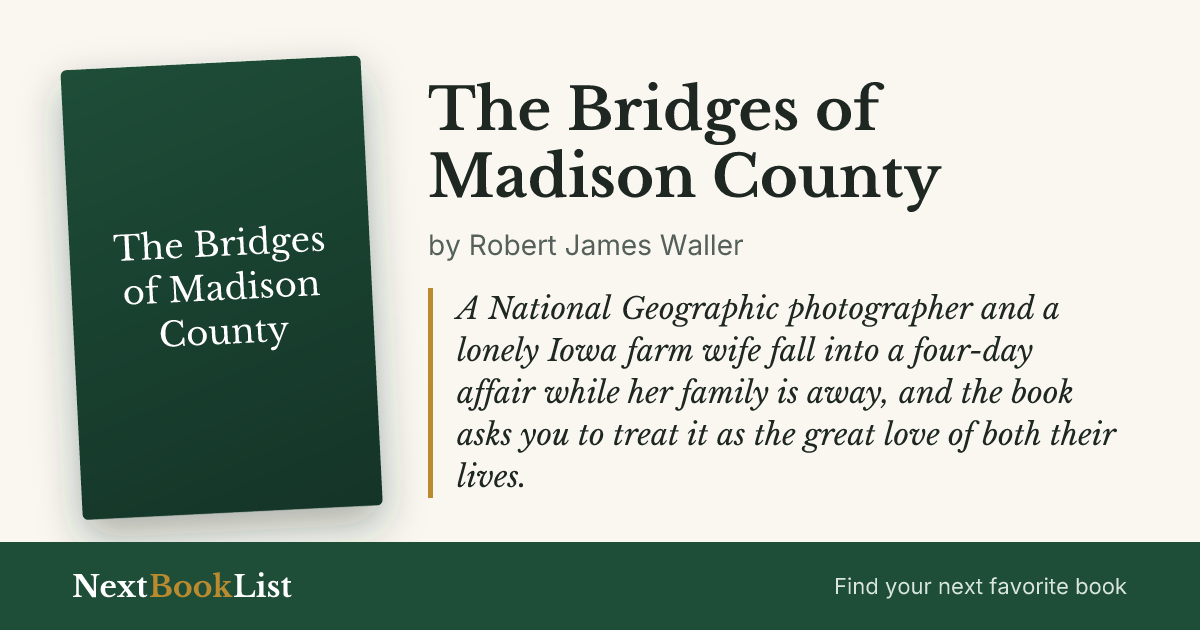
The Bridges of Madison County
by Robert James Waller · 1992
A National Geographic photographer and a lonely Iowa farm wife fall into a four-day affair while her family is away, and the book asks you to treat it as the great love of both their lives.
Worth reading? The Bridges of Madison County was a cultural phenomenon for a reason: it's short, unabashedly sentimental, and built around a single, clean emotional question. It's also aged into something closer to a curiosity -- the prose is purple in a way contemporary romance has mostly moved past, and the moral weight it puts on Francesca's choice hasn't worn evenly.
| Author | Robert James Waller |
|---|---|
| Published | 1992 |
| Publisher | Warner Books |
| Category | Fiction |
| Favorite quote | “In a universe of ambiguity, this kind of certainty comes only once, and never again, no matter how many lifetimes you live.” |
The Verdict
What made this a phenomenon is exactly what dates it now: the prose leans hard into a kind of earnest, unguarded sentimentality that a lot of readers in 1992 hadn’t seen in a mainstream bestseller, and that reads closer to overwrought today.
The bigger issue is where the book puts its sympathy. It’s far more curious about Robert’s wandering-photographer mythology than about what four days of secrecy actually cost Francesca’s marriage, and her husband and kids barely register as people with something to lose.
It’s short, and that brevity is doing real work – the affair never has to survive contact with ordinary life, so the book gets to stay wistful instead of reckoning with anything messier.
Read it if you want the template for the modern short adult romance, sentiment and all. Skip it if you want a love story willing to look honestly at who an affair actually hurts.
you want the original blueprint for the modern short, sentimental adult romance -- brief, wistful, built around one impossible choice
you find the book's prose earnest to the point of self-parody, or you want a love story that grapples honestly with the family being betrayed instead of mostly looking away from them
Book Summary
Robert Kincaid, a photographer on assignment to shoot the covered bridges of Madison County, Iowa, stops at a farmhouse to ask directions and meets Francesca Johnson, whose husband and children are away at the state fair. Over four days, they fall into an affair that both of them frame as the one true connection of their lives.
The book's structure is a device: it's presented as a story assembled from Francesca's journals after her death, discovered by her adult children, which lets Waller narrate the affair with hindsight and inevitability rather than as something happening in real time with real consequences for her family.
Francesca ultimately chooses to stay married rather than leave with Robert, and the novel treats that choice as tragic rather than as the more complicated, arguably more responsible decision it actually is -- the book is far more interested in the romance of what she gave up than in the family she chose to protect.
Top 10 Lessons from The Bridges of Madison County
- The novel frames marital duty and desire as pure opposites, with almost no interest in what a version of fulfillment inside the marriage might have looked like.
- Waller uses the found-journal frame to grant the affair retrospective significance it might not have earned told in real time.
- The book is far more curious about Robert's inner life and mythology (the drifting photographer, unbound by domestic life) than about what staying costs Francesca day to day.
- Its brevity is the format's biggest asset -- the entire affair fits in four days, which keeps the sentiment from curdling into something the plot would have to reckon with.
- The husband and children exist almost entirely offstage, which makes it easy for the book to avoid examining what the affair would mean to the people it would actually hurt.
- The novel's massive commercial success set the template many later short, wistful adult romances (including several by Nicholas Sparks) would follow almost beat for beat.
- Francesca's backstory as an Italian war bride who left a more cosmopolitan life for rural Iowa recontextualizes the affair as a reawakened identity rather than simple betrayal, though the book never lets her family's needs compete on equal terms with that longing.
- Robert Kincaid is written as a rootless wanderer whose entire life before Francesca reads as a search for the one person capable of truly seeing him, a framing that asks readers to romanticize his solitude rather than question it.
- The novel's brevity and its journal-based framing device work together to keep the affair feeling timeless and inevitable rather than examined as a real decision with real consequences.
- Critical backlash to the book's success centered on exactly this asymmetry -- reviewers noted it asks readers to mourn a choice not made rather than reckon honestly with the family the choice would have destroyed.
Top 4 Quotes from The Bridges of Madison County
"In a universe of ambiguity, this kind of certainty comes only once, and never again, no matter how many lifetimes you live."
Robert James Waller, The Bridges of Madison County
"The human heart has a way of making itself large again even after it's been broken into a million pieces."
Robert James Waller, The Bridges of Madison County
"Analysis destroys wholes. Some things, magic things, are meant to stay whole. If you look at their pieces, they go away."
Robert James Waller, The Bridges of Madison County
"We have both lost ourselves and created something else, something that exists only as an interlacing of the two of us. Christ, we're in love. As deeply, as profoundly, as it's possible to be in love."
Robert James Waller, The Bridges of Madison County
Frequently Asked Questions
Is The Bridges of Madison County worth reading?
If you want the original of this particular short, sentimental romance format, yes -- just go in expecting earnest, sometimes overwrought prose rather than a nuanced look at the affair's consequences.
What is The Bridges of Madison County about?
A four-day affair between a photographer and a married Iowa farm woman, framed as a story pieced together from her journals after her death.
Is The Bridges of Madison County based on a true story?
No, it's fiction, though Waller wrote it in the style of a discovered real account, which added to its early buzz.
Why was The Bridges of Madison County so popular in the 1990s?
Its brevity, sentimentality, and framing as a tragic once-in-a-lifetime love story made it an easy, emotionally intense read that dominated bestseller lists for years.
How does the book differ from the 1995 film?
The film gives more interiority to Francesca and softens some of the book's more purple prose, but the core plot and ending are the same.
Ready to read it?
Get The Bridges of Madison County on Amazon