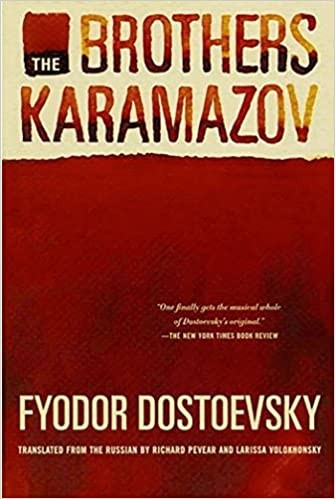
The Brothers Karamazov
by Fyodor Dostoevsky · 1880
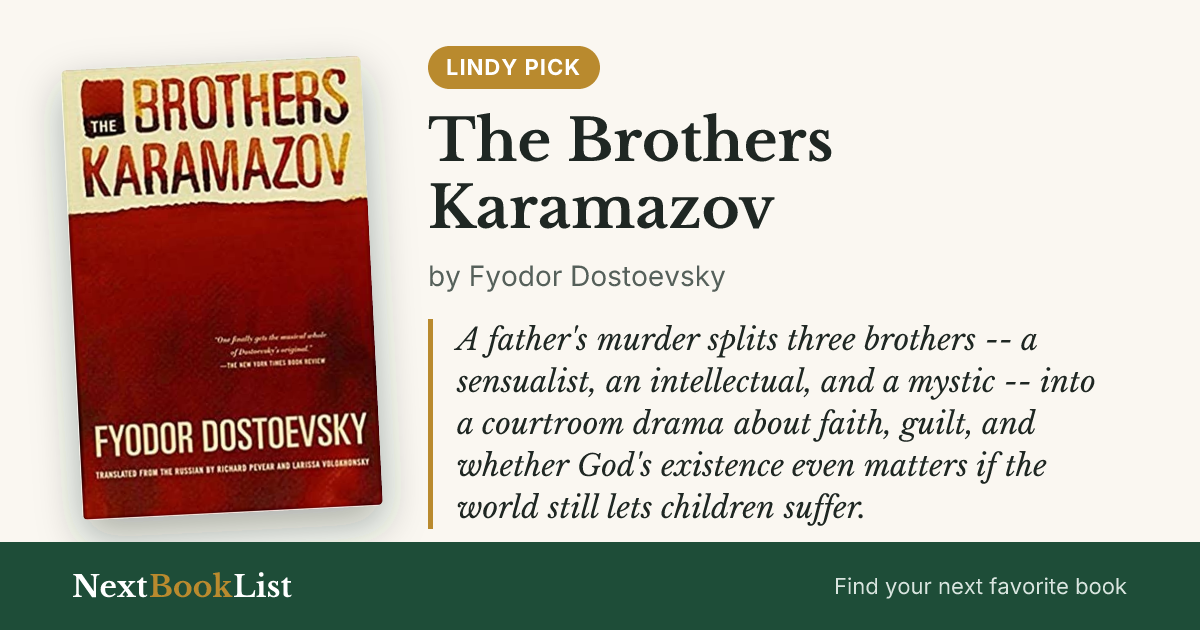
A father's murder splits three brothers -- a sensualist, an intellectual, and a mystic -- into a courtroom drama about faith, guilt, and whether God's existence even matters if the world still lets children suffer.
Worth reading? The Brothers Karamazov is the novel other novelists point to when they want to explain what fiction can do that philosophy can't. It's also long, digressive, and demands patience most modern readers aren't used to giving a book. Read it for the Grand Inquisitor chapter alone if nothing else -- it's one of the sharpest arguments against organized religion ever written by a devout believer.
| Full Title | The Brothers Karamazov |
|---|---|
| Author | Fyodor Dostoevsky |
| Published | 1880 |
| Publisher | Farrar, Straus and Giroux |
| Category | Fiction |
| Favorite quote | “It's not God that I don't accept, Alyosha, only I most respectfully return him the ticket.” |
The Verdict
Give this one real time. It’s not a book you finish in a week unless reading is your full-time job, and trying to rush it just turns the courtroom chapters into a slog.
The Grand Inquisitor chapter is worth the price of admission by itself – it’s the best few pages of religious argument in any novel, and Dostoevsky stacks the deck against his own faith on purpose. That’s the kind of intellectual honesty that makes the rest of the book earn your trust.
Skip it if you’re looking for a plot-driven murder mystery. The murder is almost incidental; the real story is what each brother believes and why, and if you don’t have patience for long philosophical dialogue, you’ll be fighting the book the whole way through.
If you’ve never read Dostoevsky, start with Crime and Punishment instead – it’s shorter, tighter, and will tell you fast whether his style works for you before you commit to this one.
you want the most ambitious novel about faith and doubt ever written, and you're willing to give it the time a real commitment deserves
you want a tight plot and a fast read -- this is 800+ pages of digression, courtroom testimony, and philosophical monologue wrapped around a murder mystery
Book Summary
Fyodor Karamazov, a vulgar and dissolute landowner, is murdered, and suspicion falls on his son Dmitri -- but the novel is less interested in whodunit than in what each of the three (or four, counting Smerdyakov) sons represents: appetite, intellect, faith, and resentment, all fighting for the old man's inheritance and his soul.
Ivan's rebellion against God, delivered through the "Grand Inquisitor" parable, is the philosophical core: if God's world requires the suffering of even one innocent child, Ivan says, he respectfully returns his ticket. Dostoevsky doesn't refute this cheaply -- he lets it stand as the strongest argument in the book, then answers it with Alyosha's lived faith rather than a counter-argument.
The murder trial in the final third turns the novel into a meditation on how truth gets distorted by rhetoric, class prejudice, and the human need for a satisfying story -- the courtroom convicts the wrong brother not from lack of evidence but from a failure of imagination.
Underneath the theology is a family drama about fathers who fail their sons and sons who inherit that failure in different forms -- Dmitri's rage, Ivan's coldness, Alyosha's search for a father figure in the monastery, all traceable back to the same absent parent.
Top 8 Lessons from The Brothers Karamazov
- The 'problem of evil' gets its most famous literary treatment here: if a good God allows innocent suffering, is faith still rational -- and Dostoevsky lets the strongest version of 'no' stand unanswered by argument.
- Ivan's Grand Inquisitor accuses Christ of overestimating humanity's capacity for freedom -- people want bread and certainty, not the terrifying responsibility of choosing good on their own.
- Dmitri's arc argues that a man can be guilty of everything except the specific crime he's convicted of -- moral guilt and legal guilt aren't the same thing.
- Alyosha represents faith as a practice, not a debate win -- he never out-argues Ivan, he just lives differently.
- The novel treats each brother as a real argument about how to live, not a mouthpiece -- you're meant to feel the pull of all three, not just root for the 'right' one.
- Smerdyakov, the illegitimate fourth brother, embodies what happens when Ivan's 'everything is permitted' philosophy gets taken literally by someone with nothing to lose.
- The courtroom section argues that a community's need for narrative closure can override its interest in actual truth.
- Fatherhood, or its absence, is the engine under the theology -- every brother's philosophy can be read as a response to being failed by Fyodor Karamazov.
Top 5 Quotes from The Brothers Karamazov
"It's not God that I don't accept, Alyosha, only I most respectfully return him the ticket."
Fyodor Dostoevsky, The Brothers Karamazov
"The awful thing is that beauty is mysterious as well as terrible. God and the devil are fighting there and the battlefield is the heart of man."
Fyodor Dostoevsky, The Brothers Karamazov
"Every one is really responsible to all men for all men and for everything."
Fyodor Dostoevsky, The Brothers Karamazov
"Life is paradise, and we are all in paradise, but we refuse to see it."
Fyodor Dostoevsky, The Brothers Karamazov
"Dear friends, don't be afraid of life! How good is life when one does something good and just!"
Fyodor Dostoevsky, The Brothers Karamazov
Frequently Asked Questions
Is The Brothers Karamazov worth reading?
Yes, if you want the most serious novel ever written about faith, doubt, and family -- but it's a real time commitment, not a casual read.
What is The Brothers Karamazov about?
Three brothers, and their murdered father, become the occasion for Dostoevsky's biggest argument about whether faith can survive the existence of suffering.
Which translation of The Brothers Karamazov should I read?
The Pevear and Volokhonsky translation is the modern standard and the one most critics recommend; the older Constance Garnett translation reads more old-fashioned but is also widely available.
Do I need to know Russian literature to understand it?
No -- the novel explains its own philosophical stakes as it goes, though a basic sense of 19th-century Russian Orthodox context helps with the monastery chapters.
Is The Brothers Karamazov hard to read?
It's long and occasionally digressive, but the prose itself isn't difficult -- the challenge is stamina, not vocabulary.
Ready to read it?
Get The Brothers Karamazov on Amazon