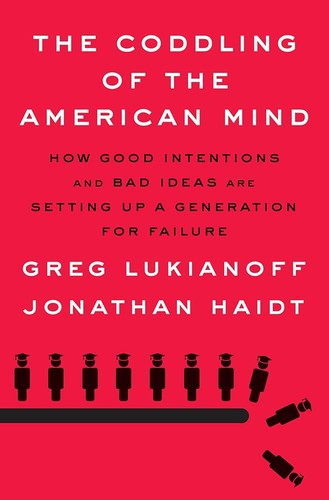
The Coddling of the American Mind
by Greg Lukianoff & Jonathan Haidt · 2018
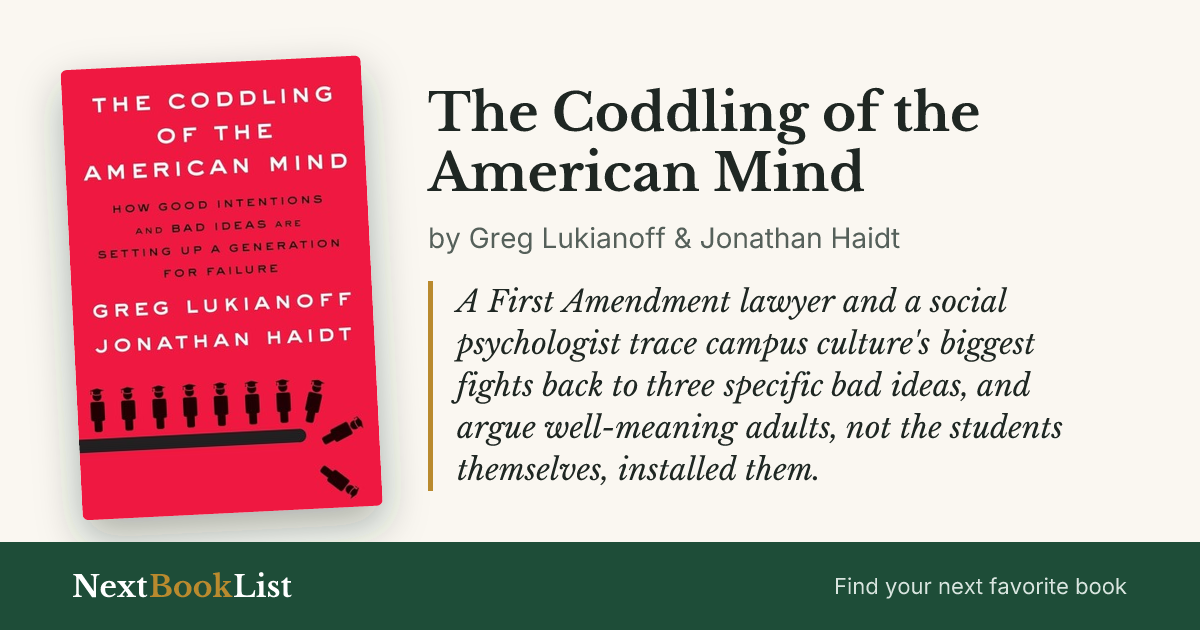
A First Amendment lawyer and a social psychologist trace campus culture's biggest fights back to three specific bad ideas, and argue well-meaning adults, not the students themselves, installed them.
Worth reading? Lukianoff, a free-speech lawyer, and Haidt, a social psychologist who also wrote The Righteous Mind, trace campus free-speech controversies and rising youth anxiety back to three 'Great Untruths' absorbed by a generation raised with unusually protective parenting: what doesn't kill you makes you weaker (rather than stronger), always trust your feelings (rather than treating them as one data point among several), and life is a battle between good people and evil people (rather than a more complicated moral landscape). They investigate six overlapping trends -- from the decline of unsupervised childhood play to the corporatization of universities to smartphone-driven social media -- as contributing causes, spreading responsibility broadly rather than blaming any single actor or political side.
| Full Title | The Coddling of the American Mind: How Good Intentions and Bad Ideas Are Setting Up a Generation for Failure |
|---|---|
| Author | Greg Lukianoff & Jonathan Haidt |
| Published | 2018 |
| Category | Sociology & Culture |
| Favorite quote | “Prepare the child for the road, not the road for the child.” |
The Verdict
Lukianoff and Haidt’s deliberate choice to spread causal responsibility across parenting, education, technology, and politics broadly, rather than picking a single villain, is part of what’s made the book cited across a genuinely wide ideological range since publication – it’s harder to dismiss as partisan than most books tackling the same territory.
you want a research-grounded, cross-ideological analysis of how protective parenting and campus culture may be undermining young people's resilience
you want a book that lets any single political side off the hook -- Lukianoff and Haidt spread responsibility across parenting, education, politics, and technology broadly, not one ideological faction
Book Summary
The authors identify three "Great Untruths" they argue have been unintentionally absorbed by a generation of young people, largely through well-intentioned protective parenting and institutional practices: the untruth of fragility ("what doesn't kill you makes you weaker," rather than the older, more accurate framing that manageable adversity builds resilience), the untruth of emotional reasoning ("always trust your feelings," rather than treating feelings as useful but fallible information), and the untruth of us-versus-them ("life is a battle between good people and evil people," rather than a more complicated moral landscape most situations actually present).
They trace these untruths to overlapping causes including a dramatic decline in unsupervised childhood play (reducing opportunities to develop independent risk assessment and conflict resolution), increased academic and social media pressure, the rise of "safetyism" treating emotional discomfort as equivalent to physical danger, and universities increasingly organized around a customer-service model that discourages exposing students to genuinely challenging ideas -- arguing all of these, well-intentioned individually, combine to undermine the resilience they're meant to protect.
Top 7 Lessons from The Coddling of the American Mind
- The 'untruth of fragility': treating manageable adversity as something to be avoided, rather than as what actually builds resilience.
- The 'untruth of emotional reasoning': treating feelings as always accurate, rather than as useful but sometimes misleading information.
- The 'untruth of us-versus-them': framing disagreements as battles between good and evil people, rather than as more complicated moral disagreements.
- A significant decline in unsupervised childhood play may reduce opportunities to develop independent risk assessment and conflict resolution skills.
- 'Safetyism' -- treating emotional discomfort as equivalent to physical danger -- can undermine the resilience it's intended to protect.
- Universities organized around a customer-service model may avoid exposing students to genuinely challenging ideas, at a real cost to intellectual development.
- Well-intentioned protective practices, pursued individually by parents, schools, and institutions, can combine into effects none of them intended.
Top 4 Quotes from The Coddling of the American Mind
"Prepare the child for the road, not the road for the child."
Greg Lukianoff & Jonathan Haidt, The Coddling of the American Mind
"University life -- along with civic life -- dies without the free exchange of ideas. In the face of intimidation, educators must speak up, not shut down. Ours is a position of unique responsibility: We teach people not what to think, but how to think."
Greg Lukianoff & Jonathan Haidt, The Coddling of the American Mind
"A culture that allows the concept of "safety" to creep so far that it equates emotional discomfort with physical danger is a culture that encourages people to systematically protect one another from the very experiences embedded in daily life that they need in order to become strong and healthy."
Greg Lukianoff & Jonathan Haidt, The Coddling of the American Mind
"Education should not be intended to make people comfortable; it is meant to make them think."
Greg Lukianoff & Jonathan Haidt, The Coddling of the American Mind
Frequently Asked Questions
Is The Coddling of the American Mind worth reading?
Yes, especially if you want a research-grounded, cross-ideological analysis of campus culture and youth anxiety trends. The authors deliberately spread responsibility across parenting, education, and technology rather than blaming a single political side.
What are the three 'Great Untruths' in The Coddling of the American Mind?
The untruth of fragility (what doesn't kill you makes you weaker), the untruth of emotional reasoning (always trust your feelings), and the untruth of us-versus-them (life is a battle between good and evil people).
Is The Coddling of the American Mind only about college campuses?
It centers heavily on campus free-speech controversies, but the authors trace the underlying causes back through childhood parenting practices, K-12 education, and social media, arguing the issue extends well beyond universities specifically.
How does this book relate to Haidt's other book, The Righteous Mind?
Both are by Jonathan Haidt and apply psychological research to social and political questions, though The Righteous Mind focuses on moral and political disagreement broadly, while The Coddling of the American Mind focuses specifically on generational resilience and campus culture.
Ready to read it?
Get The Coddling of the American Mind on Amazon