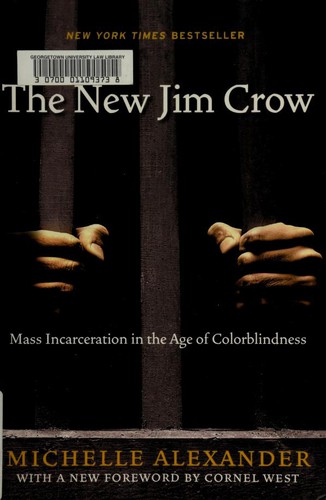
The New Jim Crow
by Michelle Alexander · 2010
A civil rights lawyer's argument that the War on Drugs rebuilt a racial caste system under the cover of colorblind law, and that mass incarceration is functioning as the mechanism, not a side effect.
Worth reading? Alexander's central claim, made as a former ACLU litigator with direct experience in the cases she's describing, is that mass incarceration -- driven substantially by the War on Drugs and disproportionately targeting Black communities despite similar drug use rates across racial groups -- functions as a new racial caste system operating under the cover of formally colorblind law. Once someone has a felony conviction, she argues, they face legal discrimination in employment, housing, voting rights, and public benefits that mirrors Jim Crow-era exclusion, just without the explicit racial language, since the discrimination is now nominally based on criminal record rather than race directly. The book spent nearly 250 weeks on the New York Times bestseller list and has been cited in judicial decisions since its publication.
| Full Title | The New Jim Crow: Mass Incarceration in the Age of Colorblindness |
|---|---|
| Author | Michelle Alexander |
| Published | 2010 |
| Category | Sociology & Culture |
| Favorite quote | “We have not ended racial caste in America; we have merely redesigned it.” |
The Verdict
Alexander’s background as a practicing litigator, not just an academic observer, gives the book’s central argument a specificity most policy-level criminal justice writing lacks – she’s describing patterns she encountered directly in casework, not synthesizing secondhand research from a distance.
you want the foundational legal and sociological argument connecting the War on Drugs to systemic racial control, from a lawyer who spent years litigating these cases directly
you want a purely historical or statistical treatment -- Alexander is making a sustained legal and moral argument throughout, not a neutral survey of criminal justice data
Book Summary
Alexander argues the War on Drugs, despite roughly equal drug use rates across racial groups, has been enforced with dramatically disproportionate impact on Black communities, producing mass incarceration at a scale and racial concentration that functions, in practical effect, as a new caste system -- one that operates through formally race-neutral law (targeting "criminals," not explicitly targeting race) while producing outcomes strikingly similar to explicit Jim Crow-era racial exclusion.
Her most consequential specific argument concerns what happens after release: a felony conviction carries legal permission for discrimination in employment, housing, voting rights (in many states), and eligibility for public benefits that don't apply to people without a record -- meaning the punishment doesn't end with a prison sentence, it extends into permanent second-class legal and economic status that Alexander argues functions as a redesigned, rather than ended, racial caste system.
Top 7 Lessons from The New Jim Crow
- The War on Drugs has been enforced with dramatically disproportionate racial impact despite roughly equal drug use rates across racial groups.
- A felony conviction carries legal permission for discrimination in employment, housing, voting rights, and public benefits that extends punishment well past a prison sentence.
- Formally race-neutral law (targeting 'criminals' rather than explicit race) can still produce outcomes functionally similar to explicit historical racial exclusion.
- Mass incarceration at scale and racial concentration can function as a caste system in practical effect, regardless of the formal legal language used.
- Colorblind legal language doesn't guarantee colorblind outcomes if enforcement patterns and downstream consequences remain racially disproportionate.
- Direct legal experience litigating specific cases can surface systemic patterns that aggregate statistics alone sometimes obscure.
- A sustained legal and moral argument, built over years of direct casework, can shift both public discourse and cited judicial reasoning.
Top 2 Quotes from The New Jim Crow
"We have not ended racial caste in America; we have merely redesigned it."
Michelle Alexander, The New Jim Crow
"Once you're labeled a felon, the old forms of discrimination -- employment discrimination, housing discrimination, denial of the right to vote, denial of educational opportunity, denial of food stamps and other public benefits -- are suddenly legal."
Michelle Alexander, The New Jim Crow
Frequently Asked Questions
Is The New Jim Crow worth reading?
Yes -- it's one of the most influential and widely cited books on mass incarceration and racial justice of the past two decades, built from Alexander's own direct legal experience litigating related cases as a former ACLU lawyer.
What is The New Jim Crow about?
Michelle Alexander's argument that the War on Drugs and mass incarceration, despite operating through formally colorblind law, function as a redesigned racial caste system, since a felony conviction carries lasting legal discrimination that mirrors Jim Crow-era exclusion.
How influential has The New Jim Crow been?
Significantly -- it spent nearly 250 weeks on the New York Times bestseller list, has been cited in judicial decisions, and helped inspire the creation of organizations including the Marshall Project.
Who is Michelle Alexander?
A civil rights lawyer and legal scholar who worked as a litigator for the ACLU before writing The New Jim Crow, drawing directly on her case experience to build the book's central argument.
Ready to read it?
Get The New Jim Crow on Amazon