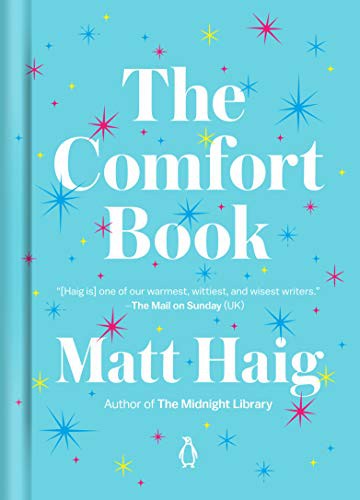
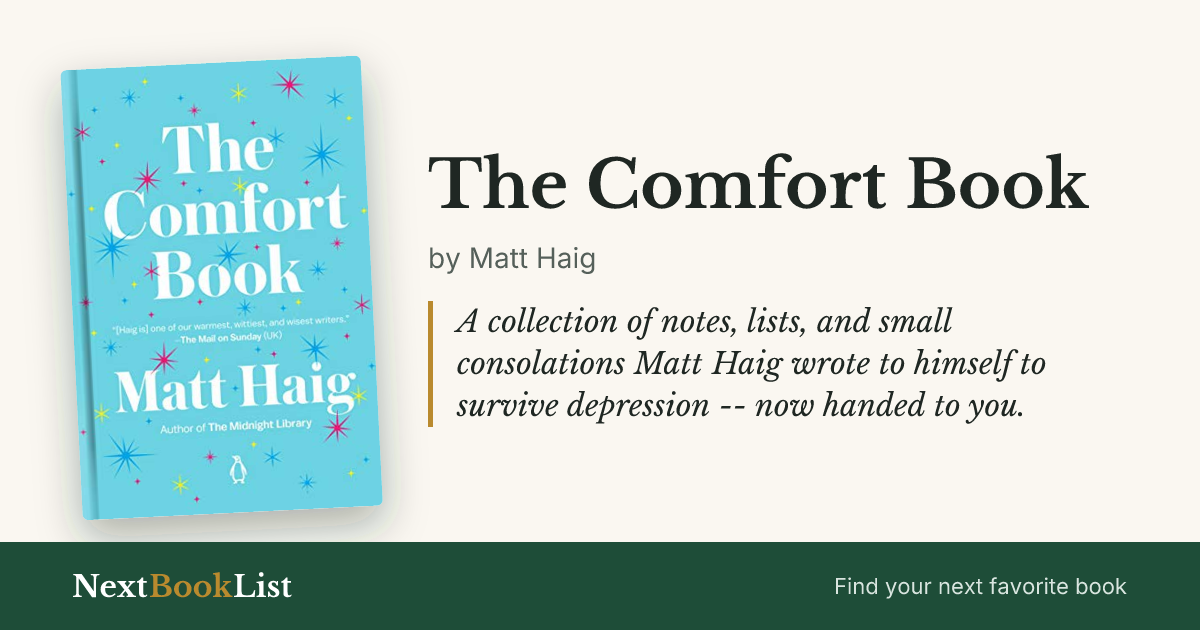
The Comfort Book
by Matt Haig · 2021
A collection of notes, lists, and small consolations Matt Haig wrote to himself to survive depression -- now handed to you.
Worth reading? The Comfort Book is Matt Haig doing for anxious, exhausted readers what Reasons to Stay Alive did for people in crisis, except gentler and more fragmentary. It's less useful than Atomic Habits if you want a system, but more trustworthy than most 'comfort' books because Haig has actually been in the dark and isn't performing wisdom he hasn't earned. Read it in small doses, not one sitting.
| Author | Matt Haig |
|---|---|
| Published | 2021 |
| Publisher | Penguin Books |
| Category | Self-Improvement & Psychology |
| Favorite quote | “You are a human, being.” |
The Verdict
This isn’t a book you read for an argument – it’s a book you keep on a nightstand and open to a random page when you need forty seconds of company. Compared to Haig’s own Reasons to Stay Alive, it’s less of a memoir and more of a toolkit built from fragments, which makes it easier to return to but less gripping as a single read.
Skip it if you want Haig’s storytelling – go to Reasons to Stay Alive or his fiction for that. Keep this one around for the days when a full book feels like too much and a paragraph is what you can manage.
you want short, quotable comfort to dip into during a hard stretch, not a structured self-help program
you want a linear argument or actionable framework -- this is a commonplace book, not a system, and reads as scattered fragments by design
Book Summary
The book is structured as a commonplace book -- short essays, lists, aphorisms, and fragments Haig collected or wrote to comfort himself during depressive episodes, meant to be read in small doses rather than cover to cover.
Its recurring argument is that hope doesn't require certainty or happiness, just an acceptance that the future is unknowable and therefore could be better than the present. Pain is treated as real but not identity-defining: you are always bigger than the pain you're in.
A secondary theme is permission -- to not fit in, to change your mind, to be inconsistent, to stop treating other people's opinions of you as verdicts. The book repeatedly tries to shrink the authority other people's judgment has over you.
Top 8 Lessons from The Comfort Book
- Hope doesn't require happiness -- it just requires accepting the future is unknowable and could be better than now.
- You are always bigger than any single feeling of pain you're having, because the 'you' exists independent of it.
- External events are neutral until your mind assigns them meaning -- you have more say in that assignment than it feels like.
- Progress doesn't have to be dramatic -- steady forward motion beats intense but directionless effort.
- You're allowed to change your mind, your identity, and your opinions without that being a failure of consistency.
- Don't seek validation from people whose advice you wouldn't actually want.
- Small, repeatable acts of self-care matter more than grand gestures during a depressive episode.
- Comparison to other people's timelines is treated as one of the more corrosive habits worth dropping.
Top 6 Quotes from The Comfort Book
"You are a human, being."
Matt Haig, The Comfort Book
"If we keep going in a straight line we'll get out of here. Walking one foot in front of the other, in the same direction, will always get you further than running around in circles."
Matt Haig, The Comfort Book
"Hope isn't the same thing as happiness. You don't need to be happy to be hopeful."
Matt Haig, The Comfort Book
"External events are neutral. They only gain positive or negative value the moment they enter our minds."
Matt Haig, The Comfort Book
"We are always bigger than the pain we feel. Always."
Matt Haig, The Comfort Book
"Don't envy things you wouldn't actually want. Don't absorb criticism from people you wouldn't go to for advice."
Matt Haig, The Comfort Book
Frequently Asked Questions
Is The Comfort Book worth reading?
Yes, as a nightstand book you open in small doses during a hard stretch. Skip it if you want a structured program rather than fragments and lists.
What is the main idea of The Comfort Book?
That hope doesn't require happiness, just accepting an unknowable future could be better than the present, and that you are always bigger than the pain you're currently feeling.
Do you need to read The Comfort Book in order?
No. It's designed to be opened at random or read a few pages at a time, not consumed cover to cover in one sitting.
Who should read The Comfort Book?
Anyone who wants short, quotable comfort during anxiety or depression. Skip it if you want Haig's storytelling -- go to Reasons to Stay Alive or his fiction for that.
Ready to read it?
Get The Comfort Book on Amazon