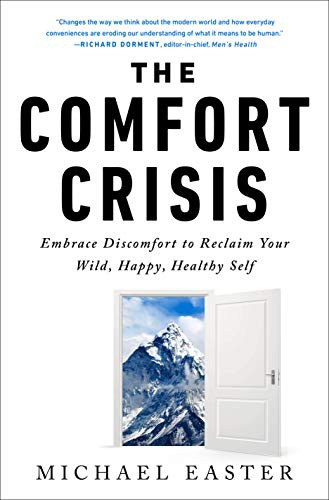
The Comfort Crisis
by Michael Easter · 2021
Easter's argument that modern comfort, on demand everything, zero friction, zero boredom, is quietly making people sick, anxious, and weak.
Worth reading? The Comfort Crisis frames a caribou-hunting trip in the Alaskan backcountry as the spine for a broader argument: humans evolved for scarcity, cold, hunger, boredom, physical exertion, and removing all of it hasn't made us happier, it's made us more anxious and physically fragile. Compared to Can't Hurt Me, it's less about extreme willpower and more about deliberately reintroducing manageable doses of hardship into an otherwise easy life. It's part memoir, part research synthesis, and the mix works. Skip it if you want a rigid program. Read it if convenience has quietly made your life smaller.
| Full Title | The Comfort Crisis: Embrace Discomfort to Reclaim Your Wild, Happy, Healthy Self |
|---|---|
| Author | Michael Easter |
| Published | 2021 |
| Publisher | Rodale Books |
| Category | Self-Improvement & Psychology |
| Favorite quote | “We've engineered the wild out of our lives, and we've engineered it out of ourselves.” |
The Verdict
Easter’s caribou hunt is the framing device, but the real argument is bigger: comfort isn’t free, and modern life has quietly stripped out the scarcity, cold, and boredom humans evolved to handle. Rucking and deliberate boredom are the two ideas most readers actually keep after finishing it.
your life has gotten frictionless and you suspect that's the problem, not the fix
you want a structured fitness program -- this is a discomfort philosophy woven through a caribou hunt memoir, not a workout plan
Book Summary
Humans evolved under conditions of scarcity, cold, physical exertion, hunger, boredom, and modern life has engineered nearly all of that away. The result isn't just comfort, it's a mismatch between what our bodies expect and what they get, and that mismatch shows up as anxiety, obesity, and fragility.
Deliberately choosing discomfort, cold exposure, fasting, long hikes carrying weight, walking instead of driving, "misogi" style hard challenges, recalibrates the nervous system's baseline and makes ordinary daily stress feel smaller by comparison.
Boredom specifically has been engineered out of modern life by phones, and that's a loss, not a convenience: boredom is where the brain does its best problem-solving and where genuine desire (as opposed to constant stimulation) gets to surface.
Top 8 Lessons from The Comfort Crisis
- Comfort isn't neutral, removing scarcity, cold, hunger, and boredom from daily life has real physical and mental costs.
- Deliberately choosing discomfort (cold exposure, fasting, hard hikes) recalibrates your baseline so daily stress feels smaller.
- Boredom is a resource, not a problem to eliminate, it's where real thinking and desire surface.
- Rucking, walking with a weighted pack, is one of the simplest, lowest-injury ways to reintroduce physical hardship.
- A 'misogi,' one very hard annual physical challenge with real chance of failure, resets your sense of your own limits.
- Chronic convenience (elevators, cars, on-demand everything) quietly erodes the physical capacity you'd otherwise maintain by default.
- Scarcity mindsets (rationing food, rationing information) sharpen appreciation in ways abundance never does.
- The goal isn't suffering for its own sake, it's a deliberate, dosed amount of hardship to keep your baseline resilient.
Top 5 Quotes from The Comfort Crisis
"We've engineered the wild out of our lives, and we've engineered it out of ourselves."
Michael Easter, The Comfort Crisis
"The brain is stimulated by comfort's opposite: reasonable amounts of discomfort."
Michael Easter, The Comfort Crisis
"Boredom is a warning light, we're bored when the brain has extra capacity that isn't being used."
Michael Easter, The Comfort Crisis
"We are living progressively sheltered, sterile, temperature-controlled, overfed, underchallenged, safety-netted lives."
Michael Easter, The Comfort Crisis
"Finally, on June 29, 2007, boredom was pronounced dead, thanks to the iPhone. And so our imaginations and deep social connections went with it."
Michael Easter, The Comfort Crisis
Frequently Asked Questions
Is The Comfort Crisis worth reading?
Yes, if convenience has crept into every part of your day and you suspect it's costing you something. It blends a hunting memoir with research on scarcity, cold, and boredom.
What is the main idea of The Comfort Crisis?
Humans evolved for scarcity and hardship; modern comfort removed nearly all of it, and that mismatch drives anxiety and physical fragility. Deliberate, dosed discomfort recalibrates the baseline.
What is 'rucking'?
Walking with a weighted pack, one of the book's simplest recommended ways to reintroduce physical hardship without high injury risk.
Ready to read it?
Get The Comfort Crisis on Amazon