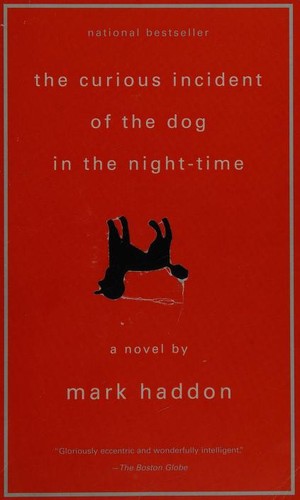
The Curious Incident of the Dog in the Night-Time
by Mark Haddon · 2003
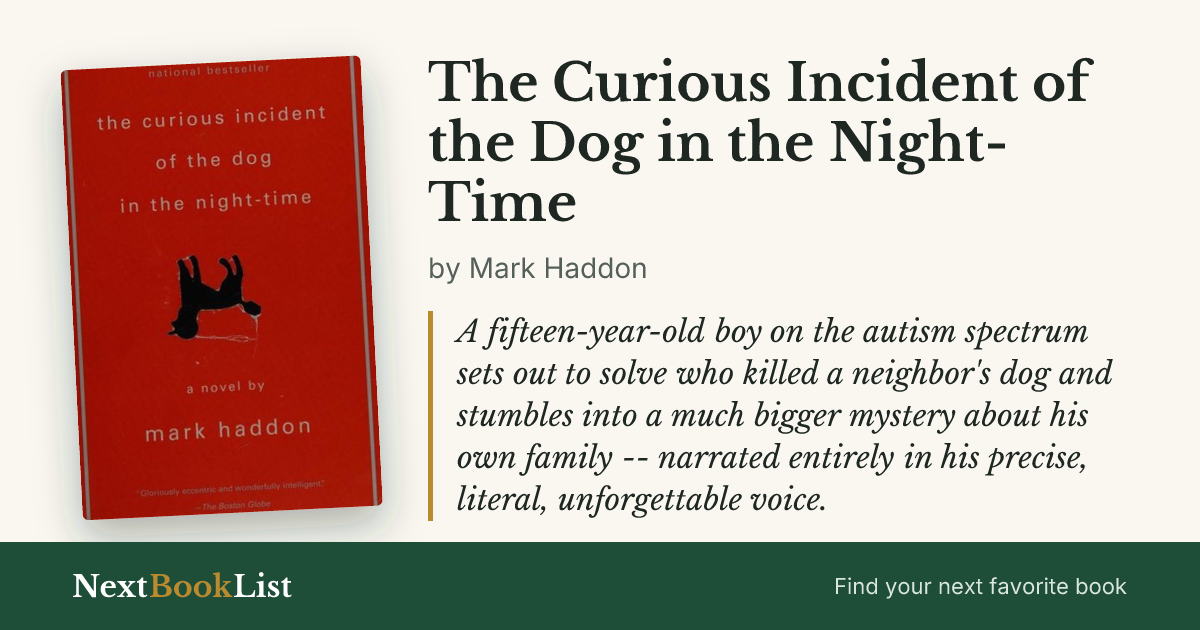
A fifteen-year-old boy on the autism spectrum sets out to solve who killed a neighbor's dog and stumbles into a much bigger mystery about his own family -- narrated entirely in his precise, literal, unforgettable voice.
Worth reading? The Curious Incident earns its reputation on voice alone. Christopher's narration, obsessive about facts, allergic to metaphor, structured around prime numbers instead of chapters, makes ordinary events (a school trip, a train ride) feel genuinely tense in a way plot mechanics alone couldn't. The dog-murder mystery is really a hook to get you into the house; the real story is about his parents' marriage and what they hid from him.
| Author | Mark Haddon |
|---|---|
| Published | 2003 |
| Publisher | Vintage |
| Category | Fiction |
| Favorite quote | “I think prime numbers are like life. They are very logical but you could never work out the rules, even if you spent all your time thinking about them.” |
The Verdict
The formal choices here aren’t gimmicks – numbering chapters by primes and letting Christopher digress into math tangents actually mirrors how his mind organizes the world, so the structure and the character reinforce each other instead of one just decorating the other.
The London train sequence is the book’s best stretch, more suspenseful than the actual murder investigation, because Haddon has spent the whole book teaching you exactly what ordinary sensory chaos costs Christopher. You feel every overwhelming detail with him.
Read it if you want a short novel with a genuinely original narrative voice built around a family secret worth uncovering. Skip it if you’re looking for a clinically accurate portrait of autism rather than one specific, fictional kid’s mind.
you want a mystery novel where the narrator's voice is the actual innovation, not the plot -- Christopher's literal-mindedness and math obsession shape every sentence, not just his personality
you want the book to function primarily as a definitive, clinical portrait of autism -- Haddon has said he did limited research and the novel is a character study first, representation second, which some readers in the autism community have pushed back on
Book Summary
Christopher Boone, a mathematically gifted teenager who reads literally and struggles with metaphor, sarcasm, and physical touch, discovers his neighbor's dog Wellington has been killed with a garden fork and decides to investigate, modeling his approach on Sherlock Holmes.
The investigation leads Christopher to uncover letters revealing that his mother, whom he believed dead, is actually alive and left the family -- a discovery that upends his understanding of his father and forces him to travel alone to London for the first time, a journey that's harder for him than any murder mystery.
Haddon structures the book entirely through Christopher's voice and organizational logic: chapters numbered by primes, diagrams and equations inserted where Christopher would naturally think in those terms, and detours into math and physics that reveal how his mind actually processes the world.
The novel's real subject is trust and honesty within a family under strain -- both of Christopher's parents lied to him for what they believed were protective reasons, and the book asks whether that kind of protective lying does more harm than the truth would have.
Top 10 Lessons from The Curious Incident of the Dog in the Night-Time
- Christopher's literal, fact-based narration reveals how much of ordinary social interaction relies on reading unstated meaning -- his confusion at metaphor and sarcasm makes the reader newly aware of how much interpretive work neurotypical communication assumes.
- The dog's murder is a maguffin -- the book uses it to get the plot moving, but the emotional core is entirely about the collapse and slow repair of Christopher's family.
- Christopher's father lying about his mother being dead, out of a genuine (if badly judged) desire to protect him, is used to argue that even well-intentioned deception in a family causes lasting damage once discovered.
- Christopher's solo train journey to London, a genuinely terrifying ordeal for him given his sensory and social difficulties, is framed as a bigger act of courage than solving any mystery.
- The novel resists neat resolution -- his parents don't fully reconcile, and Christopher's ending goal (to take his A-level math exam and go to university) is presented as a real but modest victory, not a cure.
- Christopher's love of prime numbers and structured logic isn't just a character quirk -- it's presented as a genuine coping mechanism that gives him control in a world that otherwise overwhelms him.
- Christopher solves logic and math puzzles throughout the narrative, including a version of the Monty Hall problem, as a way of processing an increasingly chaotic family situation he can't otherwise control.
- The eventual reveal that Christopher's own father killed the dog reframes the entire investigation -- the person he trusted most turns out to be the villain of the story he was investigating.
- Christopher's rigid rules, refusing to eat food that touches on the plate, sorting cars into good-day and bad-day colors, aren't quirks for comic effect -- they're presented as real coping systems for an overwhelming sensory world.
- His pet rat Toby is one of the only relationships in the book that asks nothing of him emotionally, which is presented as exactly why it works for him.
Top 4 Quotes from The Curious Incident of the Dog in the Night-Time
"I think prime numbers are like life. They are very logical but you could never work out the rules, even if you spent all your time thinking about them."
Mark Haddon, The Curious Incident of the Dog in the Night-Time
"The world is full of obvious things which nobody by any chance ever observes."
Mark Haddon, The Curious Incident of the Dog in the Night-Time
"I find people confusing."
Mark Haddon, The Curious Incident of the Dog in the Night-Time
"Metaphors are lies."
Mark Haddon, The Curious Incident of the Dog in the Night-Time
Frequently Asked Questions
Is The Curious Incident of the Dog in the Night-Time worth reading?
Yes -- Christopher's narrative voice is one of the more distinctive in modern fiction, and the book is short enough to read in a sitting or two.
What is The Curious Incident of the Dog in the Night-Time about?
An autistic teenager investigates who killed a neighbor's dog, and the investigation uncovers a bigger secret about his own family that sends him on a difficult solo journey to London.
Is The Curious Incident of the Dog in the Night-Time an accurate portrayal of autism?
It's a widely read character study, but autism advocates have noted Haddon did limited direct research, so it's best read as one character's specific voice rather than a general representation.
Is this book suitable for kids?
It's frequently assigned to teens in school and works well for that age, though some content (family conflict, mild profanity) makes it more of a young-adult-and-up book.
Is The Curious Incident of the Dog in the Night-Time a mystery novel?
It's structured like one, but the real story is a family drama -- the dog mystery mostly exists to launch the plot.
Ready to read it?
Get The Curious Incident of the Dog in the Night-Time on Amazon