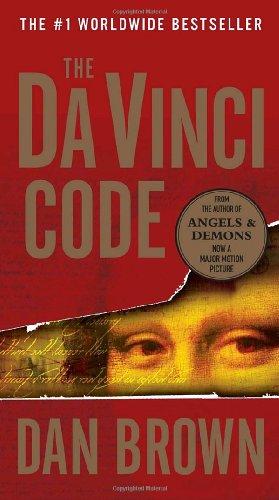
The Da Vinci Code
by Dan Brown · 2003
A Harvard symbologist and a French cryptologist race across Paris and London chasing clues hidden in Da Vinci paintings, church architecture, and a secret society, all while dodging a murderous albino monk -- and yes, it's exactly as fun and as silly as that sounds.
Worth reading? The Da Vinci Code is a machine built for one purpose, keep you turning pages, and it does that job better than almost any thriller of its decade. Every chapter ends on a hook, every clue leads directly to the next set piece, and the pacing never lets up. Judge it as literature and it falls apart fast; judge it as a page-turner and it's one of the most effective ever mass-marketed.
| Author | Dan Brown |
|---|---|
| Published | 2003 |
| Publisher | Anchor Books |
| Category | Fiction |
| Favorite quote | “History is always written by the winners. When two cultures clash, the loser is obliterated, and the winner writes the history books—books which glorify their own cause and disparage the conquered foe.” |
The Verdict
Brown’s sentences won’t win any prizes, and he knows it, or at least doesn’t seem to care. What he’s actually good at is architecture: every scene is built to end on a question, and the next scene answers it while raising two more. That structural discipline is the entire reason this book sold what it sold.
The historical content is where you need to keep your guard up. Brown’s characters state fringe or outright disputed theories with the same confident tone as verifiable facts, and the novel doesn’t flag the difference for you. Treat every “fact” a character states as plot fuel, not research.
Read it if you want a fast, puzzle-driven thriller and don’t mind functional prose. Skip it if inaccurate history dressed up as revelation is going to bother you more than the plot entertains you.
you want a fast, plot-driven thriller built entirely around puzzle-solving and conspiracy reveals, and you're fine with prose that exists purely to move you to the next cliffhanger
you care about prose quality, character depth, or historical accuracy -- Brown's writing is functional at best, and his claims about religious history and secret societies range from speculative to flatly wrong
Book Summary
Robert Langdon, a Harvard symbologist, is pulled into investigating a murder at the Louvre that turns out to be connected to a centuries-old secret society, the Priory of Sion, allegedly guarding the true bloodline of Jesus Christ and Mary Magdalene.
The novel's central hook is its central claim: that the Holy Grail isn't a physical cup but a metaphor for Mary Magdalene's womb and bloodline, and that this "truth" has been suppressed by the Catholic Church for two thousand years -- a premise Brown presents through his characters as more historically credible than mainstream scholarship supports.
Brown structures the book as a series of puzzle-box reveals, anagrams, cryptex locks, hidden symbols in Da Vinci's paintings, each one solved just in time to escape the next pursuer, which is the mechanical engine that makes the book so compulsively readable regardless of its factual shakiness.
The novel triggered a genuine cultural moment: tourism spikes at its real-world locations (the Louvre, Rosslyn Chapel, Westminster Abbey), formal rebuttals from historians and theologians, and a wave of imitator thrillers trying to replicate its puzzle-plot formula.
Top 8 Lessons from The Da Vinci Code
- The novel's pacing formula, chapter-ending cliffhangers, constant forward momentum, minimal downtime, is a masterclass in commercial thriller structure even where the underlying content doesn't hold up to scrutiny.
- Brown blends real art history and architecture with invented or heavily distorted claims, and the book's biggest weakness is that it presents both with the same confident authority, blurring the line for casual readers.
- The book's success shows how effectively a thriller can function as a delivery mechanism for a controversial idea (in this case, revisionist religious history) by wrapping it in enough momentum that readers don't stop to fact-check as they go.
- Langdon as a protagonist is defined almost entirely by his expertise rather than personal depth -- the novel is plot-first to a degree that character interiority is largely sacrificed for pace.
- The secret-society conspiracy structure (Priory of Sion, Opus Dei) borrows real organizations and gives them a fictional, more sinister function, which is a recurring and legally contested move in Brown's fiction.
- The cryptex and other puzzle-lock devices in the plot are literal physical stand-ins for the book's whole structure -- a series of locked boxes that open only when you solve the right riddle, mirroring how each chapter is built.
- The novel's real-world impact went beyond the page: tourism spikes at its actual locations and a wave of imitator conspiracy thrillers show how far a fast-moving plot can push a fictional premise into popular culture.
- Sophie Neveu, the co-lead, exists mostly to supply cryptography expertise and momentum for Langdon's investigation rather than to carry her own independent arc, consistent with the novel's plot-over-character priorities.
Top 3 Quotes from The Da Vinci Code
"Men go to far greater lengths to avoid what they fear than to obtain what they desire."
Dan Brown, The Da Vinci Code
"History is always written by the winners. When two cultures clash, the loser is obliterated, and the winner writes the history books—books which glorify their own cause and disparage the conquered foe."
Dan Brown, The Da Vinci Code
"The Bible did not arrive by fax from heaven. The Bible is the product of man, my dear. Not of God. Man created it as a historical record of tumultuous times, and it has evolved through countless translations, additions, and revisions."
Dan Brown, The Da Vinci Code
Frequently Asked Questions
Is The Da Vinci Code worth reading?
As pure entertainment, yes -- it's one of the fastest-paced thrillers of its era. Just don't treat its religious history claims as fact.
What is The Da Vinci Code about?
A Harvard symbologist investigates a murder at the Louvre that leads him into a centuries-old conspiracy around the Holy Grail, Da Vinci's paintings, and a secret society.
Is The Da Vinci Code historically accurate?
No -- many of its central claims about the Holy Grail, the Priory of Sion, and early Christian history are disputed or outright rejected by historians and theologians.
Do I need to read Angels & Demons first?
No, The Da Vinci Code works as a standalone novel even though it's technically the second Robert Langdon book.
Why was The Da Vinci Code controversial?
Its claims about Jesus and Mary Magdalene, and its portrayal of Opus Dei, drew formal objections from the Catholic Church and numerous historians who disputed its factual framing.
Ready to read it?
Get The Da Vinci Code on Amazon