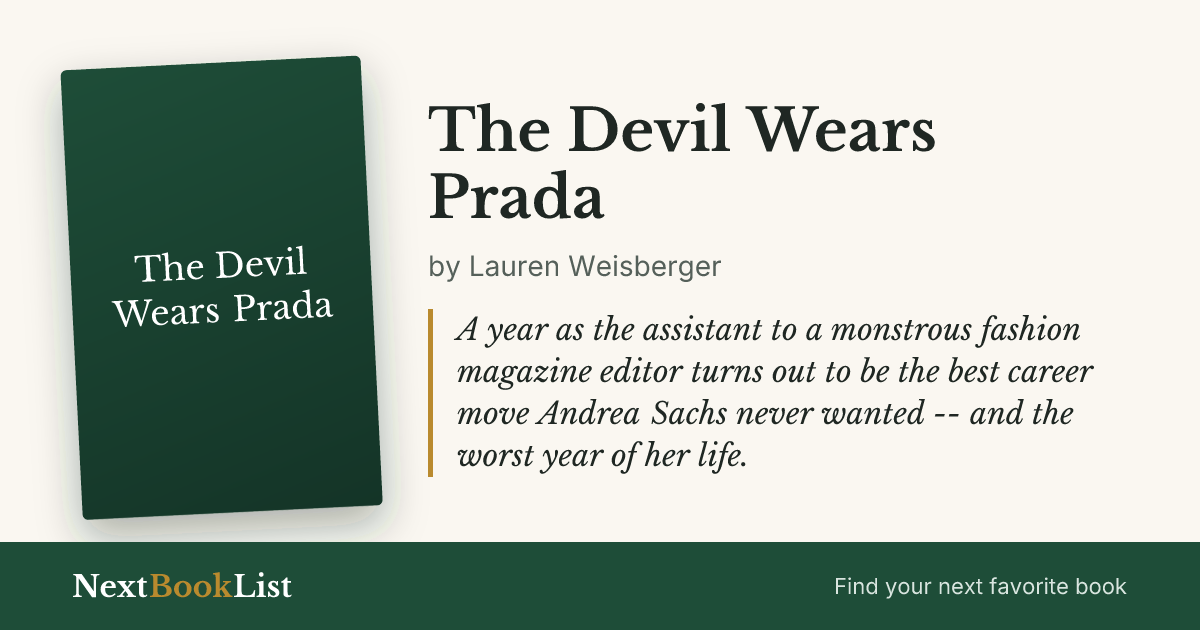
The Devil Wears Prada
by Lauren Weisberger · 2003
A year as the assistant to a monstrous fashion magazine editor turns out to be the best career move Andrea Sachs never wanted -- and the worst year of her life.
Worth reading? The Devil Wears Prada works because Weisberger wrote what she knew: a real year assisting Vogue's Anna Wintour, filed down into fiction. Miranda Priestly is a caricature, but she's a caricature built from specific, plausible cruelty -- the unreasonable demands land because you believe someone actually made them.
| Author | Lauren Weisberger |
|---|---|
| Published | 2003 |
| Publisher | Doubleday |
| Category | Fiction |
| Favorite quote | “Everyone wants to be us.” |
The Verdict
Weisberger doesn’t waste time making Miranda Priestly likable, and that’s the right call. The book is more interested in what a year of that treatment does to Andrea than in redeeming the woman dishing it out.
The Harry Potter manuscript chase and the impossible last-minute demands read like exaggeration until you remember Weisberger lived a version of this. That’s the book’s edge over a generic satire – the details are too specific to be fully invented.
Read it if you want a fast, mean workplace satire with real industry texture underneath the gossip. Skip it if you want the movie’s warmer, more redemptive version of the same story.
you want a fast, bitchy workplace satire about ambition, bad bosses, and the price of a resume line, written by someone who actually survived the job
you want nuanced character work instead of a cartoonish villain, or you've already seen the movie and assume the book has nothing new to offer
Book Summary
Andrea Sachs takes a job as junior assistant to Miranda Priestly, editor-in-chief of Runway magazine, telling herself a year of abuse is worth it for the resume line and the doors it'll open afterward.
The novel tracks the slow erosion of Andrea's outside life -- her boyfriend, her friends, her sense of herself as someone who doesn't care about fashion -- as Miranda's demands expand to fill every hour, including a famous unpublished-Harry-Potter-manuscript retrieval mission.
Weisberger's real subject isn't fashion, it's the bargain of prestige jobs: the industry glamour is real, the exploitation is real, and the book never fully resolves whether the trade was worth it, which is more honest than a clean redemption arc would have been.
Top 10 Lessons from The Devil Wears Prada
- A job that looks glamorous from outside can still be a bad deal once you tally the actual hours, humiliation, and personal cost against the resume line it buys.
- Miranda Priestly's power comes from making unreasonable demands feel normal by sheer repetition -- a workplace dynamic that reads as satire because it's recognizable.
- Andrea's outside relationships fray gradually, not all at once, which is a more realistic portrait of how a demanding job eats a life than a single dramatic blowup would be.
- The book treats fashion as a legitimate, high-stakes industry rather than a frivolous backdrop, which is part of why the satire lands instead of feeling condescending.
- Prestige and exploitation aren't opposites in this story -- Runway is both a genuinely elite career credential and a genuinely abusive place to work, at the same time.
- The Harry Potter manuscript retrieval mission is the novel's set-piece for showing how an 'impossible' request just becomes an ordinary task once a boss holds enough power over you.
- Andrea's decision to stay the full year is a deliberate bet that short-term suffering buys long-term career leverage -- a bet the book pointedly never confirms actually paid off.
- Miranda's demands are rarely about the stated task itself; they're tests of whether Andrea will comply without pushback, which matters more to Miranda than any task's outcome.
- Andrea's early contempt for the fashion industry curdles into reluctant respect for its actual skill and stakes, even as she stays disgusted by how it treats the people inside it.
- The story refuses a clean redemption arc for Miranda or full vindication for Andrea, which keeps it honest about workplace abuse instead of wrapping it in a bow.
Top 3 Quotes from The Devil Wears Prada
"Everyone wants to be us."
Lauren Weisberger, The Devil Wears Prada
"For most people, the ringing of a phone was a welcome sign. Someone was trying to reach them, to say hello, ask about their well-being, or make plans. For me, it triggered fear, intense anxiety and heart-stopping panic."
Lauren Weisberger, The Devil Wears Prada
"Okay, she's tough, but if Miranda were a man…no one would notice anything about her, except how great she is at her job."
Lauren Weisberger, The Devil Wears Prada
Frequently Asked Questions
Is The Devil Wears Prada worth reading?
Yes -- if you want a quick, sharp workplace satire, it delivers, and the book has more specific detail about magazine-industry grind than the movie has room for.
Is The Devil Wears Prada based on a true story?
It's fiction, but Weisberger drew directly on her own year as an assistant at Vogue under Anna Wintour, who's widely understood to be the model for Miranda Priestly.
Is the book different from the movie?
Yes -- the book is harsher on Miranda and gives Andrea's exhaustion and resentment more room to build; the movie softens Miranda into a more sympathetic figure by the end.
Do I need to work in fashion to enjoy it?
No -- the specifics are fashion, but the story is a generic bad-boss, prestige-job satire that translates to any demanding industry.
Ready to read it?
Get The Devil Wears Prada on Amazon