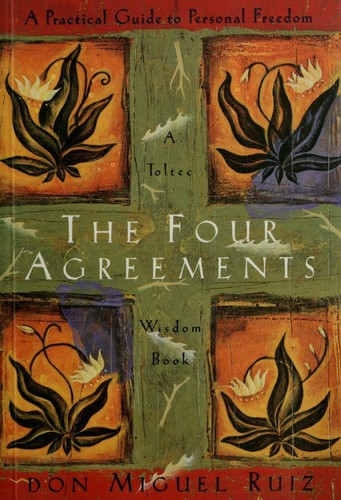
The Four Agreements
by Don Miguel Ruiz · 1997
Four rules for personal freedom, none of them longer than a sentence.
Worth reading? The Four Agreements and 12 Rules for Life sit at opposite ends of the same shelf: Peterson gives you twelve dense, footnoted rules built from mythology and clinical psychology; Ruiz gives you four one-line agreements built from Toltec wisdom, and gets to something just as useful in a fifth of the pages. If you want your self-help short and repeatable, Ruiz wins easily. Skip it if you want evidence, citations, or nuance -- The Four Agreements is closer to a spiritual guide than a research-backed framework, and it states its claims with total confidence and zero hedging. If that style bothers you, the content won't land no matter how good the four rules actually are.
| Full Title | The Four Agreements: A Practical Guide to Personal Freedom |
|---|---|
| Author | Don Miguel Ruiz |
| Published | 1997 |
| Publisher | Amber-Allen Publishing |
| Category | Self-Improvement & Psychology |
| Favorite quote | “Don't take anything personally.” |
The Verdict
Don Miguel Ruiz reduces personal freedom to four short agreements, and the brevity is the point – you can actually remember all four. It won’t give you citations or nuance, but it will give you a filter you can apply the next time someone’s comment ruins your afternoon. Short book, long shelf life.
you're exhausted from taking things personally and want a simpler filter for how to live
you want deep argumentation -- this is a short spiritual guide, not a rigorous philosophy text
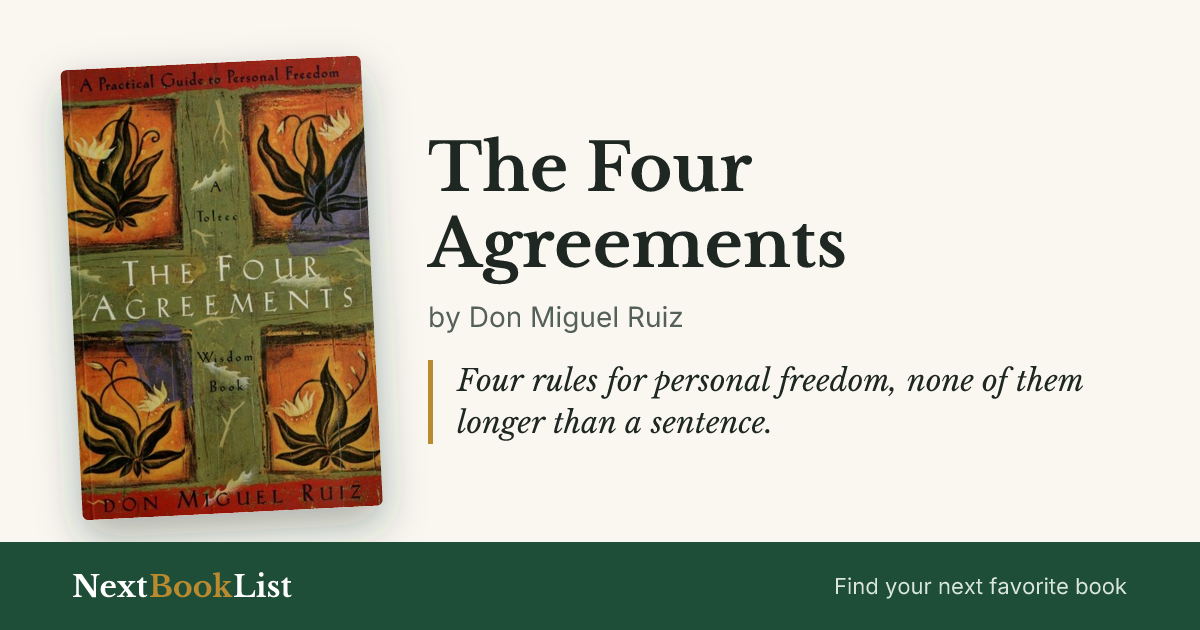
Book Summary
Most of your suffering comes from agreements you made with yourself without noticing -- about who you have to be, what you have to tolerate, what other people's words mean about you. Ruiz's whole book is about identifying those old agreements and replacing them with four new, deliberate ones.
The four agreements are: be impeccable with your word, don't take anything personally, don't make assumptions, and always do your best. Each one targets a specific way people give away their peace -- gossip and self-criticism, absorbing other people's moods as verdicts on your worth, filling silence with imagined meaning, and beating yourself up for not hitting a fixed standard regardless of the day you're having.
Freedom, in Ruiz's framing, isn't about controlling your circumstances -- it's about controlling the meaning you assign to them. Nothing other people do is really about you, even when it's aimed at you, and once that agreement sinks in, entire categories of daily suffering just stop applying.
Top 9 Lessons from The Four Agreements
- Be impeccable with your word -- what you say about yourself and others shapes your reality.
- Nothing other people do is because of you. It's because of themselves.
- Taking things personally is optional, even when someone aims a comment directly at you.
- Most conflict comes from assuming instead of asking.
- Always do your best, but recognize your best changes day to day.
- The agreements you made with yourself as a child are still running your adult life.
- Gossip and self-criticism are the same habit aimed in two directions.
- Freedom comes from controlling the meaning you assign to events, not the events themselves.
- Silence filled with assumption creates more suffering than the truth would.
Top 5 Quotes from The Four Agreements
"Be impeccable with your word."
Don Miguel Ruiz, The Four Agreements
"Don't take anything personally."
Don Miguel Ruiz, The Four Agreements
"Don't make assumptions."
Don Miguel Ruiz, The Four Agreements
"Always do your best."
Don Miguel Ruiz, The Four Agreements
"Nothing other people do is because of you. It is because of themselves."
Don Miguel Ruiz, The Four Agreements
Frequently Asked Questions
Is The Four Agreements worth reading?
Yes, if you want a short, repeatable framework instead of a long argument. It's under 200 pages and each agreement is genuinely usable the same day you read it.
What is the main idea of The Four Agreements?
Most suffering comes from agreements you made with yourself without noticing. Replace them with four deliberate ones: be impeccable with your word, don't take things personally, don't make assumptions, and always do your best.
Is The Four Agreements a religious book?
It draws on Toltec spiritual tradition but isn't tied to an organized religion. It reads more like a philosophy of personal conduct than scripture.
How long does it take to read The Four Agreements?
About 2 to 3 hours. It's short, plainly written, and built to be reread rather than studied once.
Ready to read it?
Get The Four Agreements on Amazon