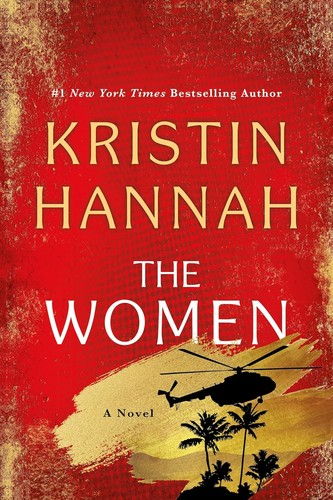
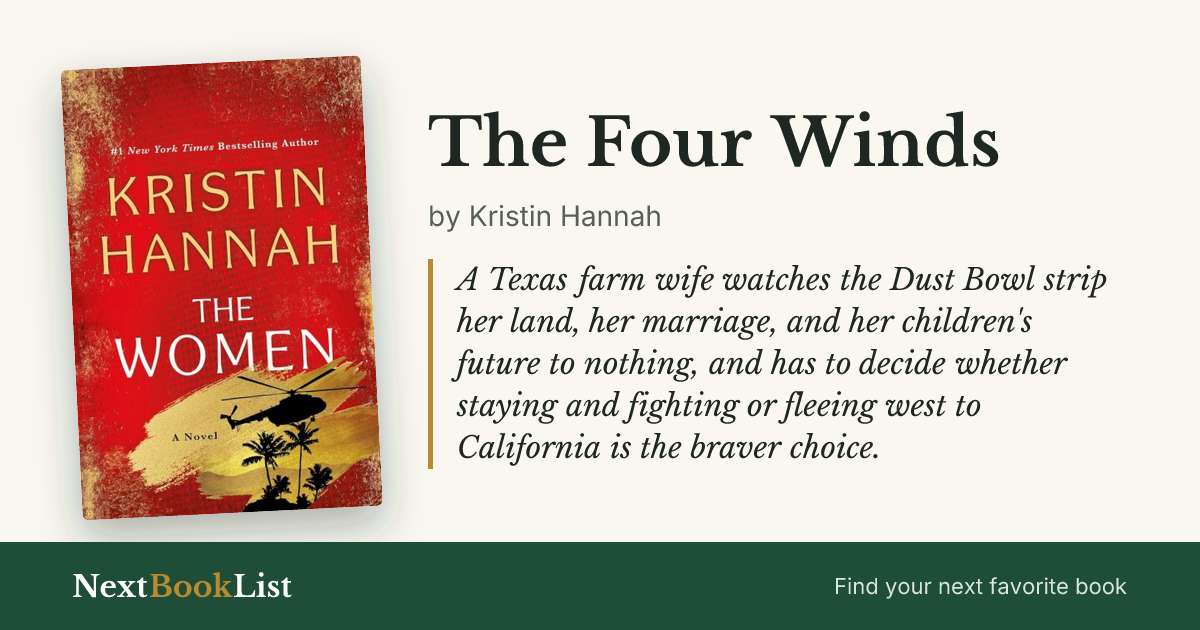
The Four Winds
by Kristin Hannah · 2021
A Texas farm wife watches the Dust Bowl strip her land, her marriage, and her children's future to nothing, and has to decide whether staying and fighting or fleeing west to California is the braver choice.
Worth reading? The Four Winds is Hannah doing what she does best: a sweeping, unabashedly emotional historical epic that trusts big feelings over understatement. It covers ground The Grapes of Wrath already claimed, dust storms, migrant camps, California's hostility to the Okies, but centers a mother's endurance instead of a family patriarch's, which gives it a genuinely different center of gravity.
| Author | Kristin Hannah |
|---|---|
| Published | 2021 |
| Publisher | St. Martin's Press |
| Category | Fiction |
The Verdict
Hannah doesn’t do subtle, and this book isn’t the exception. Every emotional beat is played at full volume, the marriage collapsing, the drought choking the land, the camps grinding down anyone who arrives with nothing. If you’re on her wavelength, it works, hard.
What elevates it above pure melodrama is how seriously the book takes the actual history, the real hostility California showed Dust Bowl migrants, the exploitative labor camps, so the emotional sweep sits on top of something true rather than invented for effect.
Read it if you want a big, unashamedly emotional historical epic centered on a woman’s endurance. Skip it if Hannah’s maximalist emotional style tends to read as manipulative to you rather than moving.
you want big, emotionally direct historical fiction in the Grapes of Wrath tradition, centered on a woman's resilience rather than a man's, with Hannah's usual gift for making you cry on a schedule
you want subtlety -- Hannah writes in bold, unambiguous emotional strokes, and if that reads as manipulative to you rather than moving, this book leans hard into that style
Book Summary
Elsa Martinelli, married into a Texas farming family more out of desperation than love, watches the 1930s drought and dust storms destroy the land her family depends on. As neighbors abandon their farms and her marriage falls apart under the strain, Elsa has to decide whether to stay and fight for what's left or take her children west toward the promise of California.
The novel follows Elsa and her children into California's migrant labor camps, where the promised land turns out to be its own kind of brutal, hostile locals, exploitative labor conditions, and a system stacked against the "Okies" fleeing the Dust Bowl, echoing the real historical reception migrants faced.
Hannah frames Elsa's arc as a slow claiming of her own worth, a woman repeatedly told (by her own family, by her marriage) that she's not enough, discovering through crisis that she's the one who holds everyone together, which gives the historical sweep a personal, character-driven spine.
Top 11 Lessons from The Four Winds
- The novel centers a mother's endurance through the Dust Bowl and Depression-era migration rather than a patriarch's, shifting the emotional focus that dominates most fiction about this era.
- California's hostility toward Dust Bowl migrants, hostile locals, exploitative labor camps, is depicted with historical grounding, not softened for a more comfortable narrative.
- Elsa's arc is built around internalized worthlessness, instilled by her own family before the drought even hits, being dismantled by the crisis that forces her into a leadership role.
- The book treats labor organizing and migrant worker exploitation in the California camps as a real historical thread, not just scenery for Elsa's personal journey.
- Motherhood under existential strain (deciding to flee, deciding to fight, protecting children with no safety net) is the book's central moral test, repeated across multiple crisis points rather than resolved once.
- Hannah doesn't give the novel a fully happy ending -- the costs of the Dust Bowl and migration are allowed to be permanent rather than neatly resolved by Elsa's growth.
- Rafe's decision to abandon the family under the strain of the drought sharpens the contrast between a man's flight and a mother's forced endurance, rather than reducing him to a simple villain.
- Elsa's relationship with her disapproving mother-in-law shifts from resentment to genuine alliance once both women are stripped of the status and comfort that once separated them.
- The novel ties Elsa's personal awakening to organized labor -- falling in with a union organizer in the migrant camps turns her private survival instinct into a public, political stand.
- Elsa is shot and killed by the farm owners while helping organize a strike, a death the book frames less as tragedy than as the final proof of the self-worth she spent the whole novel learning to claim.
- Loreda carrying her mother's fight forward, eventually returning to California to pursue the education Elsa never got, gives the ending a legacy arc instead of a clean, personal resolution.
Frequently Asked Questions
Is The Four Winds worth reading?
Yes, if you want big, emotionally direct historical fiction -- it's Hannah at her most Grapes of Wrath-adjacent, with a mother's resilience at the center.
What is The Four Winds about?
A Texas farm wife's family is destroyed by the Dust Bowl, forcing her to lead her children west to California's migrant labor camps in search of a better life.
Is The Four Winds similar to The Grapes of Wrath?
Yes, deliberately -- it covers the same Dust Bowl migration and hostile reception in California, but centers a mother's perspective rather than a family patriarch's.
Is The Four Winds a sad book?
Yes -- it doesn't soften the real costs of the Dust Bowl and Depression-era migration, and the ending isn't fully happy.
Is The Four Winds historically accurate?
Hannah grounds the migrant camp conditions and California's hostility toward 'Okies' in real historical research, within a fictional family's story.
Ready to read it?
Get The Four Winds on Amazon