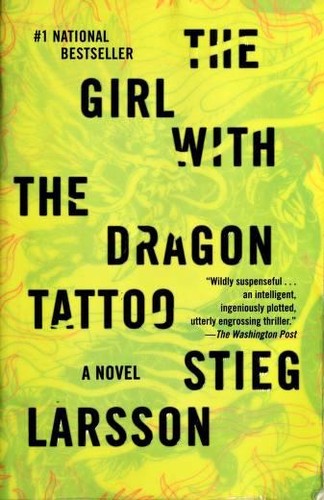
The Girl with the Dragon Tattoo
by Stieg Larsson · 2005
A disgraced financial journalist and a brilliant, damaged hacker team up to solve a decades-old disappearance inside a wealthy Swedish family riddled with Nazis, abuse, and secrets -- and the hacker, not the journalist, is the reason the book became a phenomenon.
Worth reading? The Girl with the Dragon Tattoo is a slow-starting, occasionally overstuffed thriller that's worth the patience almost entirely because of Lisbeth Salander. Mikael Blomkvist's financial-journalism subplot takes too long to connect to the main mystery, but once Lisbeth enters fully and the Vanger family investigation gets moving, the book turns into something genuinely hard to put down.
| Author | Stieg Larsson |
|---|---|
| Published | 2005 |
| Publisher | Vintage Crime/Black Lizard |
| Category | Fiction |
The Verdict
The book’s real discovery is Lisbeth, and Larsson clearly knew it, because the novel gets noticeably better every time she’s on the page. Her competence, her coldness, and the specific institutional abuse she’s survived are all drawn with more care than almost anything in Blomkvist’s half of the plot.
The financial journalism opening is the drag on pacing most readers remember. It matters eventually, but Larsson spends far more time on it than the payoff earns, and a reader could be forgiven for wondering, fifty pages in, when the actual mystery starts.
Read it if you can tolerate a slow, dense opening for one of the most memorable protagonists in modern crime fiction. Skip it if graphic sexual violence content is a hard limit for you – this book doesn’t soften it.
you want a dense, slow-building mystery with a genuinely original protagonist in Lisbeth Salander, and you can tolerate a first act that spends a lot of time on Swedish financial journalism before the actual mystery kicks in
you're sensitive to graphic depictions of sexual violence -- the novel includes extended, brutal assault scenes that are central to both the plot and Lisbeth's backstory, not incidental
Book Summary
Mikael Blomkvist, a financial journalist facing a libel conviction, is hired by wealthy industrialist Henrik Vanger to investigate the decades-old disappearance of his niece Harriet, a cold case the family has never stopped suspecting was murder.
Lisbeth Salander, a brilliant but severely traumatized hacker and investigator working for a corporate security firm, is initially hired to research Blomkvist himself, then joins the investigation directly, bringing digital forensic skills the story increasingly depends on to move forward.
The Vanger family investigation uncovers connections to Nazi sympathizers within the family's history and a serial killer targeting women, tying corporate and family corruption directly to systemic violence against women, a theme the book's original Swedish title (translated as "Men Who Hate Women") makes explicit.
Lisbeth's own backstory, including her legal status as a ward of the state and the abuse she suffers from her court-appointed guardian, runs as a parallel plot to the main mystery, establishing her as a survivor whose skills and coldness are direct responses to institutional and personal abuse.
Top 10 Lessons from The Girl with the Dragon Tattoo
- The novel uses a cold-case family mystery to indict institutional failure broadly -- corporate cover-ups, guardianship abuse, and unprosecuted historical Nazi sympathies all sit inside the same plot.
- Lisbeth Salander is written as competent specifically because of, not despite, her trauma -- her hypervigilance and distrust of institutions are direct products of the abuse she's survived, not just quirky character traits.
- The book's Swedish title, 'Men Who Hate Women,' signals that the mystery plot is a vehicle for a broader argument about violence against women across social classes, from wealthy families to state guardianship systems.
- Blomkvist and Lisbeth's professional partnership is built on competence and mutual respect rather than romantic convention, which was part of what made the character dynamic feel fresh on release.
- The financial journalism subplot involving corporate fraud, while slow to connect to the main mystery, establishes Blomkvist's professional stakes and vulnerability, which matter more once the two plots merge.
- The novel doesn't offer Lisbeth a conventional redemption arc by the end -- her trauma isn't resolved, just survived, which sets up her arc across the rest of the trilogy rather than closing it here.
- Henrik Vanger's decades of private, obsessive investigation into Harriet's disappearance is what reopens a case the rest of the family would rather leave buried, showing how a single stubborn insider can outlast institutional indifference.
- The book alternates between old-school archival digging -- photographs, ledgers, old newspaper clippings -- and Lisbeth's digital forensics, using the contrast to argue that neither method alone would have cracked the case.
- Lisbeth's court-appointed guardian Bjurman shows how the very system meant to protect a ward of the state can become another avenue for abuse once oversight disappears.
- The Vanger family's wealth and isolation let suspicion around Harriet's disappearance stay contained inside the family for decades, reinforcing the novel's broader point that power buys silence, not just cover-ups.
Frequently Asked Questions
Is The Girl with the Dragon Tattoo worth reading?
Yes, though the first act is slower than most thrillers -- stick with it until Lisbeth Salander takes a more central role and the pace picks up considerably.
What is The Girl with the Dragon Tattoo about?
A disgraced journalist and a hacker investigate a wealthy Swedish family's decades-old disappearance, uncovering Nazi ties, corporate corruption, and a serial killer.
Is The Girl with the Dragon Tattoo graphic?
Yes -- it contains extended, explicit sexual violence that's central to the plot and to Lisbeth Salander's backstory, so sensitive readers should know that going in.
Do I need to read this before the sequels?
Yes, it's the first book in the Millennium trilogy and sets up character arcs, especially Lisbeth's, that continue directly into the next two books.
Was The Girl with the Dragon Tattoo published after the author's death?
Yes -- Stieg Larsson died in 2004, before any of the Millennium trilogy books were published.
Ready to read it?
Get The Girl with the Dragon Tattoo on Amazon