The Giver
by Lois Lowry · 1993
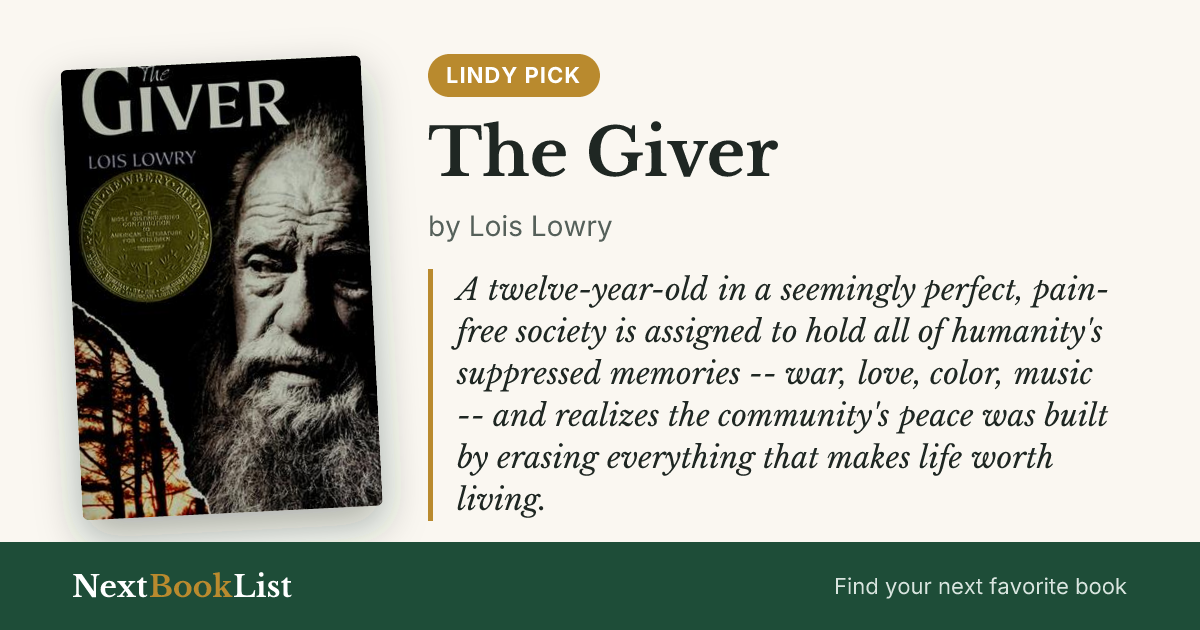
A twelve-year-old in a seemingly perfect, pain-free society is assigned to hold all of humanity's suppressed memories -- war, love, color, music -- and realizes the community's peace was built by erasing everything that makes life worth living.
Worth reading? The Giver earns its status as the foundational YA dystopia by refusing to make its utopia obviously villainous -- the community's horror is that its cruelty is procedural, polite, and delivered in the calm language of order and safety.
| Author | Lois Lowry |
|---|---|
| Published | 1993 |
| Publisher | Laurel Leaf |
| Category | Fiction |
| Favorite quote | “The worst part of holding the memories is not the pain. It's the loneliness of it. Memories need to be shared.” |
The Verdict
What makes The Giver hold up thirty years later is how little it relies on shock. There’s no dramatic reveal moment where the community’s cruelty gets announced – it accumulates through small, clinical word choices until you realize, roughly at the same pace Jonas does, exactly what “release” means.
The relationship between Jonas and the Giver is doing more work than the dystopian premise alone could carry. It’s a real mentorship, built on shared grief over knowledge nobody else in the community is allowed to hold, and that’s what keeps the back half of the book from becoming just a mechanism for exposition.
Read it if you want the dystopia that started the genre, delivered with real restraint. Skip it if you or your reader isn’t ready for a children’s book that treats infanticide as a plot point, however clinically it’s phrased.
middle-grade and up readers (roughly 10 and up) who can handle a genuinely unsettling premise -- infanticide and euthanasia are present in the book, softened by clinical language but not erased
younger or more sensitive readers who aren't ready for the book's darker implications, or readers who want the dystopia fully spelled out rather than left ambiguous at the end
Book Summary
Jonas lives in a community that has eliminated pain, conflict, and choice by eliminating memory, color, and difference along with them. Citizens are assigned families, spouses, and careers by committee; strong emotion is managed with daily medication; and the community's darkest practice, 'release,' is described so clinically that most citizens don't understand it means killing the old, the sick, and unwanted infants.
Jonas is selected to become the new Receiver of Memory, the sole person who holds the community's collective memories -- of war, love, hunger, color, snow, music -- so that everyone else can live without them. The Giver, the elderly man transferring these memories to Jonas, becomes a genuine mentor figure, and their relationship is the book's emotional core as Jonas learns what the community actually gave up.
Lowry builds the horror gradually rather than through a single reveal: it's the accumulation of small clinical details -- the word 'release,' the flat affect of Jonas's father, the community's total lack of color -- that lets a young reader arrive at the same realization Jonas does, rather than being told outright how to feel about it.
Top 7 Lessons from The Giver
- The community's cruelty is bureaucratic and procedural, not sadistic -- 'release' is described in calm, clinical language that lets the horror sneak up on the reader rather than being announced.
- Suppressing pain and difference also suppresses joy, love, and meaning -- the book's core argument is that you can't selectively numb a society.
- Jonas's father performing infant 'releases' as a routine, even loving part of his job is one of the book's most quietly disturbing details, precisely because he isn't a villain in his own mind.
- Color is used as a literal metaphor for feeling and individuality -- Jonas's ability to perceive color returning is tied directly to his growing awareness of what's been lost.
- The Giver's own grief over the memories he's forced to carry alone shows the cost of protecting a community from difficult knowledge, even when the protection is well-intentioned.
- Assigned families, spouses, and careers remove the possibility of a wrong choice, but also remove any real agency -- the book treats this as a genuine trade-off, not an obvious evil.
- The book's famously ambiguous ending refuses to confirm whether Jonas succeeds or dies, forcing readers to sit with uncertainty rather than a tidy resolution.
Top 4 Quotes from The Giver
"The worst part of holding the memories is not the pain. It's the loneliness of it. Memories need to be shared."
Lois Lowry, The Giver
"It's the choosing that's important, isn't it?"
Lois Lowry, The Giver
"We gained control of many things. But we had to let go of others."
Lois Lowry, The Giver
"If everything's the same, then there aren't any choices!"
Lois Lowry, The Giver
Frequently Asked Questions
Is The Giver worth reading?
Yes -- it's the book that established the modern YA dystopia genre, and it holds up because its horror is quiet and procedural rather than cartoonish.
What age is The Giver appropriate for?
Roughly 10 and up. It deals with euthanasia and infanticide through clinical, non-graphic language, but the implications are real and worth discussing with younger readers.
Does The Giver have a sequel?
Yes -- Lowry wrote three companion novels (Gathering Blue, Messenger, and Son) set in the same universe, with Son directly continuing Jonas's story.
What does the ending of The Giver mean?
Lowry has deliberately left it ambiguous whether Jonas and Gabriel survive or whether the ending is a hallucination of death; she's said both readings are valid.
Is The Giver a religious allegory?
It can be read that way, but Lowry has said the book is more about memory, individuality, and the cost of a pain-free society than any specific religious framework.
Ready to read it?
Get The Giver on Amazon