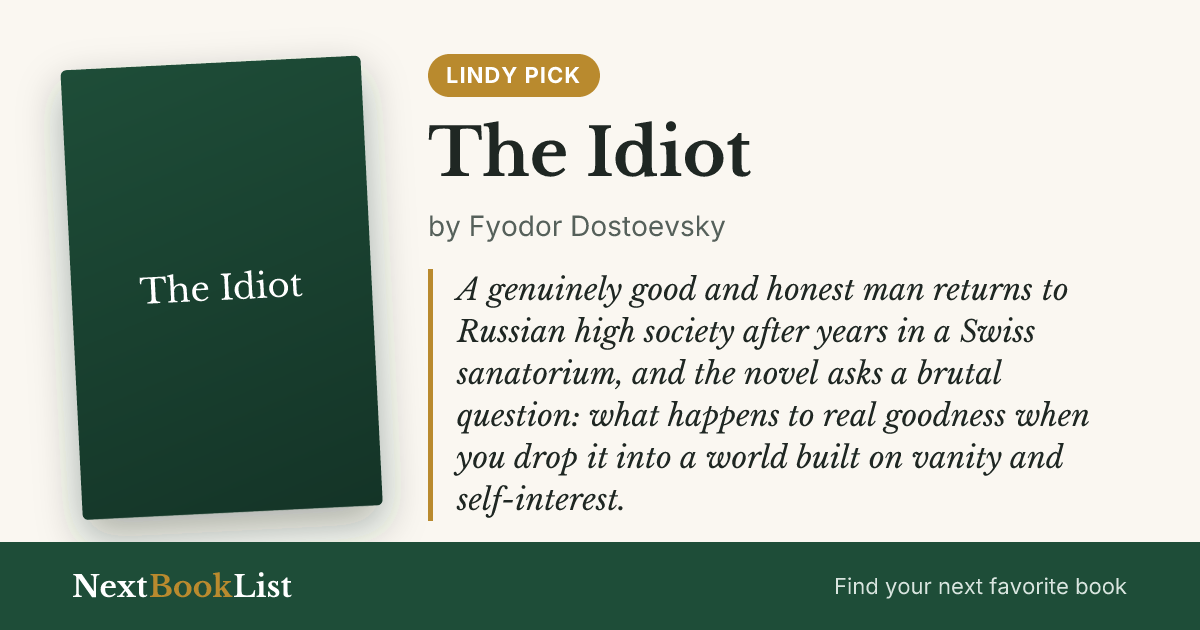
The Idiot
by Fyodor Dostoevsky · 1869
A genuinely good and honest man returns to Russian high society after years in a Swiss sanatorium, and the novel asks a brutal question: what happens to real goodness when you drop it into a world built on vanity and self-interest.
Worth reading? The Idiot is Dostoevsky's attempt to write a genuinely Christ-like character and drop him into real society to see what happens, and what happens isn't pretty. Prince Myshkin is honest, generous, and incapable of the social calculation everyone around him runs on instinct -- and the novel treats that as closer to a tragic flaw than a virtue. It's messier and less structurally tight than Crime and Punishment or The Brothers Karamazov, but the central idea is one of the most interesting in 19th-century fiction.
| Full Title | The Idiot |
|---|---|
| Author | Fyodor Dostoevsky |
| Published | 1869 |
| Publisher | Vintage Classics |
| Category | Fiction |
| Favorite quote | “Compassion is the chief and perhaps the only law of all human existence.” |
The Verdict
Myshkin is the point of this book, and he’s a genuinely strange character to spend 600 pages with – too honest, too generous, almost unable to lie even when lying would help him. That’s the experiment: watch what a truly good person does inside a room full of people who are all calculating something.
It doesn’t end well, and that’s on purpose. Dostoevsky isn’t interested in proving goodness wins; he’s interested in showing you what it costs.
Skip it if this is your first Dostoevsky – Crime and Punishment is tighter and a better on-ramp. Come back to The Idiot once you already know you like his style, because this one asks you to tolerate more looseness and more society-scene digression to get to the good stuff.
you want to see what a truly good character looks like in fiction, and you're willing to watch that goodness get chewed up by everyone around him
you want a tidy redemption arc -- this book is closer to tragedy, and Myshkin's goodness doesn't save anyone, including himself
Book Summary
Prince Myshkin returns to St. Petersburg society after years being treated for epilepsy in Switzerland, and his total honesty and lack of social ambition immediately mark him as strange -- people call him "the idiot" not because he's unintelligent but because he refuses to play the games everyone else treats as normal.
Dostoevsky uses Myshkin as a thought experiment: what would actually happen if a genuinely selfless, honest person entered a world of vanity, money, and manipulation? The answer the novel gives isn't triumphant. Myshkin's goodness doesn't reform anyone; it mostly gets exploited, misread as naivety, or used as a mirror that shows other characters their own worst qualities.
The love triangle between Myshkin, the proud and self-destructive Nastasya Filippovna, and the volatile Rogozhin drives the plot toward tragedy, with Myshkin's compassion for Nastasya reading as both his most admirable quality and the thing that destroys everyone involved.
The novel is rougher and more digressive than Dostoevsky's tighter books -- long society-party scenes, sudden narrative detours -- which makes it feel more like a genuine experiment than a polished machine, for better and worse.
Top 7 Lessons from The Idiot
- Myshkin's goodness isn't rewarded by the plot -- Dostoevsky is testing whether pure sincerity can survive contact with a status-obsessed society, and the test doesn't go well for Myshkin.
- Being called 'an idiot' in the novel says more about the society doing the labeling than about Myshkin's actual intelligence.
- Nastasya Filippovna's self-destructive pride is presented as the direct result of being treated as property by men her whole life -- her tragedy isn't a personal flaw so much as a wound.
- The novel argues that pity and love aren't the same thing, and confusing them (as Myshkin does) can hurt the person you're trying to help.
- Rogozhin's obsessive passion for Nastasya works as the dark mirror to Myshkin's selfless compassion -- both men love her, and both forms of love ultimately harm her.
- Dostoevsky drew on his own epilepsy for Myshkin's condition, and the seizure sequences are some of the most vivid interior writing in his work.
- The novel resists a clean moral -- it doesn't conclude that goodness is pointless, but it refuses to pretend goodness wins either.
Top 2 Quotes from The Idiot
"Compassion is the chief and perhaps the only law of all human existence."
Fyodor Dostoevsky, The Idiot
"Beauty will save the world."
Fyodor Dostoevsky, The Idiot
Frequently Asked Questions
Is The Idiot worth reading?
Yes, if you're interested in what a genuinely good character looks like under pressure -- but it's less structurally tight than Dostoevsky's other major novels, so go in knowing that.
What is The Idiot about?
Prince Myshkin, an honest and selfless man, returns to Russian society and gets pulled into a tragic love triangle that exposes how poorly pure goodness fares against vanity and manipulation.
Is The Idiot as good as Crime and Punishment?
It's a different kind of book -- looser and more digressive -- so most readers find Crime and Punishment the stronger entry point, with The Idiot better appreciated once you already like Dostoevsky.
Why is Prince Myshkin called 'an idiot'?
Not because he's unintelligent -- because his honesty and lack of social calculation strike Russian high society as naive to the point of foolishness.
Which translation of The Idiot should I read?
The Pevear and Volokhonsky translation is the modern standard recommendation.
Ready to read it?
Get The Idiot on Amazon